Exercises and resolutions 377 Determine the value of the angle $x$ in the following cases: Ver respostaa) $35^{\circ}$ · b) $100^{\circ}$ · c) $60^{\circ}$ · d) $25^{\circ}$ · e) $50^{\circ}$ · f) $20^{\circ}$ 378 Determine the value of the arc $x$ in the following cases: Ver respostaa) $80^{\circ}$ · b) $30^{\circ}$ · c) $60^{\circ}$ 379 In the figures, calculate the value of $x$. Ver respostaa) $35^{\circ}$ · b) $10^{\circ}$
When the vertex of the angle is inside or outside the circle, but not at the center or on it, the angle is eccentric — and its measure is an average of two arcs. Who discovered The formulas for eccentric angles are not stated in The Elements, but come directly from the proposition III.20 of Euclid (inscribed angle) combined with I.32 (external angle of a triangle). One of the most famous problems linked to them has an author: in 1471, the German astronomer Regiomontanus asked from what distance a statue on top of a pedestal is seen from the largest angle possible.
The angle between a chord and the tangent also measures half the arc. Hence the capable bow, used by navigators to escape rocks. Who discovered The measure of the segment angle is the proposition III.32 of the The Elements of Euclid, and the construction of the capable arc — the location of the points from which a segment is seen at a given angle — is the III.33. The best-known practical use has two names: the Dutch Willebrord Snellius (1617) and the French Laurent Pothenot (1692) solved the problem of discovering one’s own position from the angles under which three known points are seen, crossing two capable arcs.
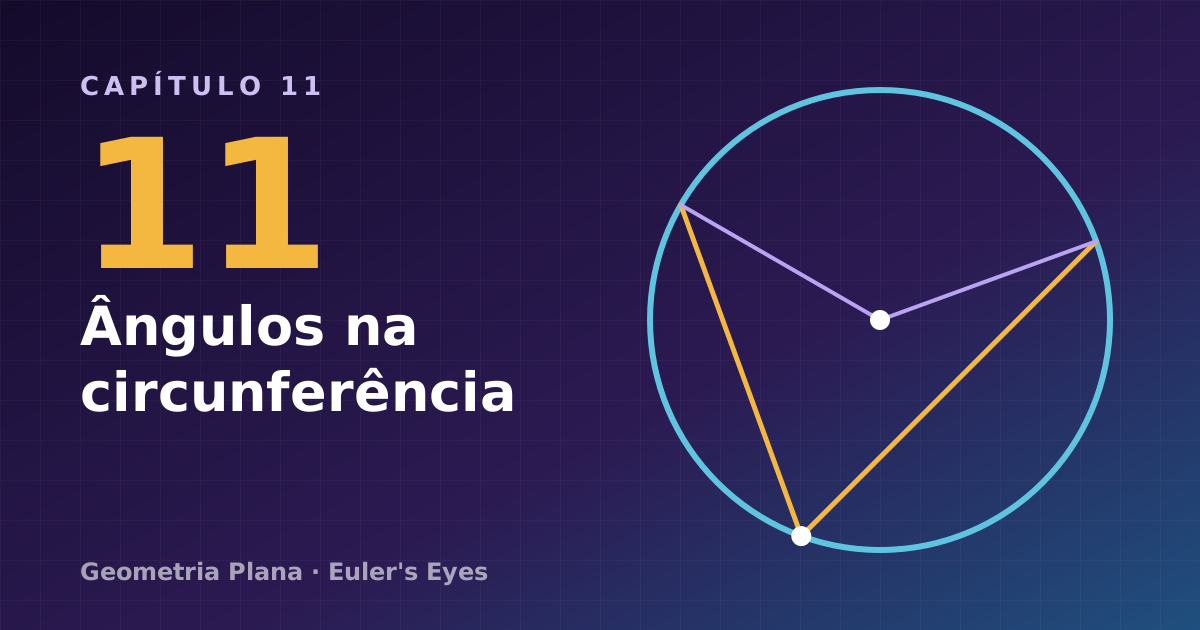
The inscribed angle measures half the arc that he sees. A special case — the angle inscribed in the semicircle is right — is attributed to Thales. Who discovered Greek tradition attributes to Tales of Miletus (6th century BC) the discovery that every angle inscribed in a semicircle is right. Diógenes Laércio says, citing the writer Pânfila, that Thales sacrificed an ox to celebrate the result. The general relationship — the central angle is twice that inscribed on the same arc — is the proposition III.20 of the The Elements of Euclid, and the case of the semicircle is the III.31.
The central angle has the apex at the center of the circle and measures the same as the arc it sees. With this idea, the size of the Earth was measured. Who discovered The relationship between central angle and arc is the basis of the proposition III.26 of The Elements of Euclid: in equal circles, equal central angles correspond to equal arcs. The most famous use of it is by Eratosthenes of Cyrene (c. 276–194 BC), director of the Library of Alexandria, who calculated the circumference of the Earth from a central angle.
Measuring an arc in degrees is so natural today that we forget where it came from: from observing the sky. Who discovered The Babylonian astronomers divided the Sun’s path across the sky into 12 signs of 30 parts, totaling 360. The Greek Hyparchus of Nicaea (2nd century BC) took this measurement to geometry and created the first known chord table, which related each arc to the corresponding chord — the beginning of trigonometry. Claudius Ptolemy expanded the table in Almagest (c. 150 AD), with chords of half degrees. The comparison and sum of arcs of the same circle follow book III of The Elements by Euclid.