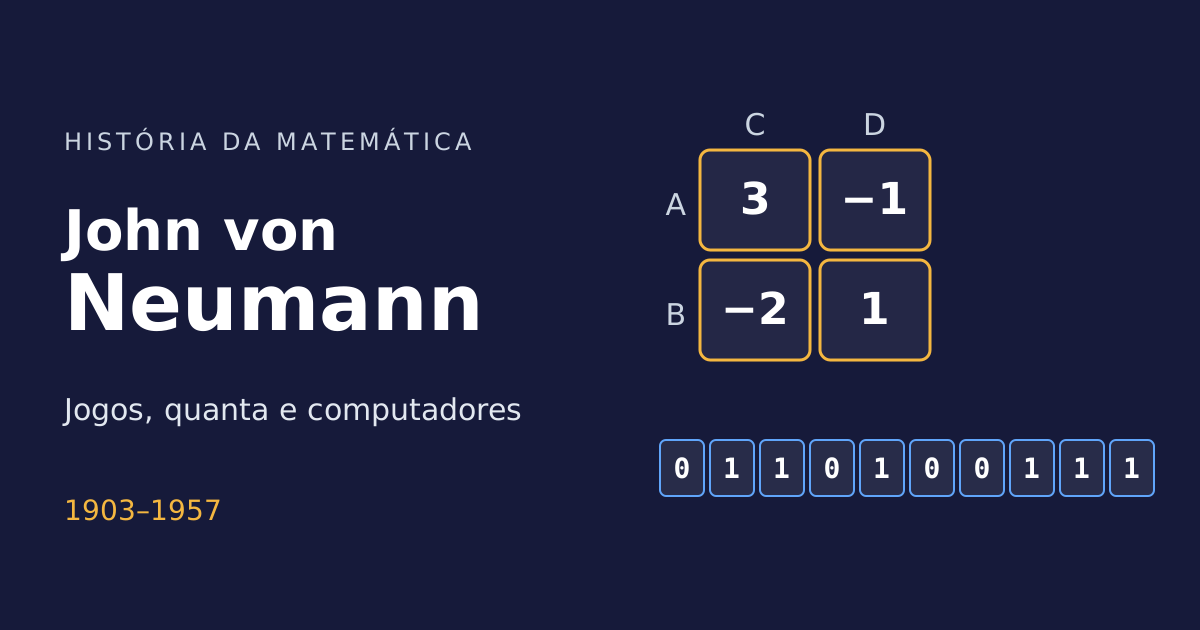
The legacy of John von Neumann
I have sometimes wondered whether a brain like von Neumann’s does not indicate a species superior to that of man.
— Hans Bethe, Nobel laureate in Physics, as quoted by Norman Macrae The eight texts in this trail show only part of what von Neumann did. The full list fills six volumes of collected works and runs through almost every branch of the mathematics of his time.
Pure mathematics Operator algebras. Between 1929 and 1943, partly with Francis Murray, he created the theory of operator algebras now called von Neumann algebras, one of the most active fields of analysis and mathematical physics. The ergodic theorem. In 1932 he proved a version of the theorem that justifies a principle of statistical physics: the average of a quantity over time equals the average over all possible states. Hilbert’s fifth problem. In 1933 he solved the compact case of one of the problems Hilbert had posed in 1900, about when a continuous group is automatically “smooth”. Economics, weather and strategy Economic growth. In a paper published in 1937, presented years earlier at a seminar in Princeton, he built a model of an expanding economy and proved the existence of an equilibrium with the same mathematics as minimax. It is one of the founding texts of mathematical economics. Weather forecasting. In 1950 a group led by Jule Charney, with von Neumann, made the first numerical weather forecast on the ENIAC: 24 hours of forecast took about 24 hours of calculation. The models that forecast weather and climate today descend from that experiment. Nuclear strategy. In the Cold War, game theory was used to think about the arms race, and von Neumann took part in planning intercontinental missiles. The phrase “mutually assured destruction”, tied to that reasoning, still sums up an era. The word “singularity” In 1958 Stanisław Ulam wrote a piece in memory of his friend. In it he recalled a conversation about the ever-accelerating progress of technology, which seemed to be approaching “some essential singularity in the history of the race beyond which human affairs, as we know them, could not continue”. It is the first recorded use of the word in this sense, which decades later became a theme of discussions about artificial intelligence.