Let’s prove three properties that relate the measurements of the sides to the measurements of the angles of a right-angled triangle. They link the trigonometry of the cycle, which we have studied so far, to the trigonometry of triangles, where it all began. The story It is said that Tales of Miletus (6th century BC) measured the height of the Great Pyramid of Egypt by comparing its shadow with the shadow of a stick: at the same instant, the Sun forms the same angle with both objects, and the ratio between height and shadow is the same for both. This is exactly the idea of this chapter — once an angle is fixed, the ratio between two sides of the right triangle is fixed — although, for Thales, there were still no names or tables for these ratios. The story came to us from much later authors, such as Diogenes Laertius and Plutarch.
For the cosine, the auxiliary line is vertical: the solutions for $\cos x > m$ are to the right of it, and those for $\cos x < m$, to the left. The story The interval notation we use in this book, with “turned” brackets to indicate an excluded extreme — $\left]a, b\right[$ — is French tradition; it was disseminated in the 20th century by the group Nicolas Bourbaki, a collective pseudonym of French mathematicians who rewrote the foundations of mathematics in a series of books. In English-speaking countries, notation with parentheses, $(a, b)$, is more common.
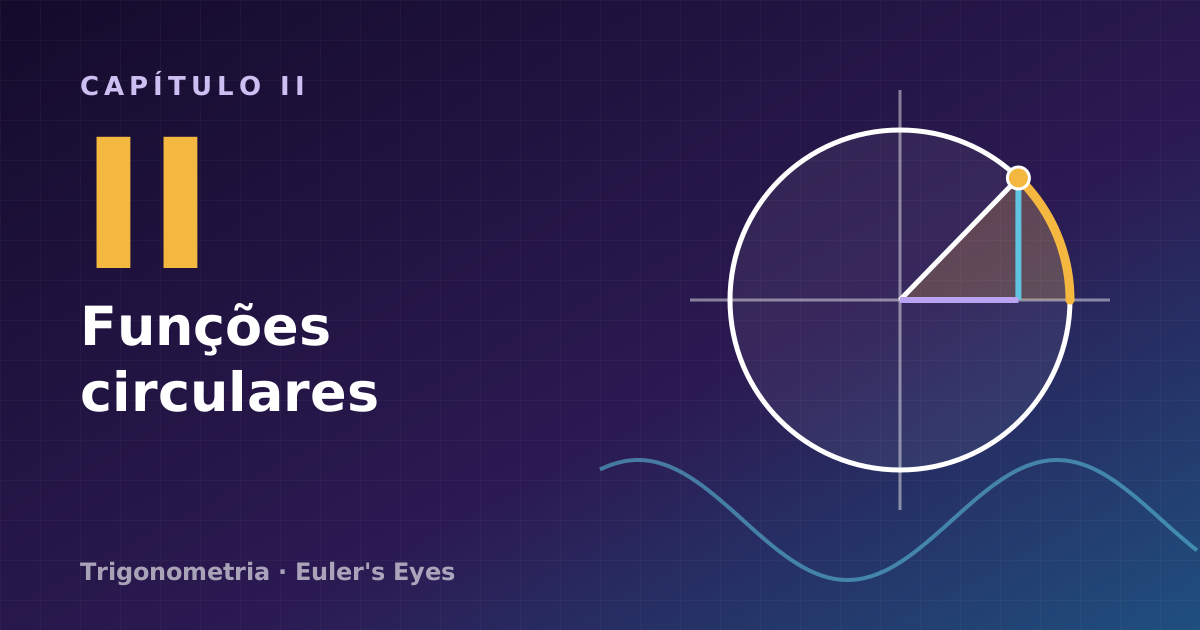
If the sine is the height of the rotating point, the cosine is its horizontal distance from the center. The two go together: when one is at maximum, the other goes through zero. The story For centuries, the cosine had no name of its own: it was just “the sine of the complement”. Viète called it sinus residuae, and each author wrote differently. In 1620, the Englishman Edmund Gunter proposed, in his Canon triangulorum, the abbreviated form co-sinus — and with it also co-tangens. Four years later, Gunter was the first to use the abbreviation sin in a figure; The names stuck, and the prefix co- became the brand of all “complement” functions.