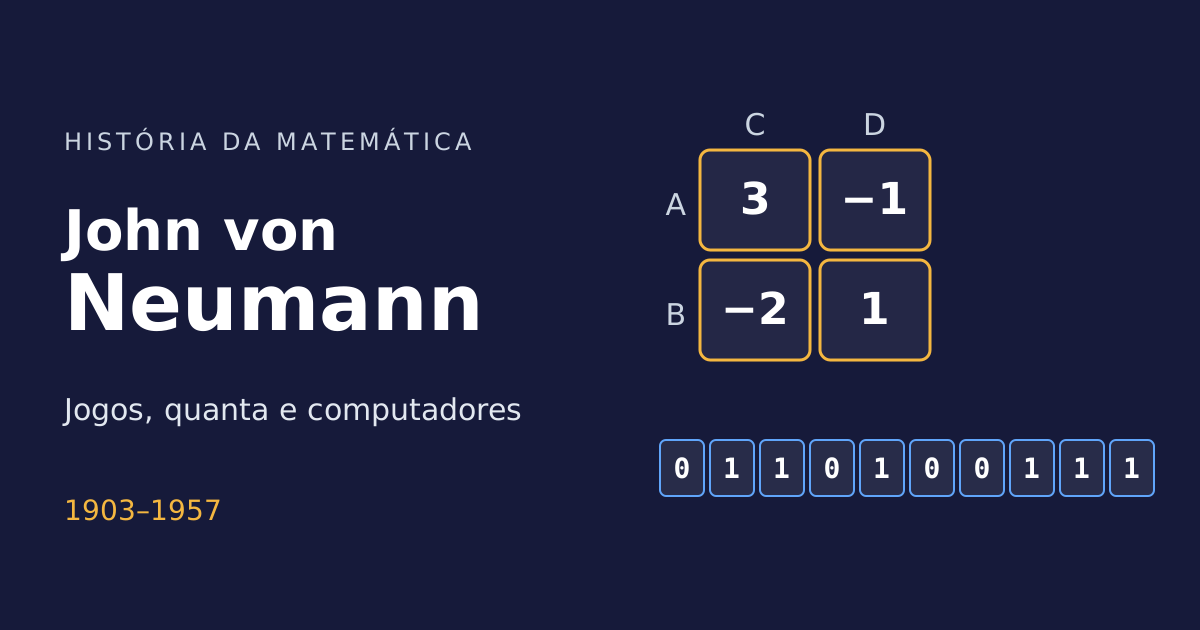
In odds and evens there is no good move. If you always show one finger, your opponent learns and starts winning every time. The only defence is not to be predictable: to play at random, one half of the time, two the other half. Then, whatever your opponent does, you win half the games. In 1928, in a paper called On the theory of parlour games, von Neumann showed that this idea holds for every two-person zero-sum game, in which what one wins the other loses. And that it always leads to an exact number, the value of the game.