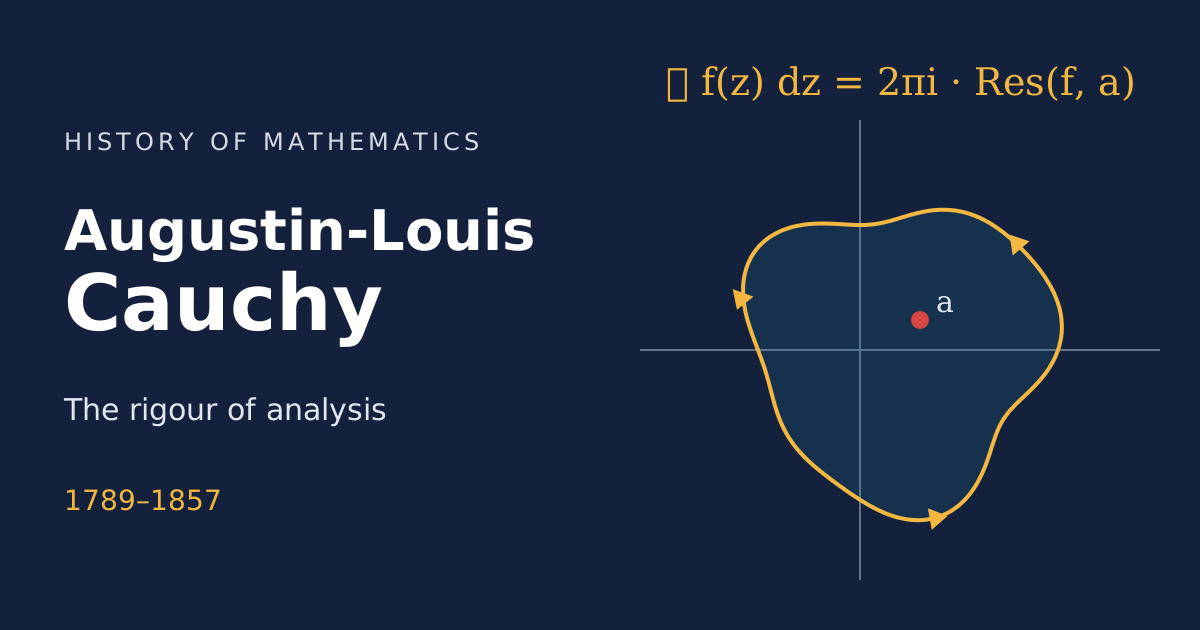
On 30 November 1812, the young engineer from Cherbourg read to the Institut de France a memoir with a long title: on functions that can take only two values, equal and of opposite signs, when the variables are interchanged. Behind the title was the first general theory of determinants. Functions that change sign Take three variables $a_1, a_2, a_3$ and the product of the differences $$\Delta = (a_2 - a_1)(a_3 - a_1)(a_3 - a_2).$$If we swap $a_1$ and $a_2$, each factor either stays the same or changes sign, and altogether $\Delta$ becomes $-\Delta$. Any swap of two variables does the same. A permutation of the variables, which is a sequence of swaps, multiplies $\Delta$ by $+1$ or by $-1$: it is even or odd.
In the small hours of 30 May 1832, in Paris, a young man of twenty spent the night writing. Évariste Galois had a duel arranged for dawn and knew he would probably not survive it. He wrote a long letter to his friend Auguste Chevalier summarising the ideas the Academy of Sciences had rejected or lost, and asked that it be shown to Jacobi and Gauss, “not on the truth, but on the importance of these theorems”. In the margin of a manuscript he left a sentence that became famous: