Hero Image
The life of James Clerk Maxwell

Timeline 1831Born on 13 June in Edinburgh, Scotland. Spends his childhood on the family estate, Glenlair. 1839His mother dies of cancer, when he is 8. 1846At 14, a paper of his on oval curves is read at the Royal Society of Edinburgh. 1850Enters the University of Cambridge. 1855Presents his theory of colour and the paper “On Faraday’s lines of force”. 1856Becomes a professor in Aberdeen, aged 25. 1859Publishes the essay on Saturn’s rings, which won the Adams Prize. Presents the distribution of molecular speeds. 1860Loses his job when two colleges merge. Moves to King’s College, London. 1861Shows the first colour photograph at the Royal Institution. 1862Calculates that electromagnetic waves travel at the speed of light. 1865Publishes “A dynamical theory of the electromagnetic field” and returns to Glenlair. 1871Becomes the first Cavendish Professor of Experimental Physics, in Cambridge. 1873Publishes the Treatise on Electricity and Magnetism. 1879Dies on 5 November in Cambridge, aged 48. ◀ Previous Follow the journey Next ▶ 1831 EdinburghBorn on 13 June. Later he studies at the Edinburgh Academy and University; at 14 a paper of his on ovals is read at the Royal Society of Edinburgh. 1831–1841 GlenlairHe spends his childhood on the family estate, asking “what’s the go of that?”. His mother dies when he is eight. 1850–1856 CambridgeHe studies at Trinity College. He presents his theory of colours and his paper on Faraday’s lines of force. 1856–1860 AberdeenA professor at 25. He wins the Adams Prize with his essay on Saturn’s rings and loses his job when the colleges merge. 1860–1865 LondonAt King’s College he shows the first colour photograph and discovers that light is an electromagnetic wave. 1865–1871 GlenlairHe returns to the country and writes the Treatise on Electricity and Magnetism. 1871–1879 CambridgeThe first Cavendish Professor, he founds the Cavendish Laboratory. He dies in 1879, aged 48. Enable JavaScript to see the map. The stages are listed below. Maxwell between Scotland and England, always returning to Glenlair. Map: © OpenStreetMap contributors

Hero Image
The life of Joseph-Louis Lagrange

Timeline 1736Born on 25 January in Turin, capital of the Kingdom of Sardinia, as Giuseppe Lodovico Lagrangia. 1753At 17, reads an essay by Edmond Halley and decides to devote himself to mathematics. 1755Writes to Euler with the method that will give rise to the calculus of variations. In September he is appointed professor at the Artillery School in Turin, aged 19. 1757Helps found the scientific society that will become the Turin Academy of Sciences. 1764Wins the Paris Academy prize by explaining why the Moon always shows the same face. 1766Moves to Berlin to take Euler’s place at the Academy of Frederick the Great. 1770Proves that every whole number is a sum of four squares and begins studying the permutations of the roots of an equation. 1772Shares the Paris prize with Euler for the three-body problem, where the Lagrange points appear. 1787After Frederick’s death, moves to Paris, where he lives in the Louvre. 1788Publishes the Analytical Mechanics. 1790Joins the commission that will create the metric system. 1794Lavoisier is guillotined. Lagrange becomes a professor at the new École Polytechnique. 1797Publishes the Theory of Analytic Functions, with the notation $f'(x)$. 1808Napoleon makes him a count of the Empire. 1813Dies on 10 April in Paris and is buried in the Panthéon. ◀ Previous Follow the journey Next ▶ 1736–1766 TurinAt 19 he is a professor at the Artillery School. He writes to Euler the method that will give rise to the calculus of variations. 1766–1787 BerlinHe takes Euler’s place at the Academy of Frederick the Great. He proves the four-square theorem and finds the Lagrange points. 1787–1813 ParisHe lives in the Louvre, publishes the Analytical mechanics, helps create the metric system and teaches at the École Polytechnique. He is buried in the Panthéon. Enable JavaScript to see the map. The stages are listed below. Lagrange in three capitals, Turin, Berlin and Paris. Map: © OpenStreetMap contributors

Hero Image
The life of Johann Bernoulli

Timeline 1667Born on 27 July in Basel, the tenth child of Nicolaus Bernoulli. 1682Sent to Neuchâtel to learn the trade. He has no talent for it. 1683Enters the University of Basel. Studies medicine and, with his brother Jakob, mathematics. 1691Solves the catenary problem. Travels to Geneva and then to Paris. 1692Begins teaching the calculus to the Marquis de l’Hôpital. 1694Takes his doctorate in medicine. Signs a contract with l’Hôpital and marries Dorothea Falkner. 1695Becomes professor of mathematics in Groningen, in Holland. 1696Issues the challenge of the brachistochrone. L’Hôpital’s book, made from his lessons, comes out. 1705Returns to Basel. Jakob dies, and Johann inherits his chair. 1717States the principle of virtual work in a letter to Varignon. 1720Begins guiding the young Leonhard Euler. 1734Shares a Paris Academy prize with his son Daniel and throws him out of the house. 1748Dies on 1 January in Basel, aged 80. ◀ Previous Follow the journey Next ▶ 1667–1682 BaselHe is born, the tenth child of Nicolaus Bernoulli, who wants to make him a merchant. 1682 NeuchâtelHe is sent to learn trade. He has no talent for it. 1683–1691 BaselHe studies medicine and, with his brother Jakob, Leibniz’s calculus. He solves the problem of the catenary. 1691 GenevaHe passes through Geneva on his way to Paris. 1691–1692 ParisHe meets Malebranche’s circle and starts teaching calculus to the Marquis de l’Hôpital, also at the château of Oucques. 1695–1705 GroningenProfessor of mathematics in Holland. In 1696 he issues the brachistochrone challenge. 1705–1748 BaselHe returns home, inherits Jakob’s chair, guides the young Euler and quarrels with his son Daniel. He dies in 1748, aged 80. Enable JavaScript to see the map. The stages are listed below. Johann Bernoulli between Basel, Paris and Groningen. Map: © OpenStreetMap contributors

Hero Image
The life of Sophie Germain

Timeline 1776Born on 1 April in Paris, the daughter of a wealthy silk merchant. 1789At 13, during the Revolution, she reads the story of Archimedes’ death and decides to study mathematics. 1794The École Polytechnique is founded and does not admit women. Sophie obtains the lecture notes and sends Lagrange a paper under the name Monsieur Le Blanc. 1801Gauss publishes the Disquisitiones Arithmeticae. 1804She begins writing to Gauss, again as Monsieur Le Blanc. 1806French troops occupy Braunschweig. Sophie asks a general who is a friend of the family to protect Gauss, who thus discovers who she is. 1809The Academy of Sciences announces a prize for the mathematical theory of vibrating plates. 1816On her third attempt, she wins the prize. She is the first woman to receive a prize from the Academy. 1823Legendre makes public her theorem on Fermat’s Last Theorem. 1829She learns she has breast cancer. 1831Dies on 27 June in Paris, aged 55. ◀ Previous Follow the journey Next ▶ 1776–1794 Rue Saint-DenisShe grows up in the house of her father, a rich silk merchant. At 13, during the Revolution, she decides to study mathematics. 1794 École PolytechniqueThe school does not admit women. She obtains the lecture notes and sends a paper to Lagrange as Monsieur Le Blanc. 1804–1806 BrunswickShe writes to Gauss about number theory. In 1806, with the city occupied, she asks a French general to protect Gauss, who thus learns who she is. 1816 Institut de FranceAt the third attempt she wins the Academy’s prize on vibrating plates, the first woman to receive a prize from the Academy. 1831 Père-Lachaise cemeteryShe dies on 27 June, aged 55. It is said that her death certificate recorded her as a rentière, a person of private means, and not as a mathematician. Enable JavaScript to see the map. The stages are listed below. Sophie Germain’s Paris, with a line for the letters sent to Gauss in Brunswick. Map: © OpenStreetMap contributors

Hero Image
Euclid of Alexandria: the author without a face

Timeline c. 530 BCPythagoras and his followers study numbers and figures in southern Italy. c. 387 BCPlato founds the Academy in Athens. Over the door, according to tradition: “Let no one ignorant of geometry enter”. 331 BCAlexander the Great founds Alexandria, in the Nile delta. c. 300 BCEuclid teaches in Alexandria, in the time of King Ptolemy I, and writes the Elements. c. 250 BCArchimedes, in Syracuse, cites the Elements. c. AD 100A papyrus found at Oxyrhynchus, in Egypt, preserves a passage from Book II. c. 370Theon of Alexandria prepares the edition that will be copied over the following centuries. c. 450Proclus writes his commentary on Book I, with the little news we have of Euclid. c. 800The Elements are translated into Arabic in Baghdad. c. 1120Adelard of Bath translates the Arabic text into Latin. 1482First printed edition, in Venice, by Erhard Ratdolt. ◀ Previous Follow the journey Next ▶ c. 387 a.C. AthensPlato founds the Academy. The geometry Euclid will organise grows up in the Greek schools. c. 300 a.C. AlexandriaEuclid teaches in the time of Ptolemy I and writes the thirteen books of the Elements. c. 250 a.C. SyracuseArchimedes already cites the Elements in his works. c. 100 OxyrhynchusA papyrus found in the town’s rubbish heaps preserves a passage from Book II, with a figure. c. 370 AlexandriaTheon of Alexandria prepares the edition that will be copied for a thousand years. c. 450 AthensProclus writes his commentary on Book I, with the little news we have about Euclid. c. 800 BaghdadIn the House of Wisdom the Elements are translated into Arabic. c. 1120 BathAdelard of Bath translates the Arabic text into Latin, and the book returns to Europe. 1482 VeniceErhard Ratdolt prints the first edition, with the figures in the margins. More than a thousand editions followed. Enable JavaScript to see the map. The stages are listed below. The journey of the Elements, from Athens and Alexandria to the first printed edition in Venice. Map: © OpenStreetMap contributors

Hero Image
The life of Albert Einstein

Timeline 1879Born on 14 March in Ulm, in southern Germany. The family soon moves to Munich. 1891At 12, receives a book of Euclidean geometry, which he would call the “holy little book”. 1895Fails the entrance exam of the Zurich Polytechnic, despite high marks in mathematics and physics. 1900Graduates in Zurich. Spends two years without a steady job. 1902Starts work at the patent office in Bern, as a “technical expert, third class”. 1905The miraculous year: four papers that change physics and a doctoral thesis. 1909Leaves the patent office and becomes a professor in Zurich. 1914Moves to Berlin, as a member of the Prussian Academy of Sciences. 1915Presents the equations of general relativity. 1919The eclipse of 29 May, observed in Sobral and on the island of Príncipe, confirms the theory. Einstein becomes world-famous. 1922His Nobel Prize in Physics for 1921 is announced, for the photoelectric effect. 1925Visits Rio de Janeiro, from 4 to 12 May. 1933With the Nazis in power, leaves Germany for good. Settles in Princeton, in the United States. 1939Signs a letter to President Roosevelt about the possibility of an atomic bomb. 1955Dies on 18 April in Princeton. ◀ Previous Follow the journey Next ▶ 1879 UlmBorn on 14 March. The family soon moves away. 1880–1894 MunichHe receives the “holy little book” of geometry and hates his school, where everything is learned by heart. 1894–1895 ItalyAt 15 he leaves school and follows his family, which has moved to Italy. 1895–1896 AarauHaving failed the Zurich exam, he finishes secondary school at a freer Swiss school. 1896–1902 ZurichHe studies at the Polytechnic and graduates in 1900. He spends two years without a steady job. 1902–1909 BernTechnical expert third class at the patent office. In 1905, the miracle year, he writes four papers that change physics. 1911–1912 PragueProfessor at the University of Prague, between two periods in Zurich. 1914–1932 BerlinA member of the Prussian Academy. He presents general relativity (1915) and becomes famous after the 1919 eclipse. 1925 Rio de JaneiroHe spends eight days in Rio, from 4 to 12 May, and is enchanted by the Botanical Garden. 1933–1955 PrincetonWith the Nazis in power, he leaves Germany. He works at the Institute for Advanced Study until his death in 1955. Enable JavaScript to see the map. The stages are listed below. From Ulm to Princeton, with a stop in Rio de Janeiro. Map: © OpenStreetMap contributors

Hero Image
The life of James Bernoulli

Timeline 1655Born on 6 January in Basel, into a family of spice merchants. 1671Receives his master’s degree in philosophy. Goes on studying theology, as his father wishes. 1676Finishes theology and sets off on his travels. In Geneva he teaches mathematics to a blind girl. 1681Visits England, where he meets Robert Boyle and Robert Hooke. Writes about the great comet of 1680. 1683Back in Basel, lectures on experimental physics and studies the problem of compound interest. 1684Marries Judith Stupanus. Begins reading Leibniz’s papers on the calculus. 1687Becomes professor of mathematics at the University of Basel, a post he holds until his death. 1689Publishes the first of his dissertations on infinite series, with the harmonic series. 1690Solves the isochrone problem and uses the word integral for the first time. 1694Describes the lemniscate. 1697Breaks publicly with his brother Johann over the brachistochrone. 1705Dies on 16 August in Basel, leaving the Ars conjectandi unfinished. 1713The Ars conjectandi is published by his nephew Nicolaus. ◀ Previous Follow the journey Next ▶ 1655–1676 BaselHe is born into a family of spice merchants. At his father’s wish he studies theology; on his own, mathematics. 1676 GenevaHe tutors Elisabeth von Waldkirch, a blind girl, teaching her to read, write and a little mathematics. 1677–1680 FranceHe studies the philosophy of Descartes and Malebranche. 1681 HollandHe meets the scientists of the new experimental philosophy. 1681 EnglandHe meets Robert Boyle and Robert Hooke and writes about the great comet of 1680. 1683–1705 BaselHe returns home, teaches himself Leibniz’s calculus and is a professor at the university until his death in 1705. Enable JavaScript to see the map. The stages are listed below. Jakob Bernoulli’s years of travel, from Basel to England and back. Map: © OpenStreetMap contributors
Hero Image
The life of Blaise Pascal

Timeline 1623Born on 19 June in Clermont, in the Auvergne region of France. 1626His mother, Antoinette Begon, dies. Blaise is 3. 1631His father, Étienne Pascal, moves to Paris with his three children. 1635At 12, he rediscovers on his own that the angles of a triangle add up to two right angles. 1640At 16, he publishes the Essay on conics, with the hexagon theorem. 1642Starts building a calculating machine to help his father, a tax official in Rouen. 1647Publishes the New experiments concerning the vacuum. Descartes visits him. 1648Florin Périer, his brother-in-law, measures the weight of air by climbing the Puy de Dôme. 1654Exchanges letters with Fermat about games of chance and writes the Treatise on the arithmetic triangle. On 23 November he has his “night of fire”. 1656Begins publishing the Provincial letters under a pseudonym. 1658Solves the problems of the cycloid and launches a contest about them. 1662Opens a line of public coaches in Paris. Dies on 19 August, aged 39. 1670His friends publish the Pensées, put together from his notes. ◀ Previous Follow the journey Next ▶ 1623–1631 ClermontHe is born in Clermont, in Auvergne. His mother dies when he is three. 1631–1639 ParisHis father teaches him at home and takes him to Mersenne’s gatherings. At 16 he writes the Essay on conics. 1640–1647 RouenHis father is a tax collector in Normandy. To help him, Blaise builds the Pascaline and carries out his experiments on the vacuum. 1648 Puy de DômeAt Pascal’s request his brother-in-law Florin Périer climbs the mountain with a barometer and shows that the air weighs less at the top. 1647–1662 ParisThe letters to Fermat on games of chance, the night of fire, the Provincial Letters, the cycloid and the public coaches. He dies in 1662, aged 39. 1655 Port-Royal-des-ChampsAfter the night of fire he spends periods at the convent where his sister Jacqueline lives and defends Port-Royal against the Jesuits. Enable JavaScript to see the map. The stages are listed below. Pascal between Clermont, Paris and Rouen, and the mountain that weighed the air. Map: © OpenStreetMap contributors
Hero Image
The life of Pierre de Fermat

Timeline c. 1607Born at Beaumont-de-Lomagne, in the south of France. The exact year is disputed. 1626Graduates in law from the University of Orléans. 1629–1631In Bordeaux, studies the work of Viète and reconstructs lost books of Greek geometry. 1631Becomes a councillor in the Parlement of Toulouse. Gains the right to use “de” in his name. 1636Begins corresponding with Marin Mersenne. He already has his analytic geometry and his method of maxima and minima. 1637Around this year, writes in the margin of Diophantus’s Arithmetica the note of the “last theorem”. 1640Announces the little theorem and the conjecture about the numbers $2^{2^n}+1$. 1652Nearly dies of plague. He is even reported dead. 1654Exchanges letters with Blaise Pascal and, with him, founds probability theory. 1662Derives the law of refraction from the principle of least time. 1665Dies on 12 January in Castres. 1670His son Samuel publishes Diophantus’s Arithmetica with his father’s margin notes. ◀ Previous Follow the journey Next ▶ c. 1607 Beaumont-de-LomagneHe is born into a family of leather merchants. The exact year is still debated. 1626 OrléansHe graduates in law from the University of Orléans. 1629–1631 BordeauxHe studies the work of Viète and reconstructs lost books of Greek geometry. He already has his method of maxima and minima. 1631–1665 ToulouseA councillor in the Parlement. In his spare time he writes to Mersenne and Pascal and notes the “last theorem” in the margin of Diophantus. 1665 CastresHe dies on 12 January, while serving at the court in Castres. Enable JavaScript to see the map. The stages are listed below. Fermat’s life in south-western France, between the law and mathematics. Map: © OpenStreetMap contributors

Hero Image
The life of Gottfried Wilhelm Leibniz

Timeline 1646Born on 1 July in Leipzig, in the Holy Roman Empire. 1661Enters the University of Leipzig, aged 14. 1666Publishes De arte combinatoria. Leipzig refuses him a doctorate in law; Altdorf awards it the following year. 1672Goes to Paris on a diplomatic mission. Begins to study mathematics seriously with Christiaan Huygens. 1673Presents his calculating machine in London and is elected to the Royal Society. 1675In manuscripts of October and November, creates the symbols $\int$ and $d$. 1676Moves to Hanover, where he will work as librarian and counsellor for 40 years. 1684Publishes the first paper on differential calculus in the journal Acta Eruditorum. 1700Founds the Berlin Academy of Sciences and becomes its first president. 1703Publishes his explanation of binary arithmetic. 1716Dies on 14 November in Hanover. ◀ Previous Follow the journey Next ▶ 1646–1666 LeipzigHe is born and studies in Leipzig. The university refuses him a doctorate in law, saying he is too young. 1666–1667 AltdorfHe obtains his doctorate within a few months, near Nuremberg, and turns down the professorship he is offered. 1668–1672 MainzHe enters the service of the Prince-Archbishop of Mainz as a jurist and adviser. 1672–1676 ParisHe arrives on a diplomatic mission and learns mathematics from Christiaan Huygens. In 1675 he creates the symbols $\int$ and $d$. 1673 LondonHe shows his calculating machine at the Royal Society and is elected a fellow. 1676 The HagueOn his way to Hanover he visits the philosopher Baruch Spinoza. 1676–1716 HanoverLibrarian and adviser to the dukes for forty years. He publishes the calculus (1684) and binary arithmetic (1703). He dies in 1716. 1687–1690 RomeHe travels for three years through archives in Germany, Austria and Italy to write the history of the ducal family. 1700 BerlinHe founds the Berlin Academy of Sciences and becomes its first president. Enable JavaScript to see the map. The stages are listed below. The journeys of Leibniz, diplomat, librarian and mathematician. Map: © OpenStreetMap contributors
Hero Image
The life of Isaac Newton

Timeline 1643Born on 4 January at Woolsthorpe, England. In English records of the time the date is 25 December 1642. 1661Enters Trinity College, Cambridge, as a poor student. 1665–1667With the university closed by the plague, he returns home. He develops series, fluxions, the theory of colours and his first ideas on gravity. 1669Aged 26, becomes Lucasian Professor of Mathematics, succeeding Isaac Barrow. 1672Presents his reflecting telescope and publishes his theory of light and colours. 1687Publishes the Principia, paid for out of Edmond Halley’s own pocket. 1696Moves to the Royal Mint in London, first as Warden and, from 1699, as Master. 1703Becomes President of the Royal Society. 1704Publishes Opticks. 1727Dies on 31 March in London. He is buried in Westminster Abbey. ◀ Previous Follow the journey Next ▶ 1643–1661 WoolsthorpeHe is born on a farm, the posthumous son of a farmer, and goes to school in nearby Grantham. 1661–1665 CambridgeHe enters Trinity College as a poor student who pays his way by serving other students. 1665–1667 WoolsthorpeWith the university closed by the plague, he goes home. He develops series, fluxions, the theory of colours and his first ideas on gravity. 1667–1696 CambridgeHe holds the Lucasian chair, builds the reflecting telescope and writes the Principia (1687). 1696–1727 LondonHe runs the Royal Mint, at the Tower of London, and presides over the Royal Society. He dies in 1727 and is buried in Westminster Abbey. Enable JavaScript to see the map. The stages are listed below. Newton’s three places, from Woolsthorpe to Cambridge and London. Map: © OpenStreetMap contributors
Hero Image
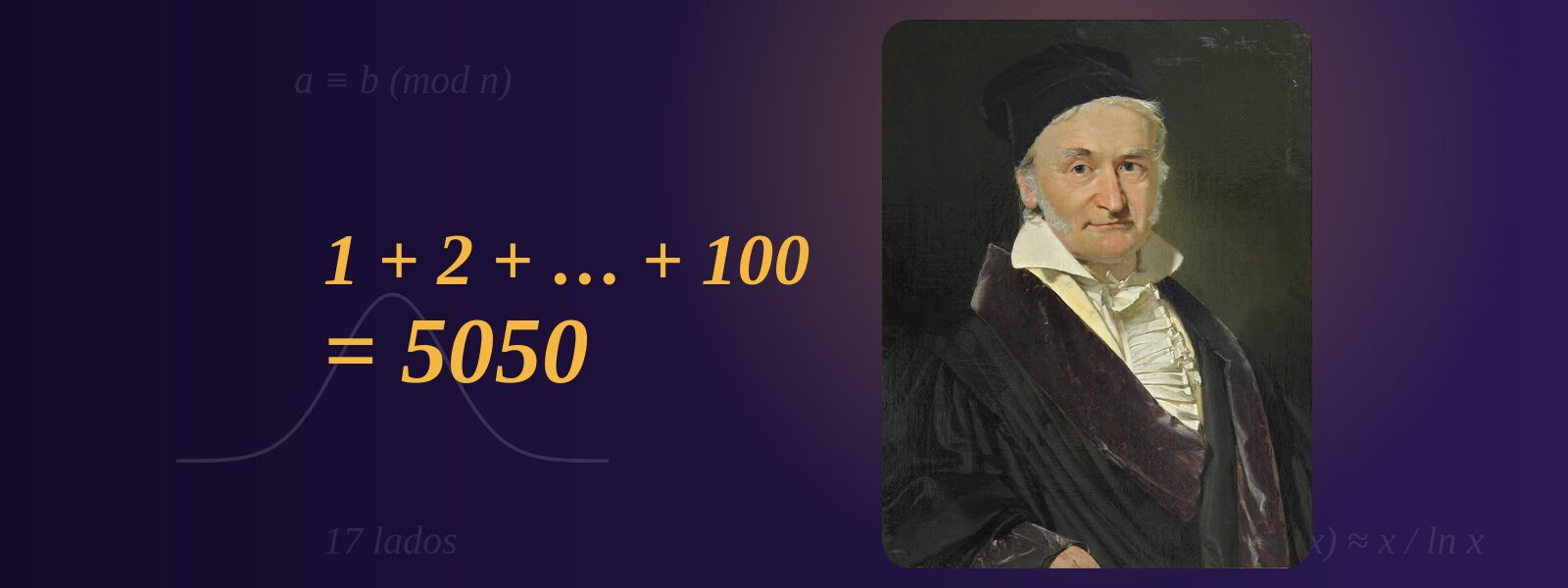
The life of Carl Friedrich Gauss

Timeline 1777Born on 30 April, in Braunschweig, son of a gardener and bricklayer. 1786Around 9 years, sum of 1 to 100 in seconds at school. 1791Duke Carl Wilhelm Ferdinand starts paying for his studies. 1795Enter the University of Göttingen. 1796In March 30, discover how to construct the regular polygon with 17 sides. Start your math journal. 1799Doctorate from Helmstedt, with proof of the fundamental theorem of algebra. 1801Publishes the Disquisitiones Arithmeticae and calculates the orbit of the dwarf planet Ceres. 1807He became director of the Göttingen Observatory, where he remained until his death. 1809Publishes the Theoria motus, with the least squares method and the normal curve. 1818Start measuring the Kingdom of Hannover with triangles. In 1821 he invents the heliotrope. 1827Publishes the Theorema Egregium, on the curvature of surfaces. 1833With Wilhelm Weber, he set up one of the first electric telegraphs. 1855Dies on 23 February, in Göttingen. ◀ Previous Follow the journey Next ▶ 1777–1795 BrunswickThe son of a gardener and bricklayer, he adds 1 to 100 in seconds at school. Duke Carl Wilhelm Ferdinand starts paying for his studies. 1795–1798 GöttingenHe studies at the university. On 30 March 1796 he discovers how to construct the regular 17-gon and begins his diary. 1799 HelmstedtHe takes his doctorate with a proof of the fundamental theorem of algebra. 1799–1807 BrunswickHe publishes the Disquisitiones Arithmeticae (1801) and computes the orbit of Ceres. Here he receives the letters of “Monsieur Le Blanc”. 1807–1855 Göttingen ObservatoryHe directs the observatory for almost fifty years. He surveys the Kingdom of Hanover with triangles, publishes the Theorema Egregium and builds a telegraph with Weber. He dies in 1855. Enable JavaScript to see the map. The stages are listed below. Gauss hardly travelled. He spent his life within a hundred kilometres of Braunschweig and Göttingen. Map: © OpenStreetMap contributors