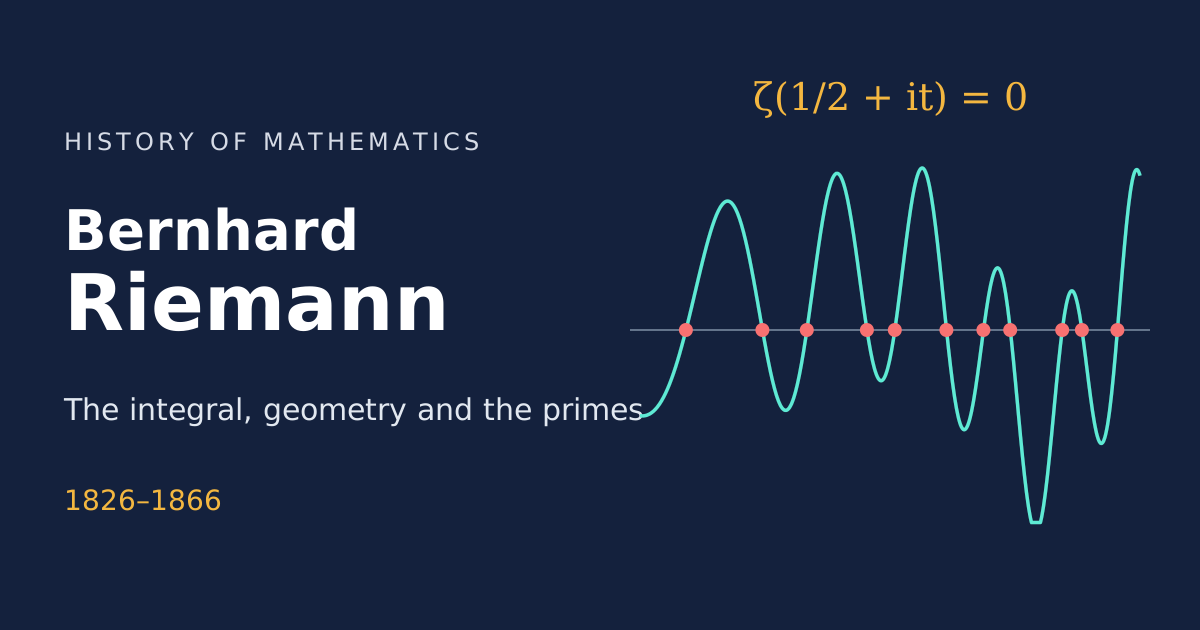
Newton and Leibniz invented integral calculus in the seventeenth century, but for a long time nobody worried about defining precisely what an integral is. For ordinary functions, the integral was simply the inverse of the derivative, or the area under the curve, and that was enough. Strange functions In the early nineteenth century the situation changed. Fourier showed that very irregular functions, with jumps and corners, could be written as sums of sines and cosines, and the coefficients of those sums were given by integrals. But what sense did it make to integrate a function full of jumps? Cauchy gave a first definition for continuous functions. Dirichlet, Riemann’s teacher, found in 1829 a function that could not be integrated at all: the one that equals 1 at the rationals and 0 at the irrationals.
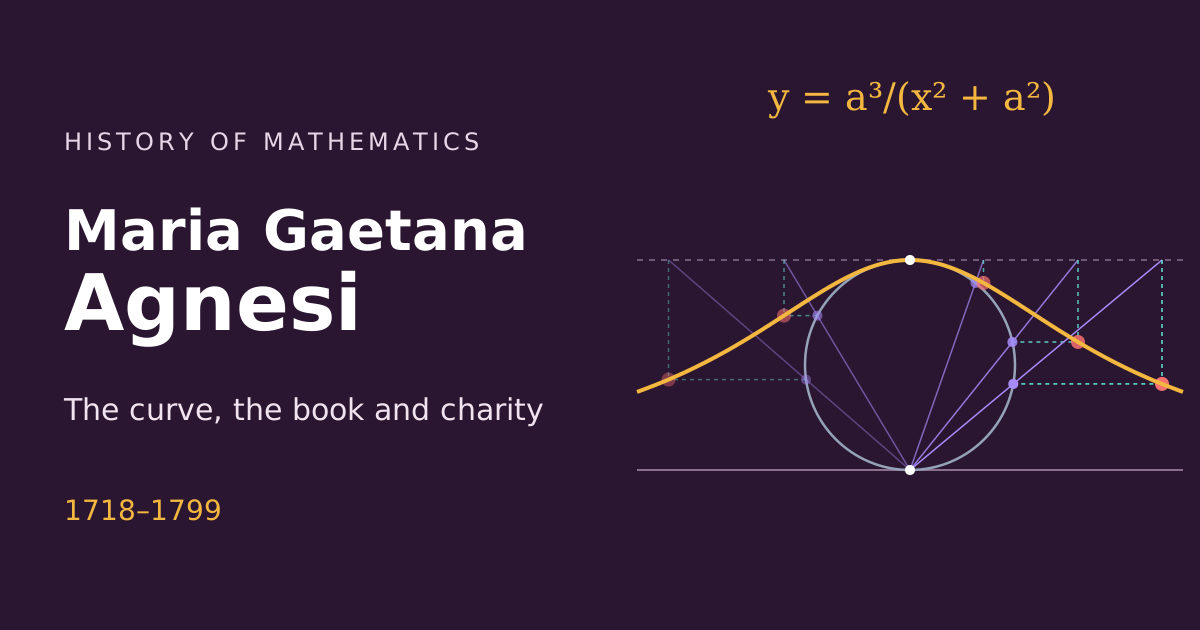
The third book of the Instituzioni deals with integral calculus: areas under curves, volumes, lengths. The versiera gives a surprising example. The curve never touches the $x$-axis; it stretches out without end on both sides. Even so, the region between the curve and the axis has a finite area. A well-known antiderivative With $a = 1$, the curve is $y = \frac{1}{1 + x^2}$. We need a function whose derivative is $\frac{1}{1 + x^2}$. It exists and is an old acquaintance: the arctangent. If $u = \arctan x$, then $x = \tan u$ and
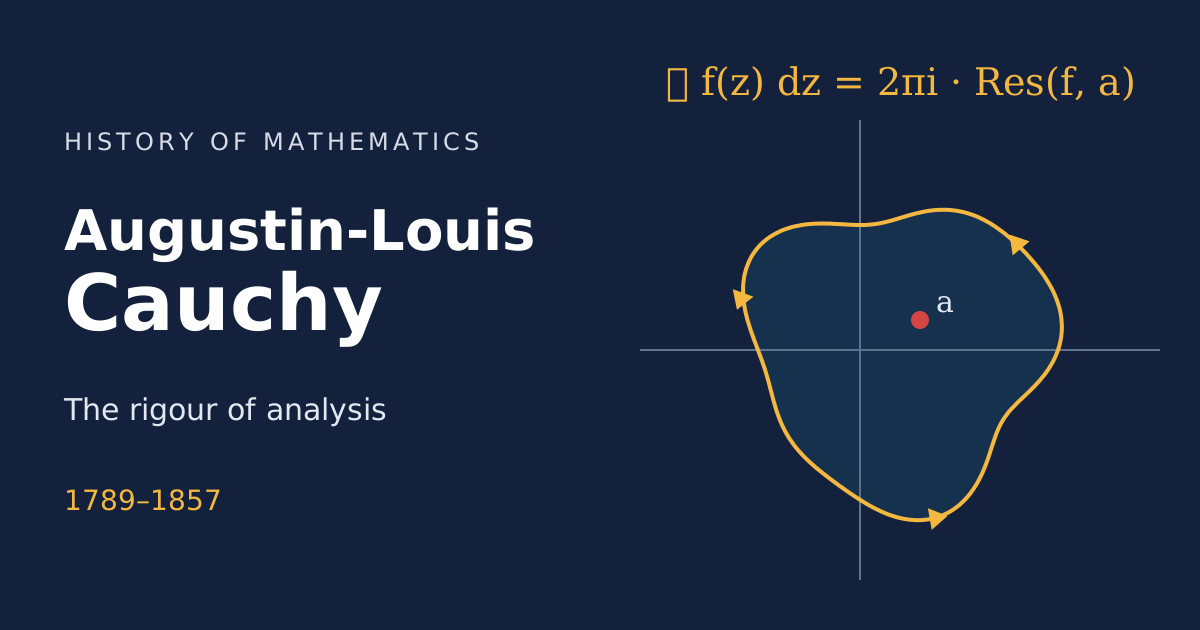
Two years after the Cours d’analyse, Cauchy published the Résumé des leçons données à l’École royale polytechnique sur le calcul infinitésimal (1823). In forty short lessons he rebuilt differential and integral calculus on the idea of limit. It is, in essence, the outline that calculus textbooks still follow today. The derivative For Lagrange, the derivative of $f$ was the coefficient of $i$ in the power series of $f(x + i)$. Cauchy defined it as a limit:
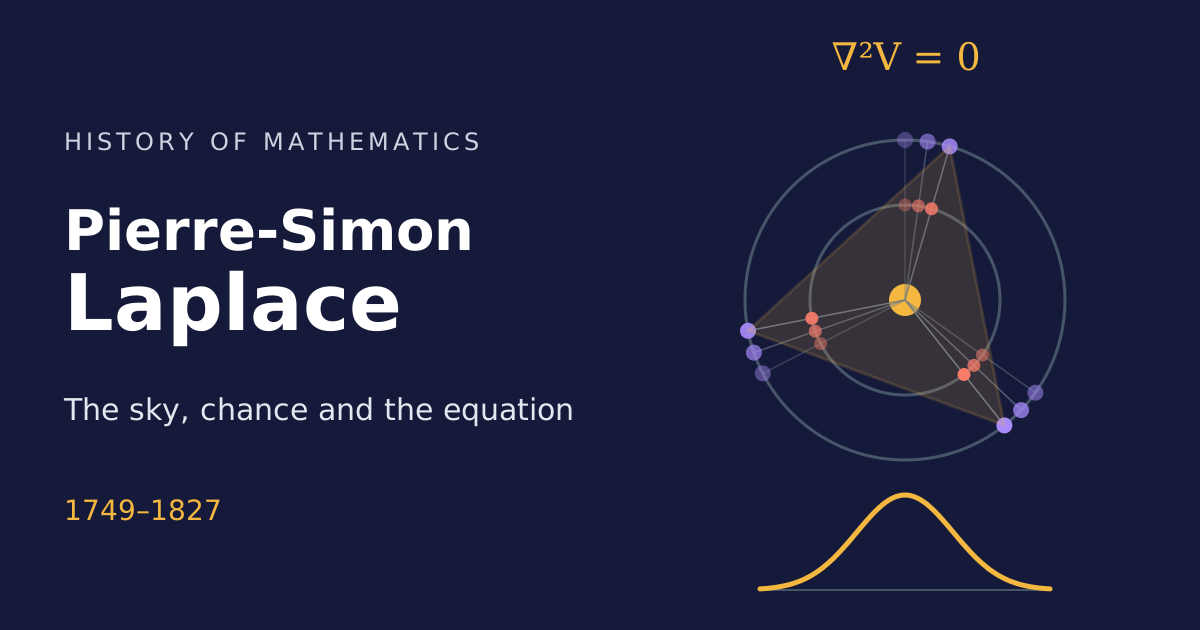
Mathematical probability began with games of chance, in the letters between Pascal and Fermat in 1654, and gained its first great theorem with Jakob Bernoulli’s law of large numbers. Laplace turned it into a complete theory. His first work on the subject dates from 1774; the Analytic Theory of Probabilities, of 1812, gathered almost forty years of research, and the Philosophical Essay on Probabilities, of 1814, explained it all to the public without formulas.
At the end of the eighteenth century, Euler and Laplace computed hard real integrals with a daring trick: they replaced the real variable with a complex one, did the calculations and returned to the real. Laplace called this “the passage from the real to the imaginary”. The results checked out, but nobody could say when the trick was legitimate. It was to answer this question that Cauchy, at 25, submitted a memoir on definite integrals to the Academy in 1814. It was only published in 1827, and it was only the beginning.