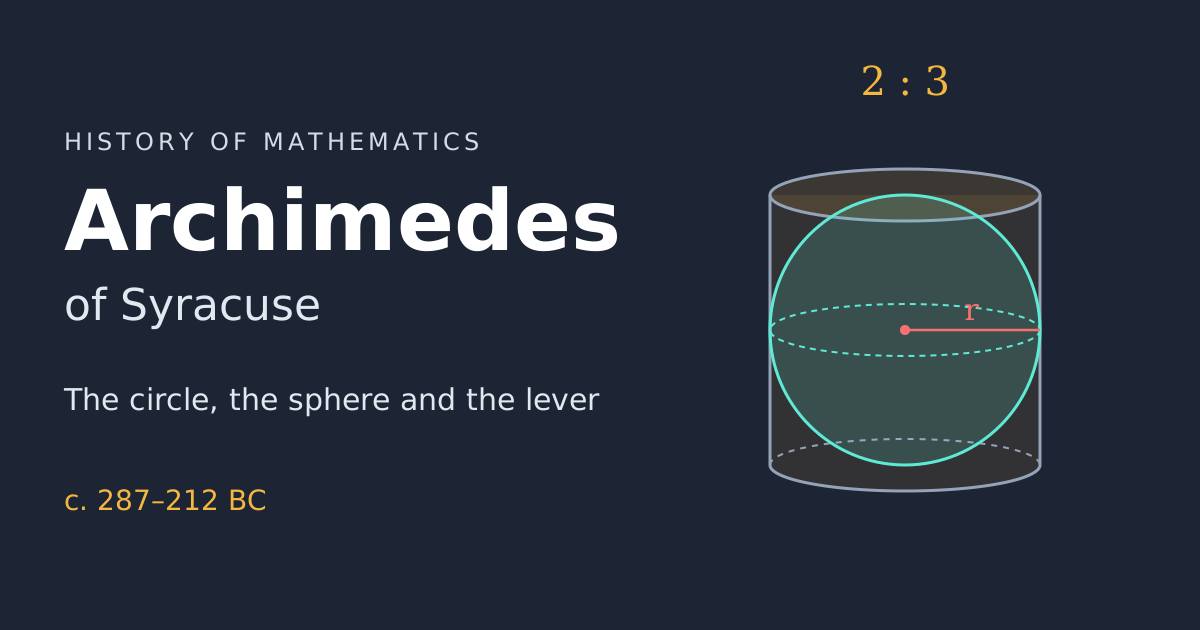
That every circle has the same ratio between circumference and diameter was known before Archimedes. What was uncertain was the value of this ratio, which we now call $\pi$: the Babylonians sometimes used $3\frac{1}{8}$, the Egyptians something close to $3.16$. In the short treatise Measurement of a Circle, Archimedes did two things: he related the area of the circle to its circumference, and he showed how to compute $\pi$ to any desired precision.
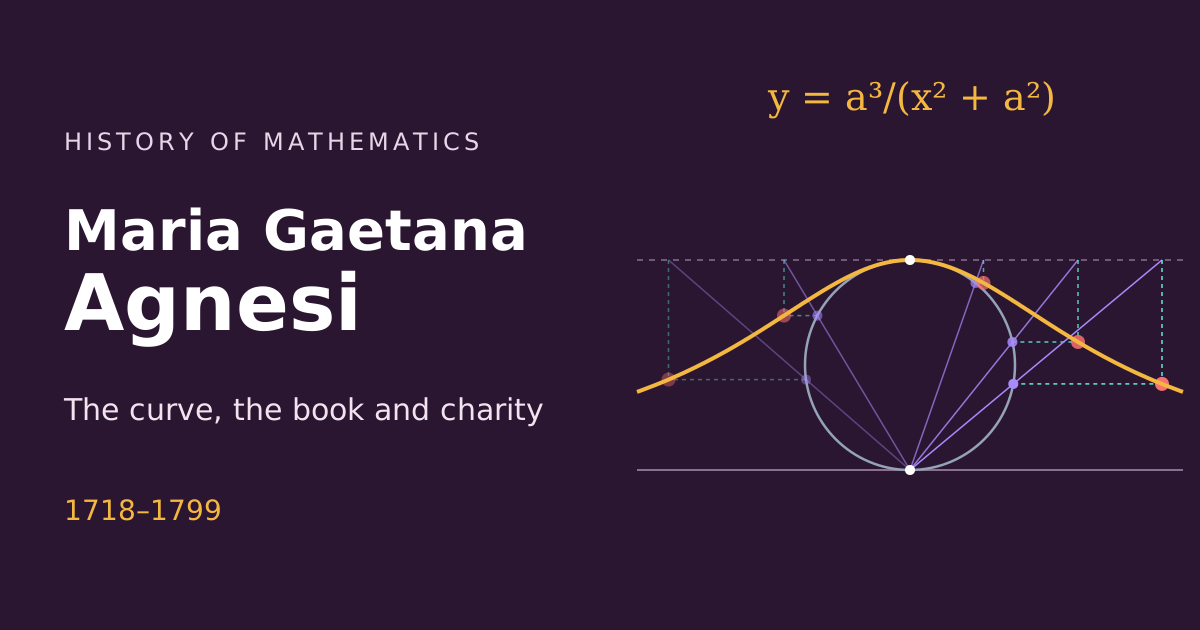
The third book of the Instituzioni deals with integral calculus: areas under curves, volumes, lengths. The versiera gives a surprising example. The curve never touches the $x$-axis; it stretches out without end on both sides. Even so, the region between the curve and the axis has a finite area. A well-known antiderivative With $a = 1$, the curve is $y = \frac{1}{1 + x^2}$. We need a function whose derivative is $\frac{1}{1 + x^2}$. It exists and is an old acquaintance: the arctangent. If $u = \arctan x$, then $x = \tan u$ and