James Bernoulli lived only fifty years and published little in his lifetime, almost all of it in short papers in the Acta Eruditorum. Even so, few mathematicians left so many words, symbols and ideas that we still use every day: integral, Bernoulli trial, binomial distribution, Bernoulli numbers, law of large numbers, stochastic. The word integral Leibniz called the operation inverse to the derivative calculus summatorius, the calculus of sums, and wrote it with $\int$, an elongated S for summa. In May 1690, solving the isochrone problem, Jakob wrote that the two expressions had “equal integrals”. It was the first time the word integral appeared in print in a mathematical text. Johann adopted the term, and in 1696 Leibniz agreed to swap his “summatory calculus” for the Bernoullis’ integral calculus. The symbol stayed Leibniz’s; the name, Jakob’s.
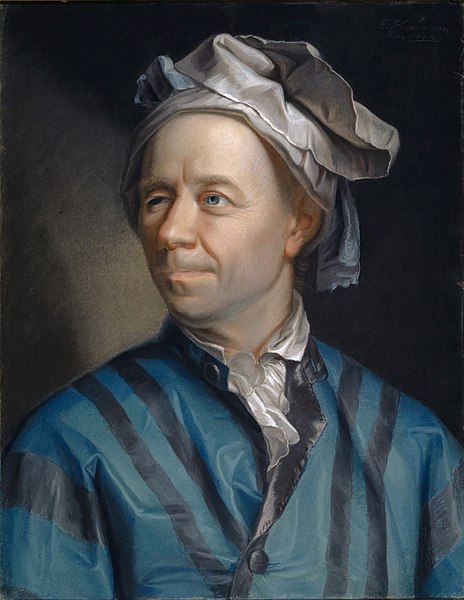
Historical images All come from Wikimedia Commons. We use the thumbnails provided by Commons, unedited. Portrait of Jakob Bernoulli, painted in 1687 by his brother Niklaus Bernoulli: source page · public domain. Title page of the Ars conjectandi, Basel, 1713: source page · public domain. Jakob Bernoulli’s tombstone in the cloister of Basel Minster, photo by Wladyslaw Sojka: source page · Free Art License. Cross-section of a nautilus shell, photo by Florian Elias Rieser: source page · CC BY-SA 4.0. Blog figures The cover, the drawing of the two spirals and the graph of the proportion of heads in simulated coin tosses are original illustrations, with versions in each of the site’s languages. The table of notations for the integral, in the post on the legacy, was redone from a table in this site’s old calculus course.
Write $$1+\frac12+\frac14+\frac18+\cdots=2.$$It looks like a calculation such as $3+4=7$: terms on the left, result on the right. But nobody has ever added up all these terms, nor ever will. The equals sign here does a job different from all those chapter 4 listed. It states that the partial sums $$1,\quad1.5,\quad1.75,\quad1.875,\quad\ldots$$get as close to $2$ as you like. In symbols, $$\sum_{n=0}^{\infty}\frac1{2^n}=\lim_{N\to\infty}\sum_{n=0}^{N}\frac1{2^n}=2.$$The $\infty$ on top of the $\Sigma$ is the same direction-$\infty$ as in the previous text: it is not a last term, it is the instruction to keep going.