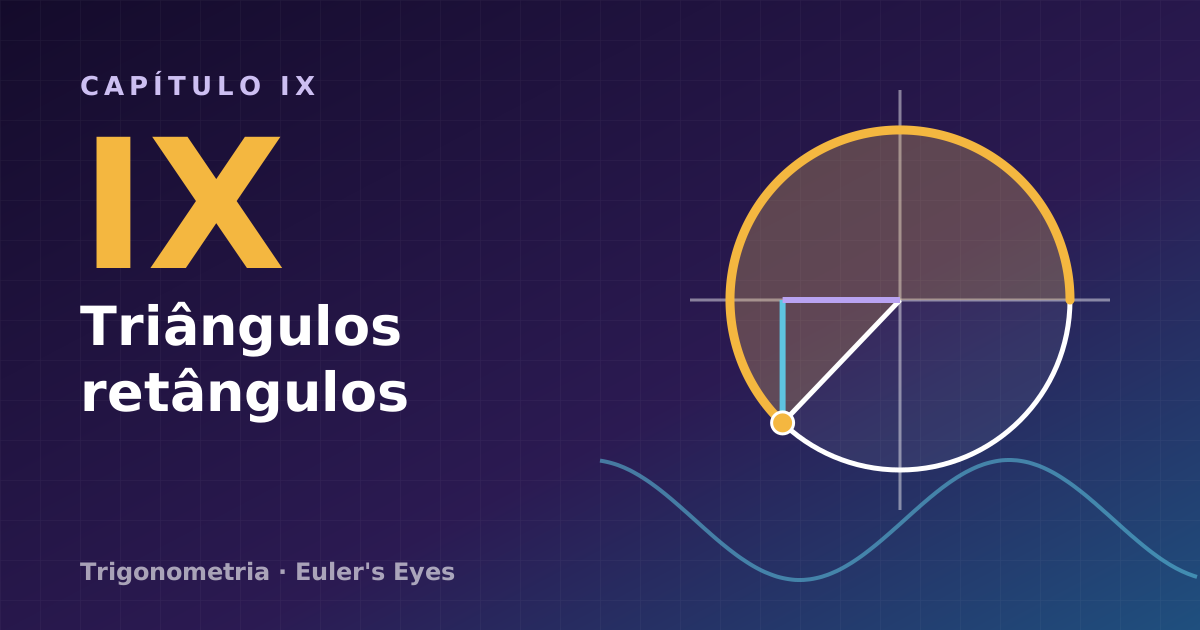
Let’s prove three properties that relate the measurements of the sides to the measurements of the angles of a right-angled triangle. They link the trigonometry of the cycle, which we have studied so far, to the trigonometry of triangles, where it all began. The story It is said that Tales of Miletus (6th century BC) measured the height of the Great Pyramid of Egypt by comparing its shadow with the shadow of a stick: at the same instant, the Sun forms the same angle with both objects, and the ratio between height and shadow is the same for both. This is exactly the idea of this chapter — once an angle is fixed, the ratio between two sides of the right triangle is fixed — although, for Thales, there were still no names or tables for these ratios. The story came to us from much later authors, such as Diogenes Laertius and Plutarch.
Let $f$ and $g$ be two trigonometric functions of the variable $x$. Solving the inequality $f(x) < g(x)$ is to obtain the set $S$ — the solution set or truth set — of numbers $r$ for which $f(r) < g(r)$ is a true sentence. The story The signals $<$ and $>$ appeared printed in 1631, in the book Artis analyticae praxis, published ten years after the death of the English mathematician Thomas Harriot, who was also an astronomer and navigator. The signs $\le$ and $\ge$ (with a dash under the sign) were introduced in 1734 by the French Pierre Bouguer, mathematician and hydrographer. Before that, inequalities were written out in full — “is greater than”, “is less than”.
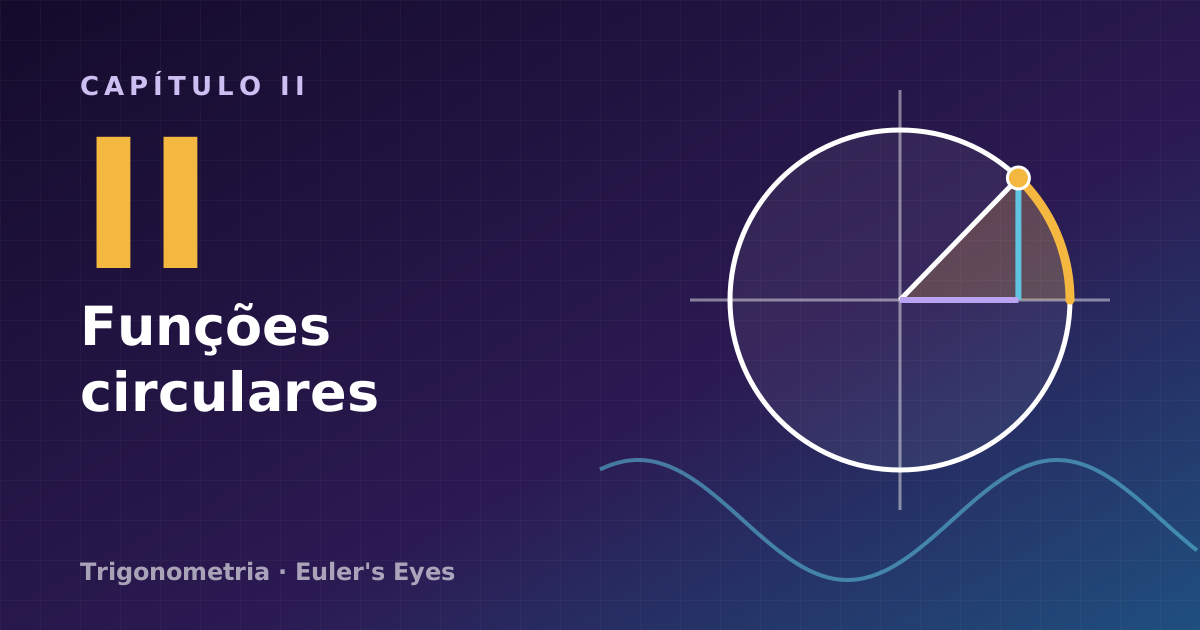
The sine is the height of the point that rotates in the cycle. When the point turns, the height rises and falls between $-1$ and $1$, drawing the most famous curve in mathematics: the sinusoid. The story For more than a thousand years, the sine was a table number: no one thought about drawing its graph. The first known sinusoid appeared around 1634, in a work by the Frenchman Gilles Personne de Roberval on the cycloid, the curve described by a point on a rolling wheel. To calculate the area under the cycloid, Roberval used an auxiliary curve, which he called the “companion of the cycloid” — and this companion is exactly a sinusoid. It was Euler, a century later, who began to treat the sine as a function of a real number, and only then did the graph gain the central place it has today.