Further reading Leitura Legendre: towards a rigorous and didactic geometry In ancient Greece, axiom seemed to mean a truth common to all fields of study, and postulate, a truth of a specific field. Euclid assumed five postulates — among them, that from any point a straight line is drawn to any other, that every limited straight line extends, that with any center and radius a circle is drawn, that right angles are equal, and the famous fifth, that of parallels — and five axioms, such as “things equal to the same thing are equal to each other” and “the whole is greater than the part”. From then on, The Elements rattle off theorems without exercises or applications: a text that is not very didactic by modern standards. Euclid, Renaissance representation traditionally associated with Euclid or Archimedes.Rafael Sanzio · Wikimedia Commons · Public domain In 18th-century France several books appeared to make Euclid more accessible, but many sacrificed rigor. A notable exception was Elements of Geometry by Adrien-Marie Legendre (1752–1833). Legendre shined in his research — in elliptic functions and number theory, in which he completely enunciated the law of quadratic reciprocity — and his geometry book, which reconciled rigor and didactic, had twenty editions in France during the author’s lifetime. In 1809 it was translated in Rio de Janeiro and adopted at the Royal Military Academy, created the following year. For about forty years, Legendre tried to prove the fifth postulate from the others — an impossible task, as we now know — but even in these attempts he showed great ingenuity. Adrien-Marie Legendre, caricature by Julien-Léopold Boilly.Julien-Léopold Boilly · Wikimedia Commons · Public domain
Exercises and resolutions 413 Determine the value of $x$ in each case below, with $r$, $s$ and $t$ parallel lines. Ver respostaa) 3 · b) 12 · c) 15 · d) 6 414 In the figures, the lines $r$, $s$ and $t$ are parallel. Determine the values of $x$ and $y$. Ver respostaa) $x = \dfrac{10}{3}$ · b) $x = \dfrac{25}{6}$ · c) $x = \dfrac{10}{3}$ e $y = \dfrac{18}{5}$
The angle bisector of an angle of a triangle divides the opposite side into parts proportional to the other two sides. Who discovered The internal angle bisector theorem is the proposition VI.3 of the The Elements of Euclid (c. 300 BC). The one with external angle bisector is not in the Greek text: it was added as “proposition A” of book VI by the Scotsman Robert Simson, in his edition of The Elements of 1756, which served as the basis for teaching geometry in the United Kingdom for more than a century. The two angle bisectors are linked to the circle of Apollonius, studied by Apollonius of Perga (3rd century BC).
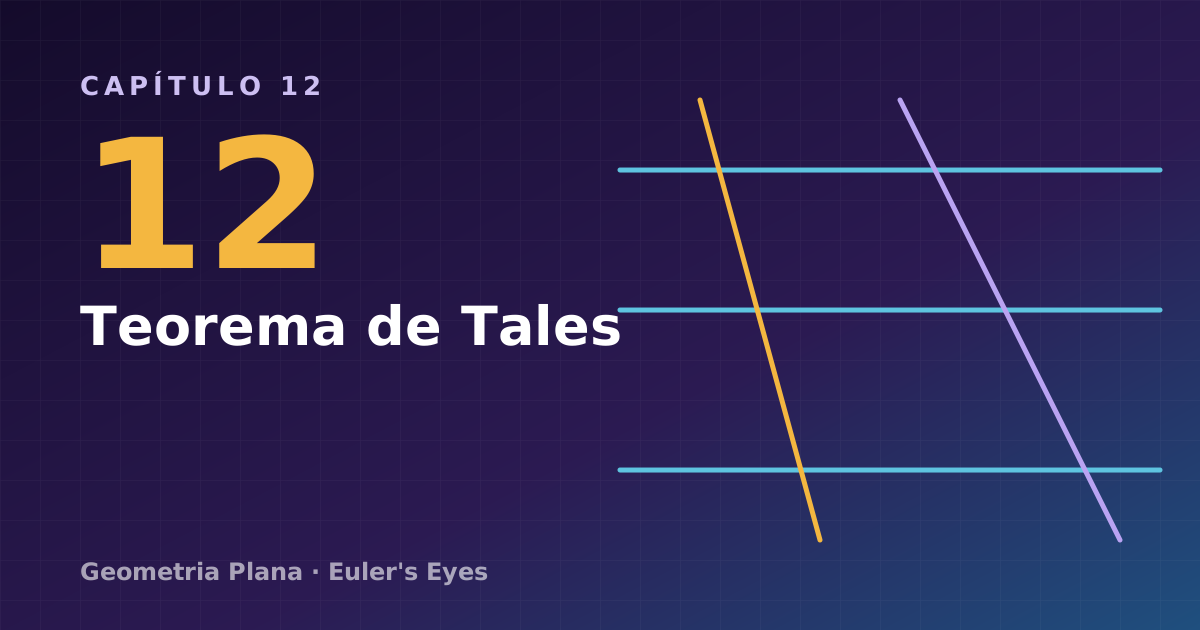
A bundle of parallel lines cuts two transversals into proportional parts. It is with this idea that a board is divided into equal parts without doing any math. Who discovered The result is called Tales of Miletus (6th century BC), associated by tradition with the measurement of the height of the Great Pyramid by shadows (see the curiosity about it at the opening of the chapter). The demonstration we know is from Euclid, in proposition VI.2 of The Elements (c. 300 BC), and uses areas of triangles. The name “Tales’ theorem” for this result is a tradition in countries such as Brazil, Portugal, France, Spain and Italy; in German and English, the same name refers to the angle inscribed in the semicircle.