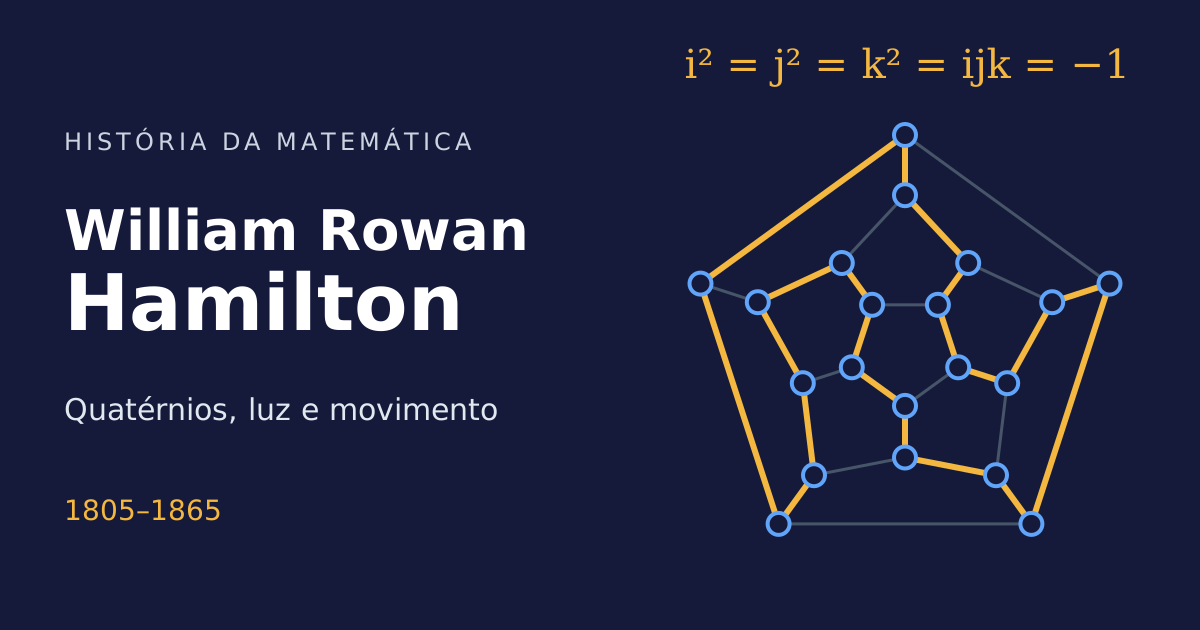
In a quaternion $q = a + bi + cj + dk$ there are two parts of different kinds. The number $a$ stays put on the line of real numbers; the part $bi + cj + dk$ points in a direction in space. In 1846 Hamilton named them: the first is the scalar, because it can be read off a scale, from less to more; the second is the vector, from the Latin vector, “carrier”, because it carries one point to another. Both words caught on, and today they are used by people who have never heard of quaternions.
On 16 October 1843 the Irishman William Rowan Hamilton was walking with his wife along the Royal Canal in Dublin when he suddenly solved a problem that had tormented him for fifteen years. He took a penknife from his pocket and cut the formula into a stone of Brougham Bridge: $$i^2=j^2=k^2=ijk=-1.$$The carving wore away long ago, but there is now a plaque on the spot, and every year mathematicians walk to the bridge on 16 October. Rarely has a notation had such a well-documented birth.