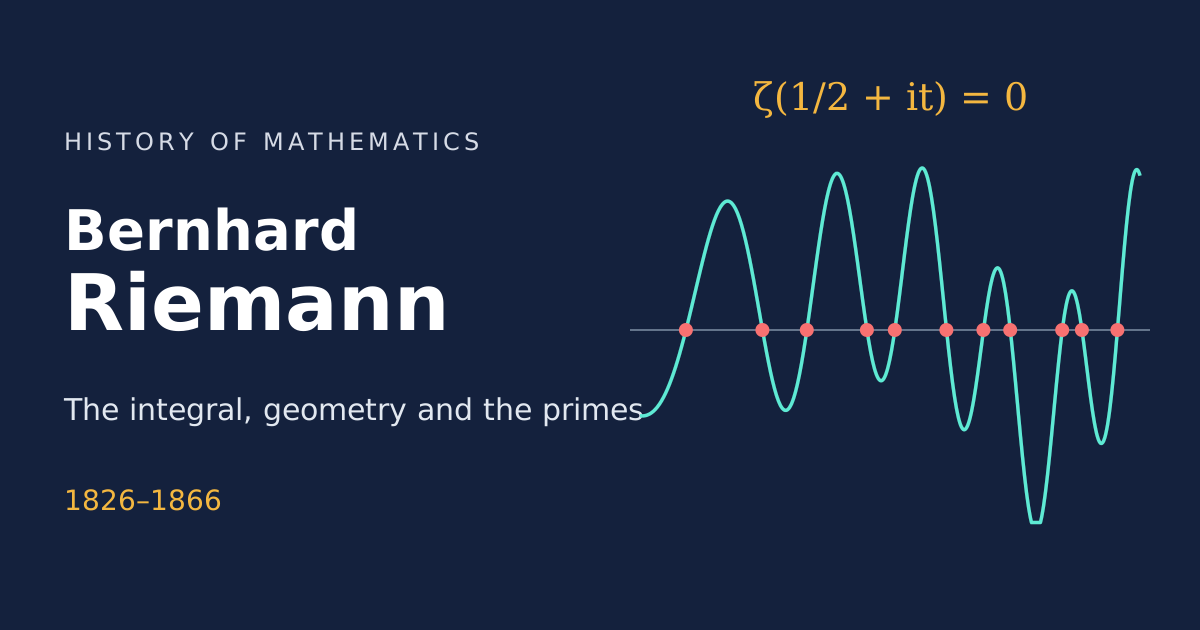
Riemann’s doctoral thesis, of 1851, has a modest title: Foundations for a General Theory of Functions of a Complex Variable. Inside it are two ideas that changed mathematics: the conditions a complex function must satisfy in order to have a derivative, and a geometric way of dealing with functions that have several values. Functions that can be differentiated A complex function $f(z)$, with $z = x + iy$, can be written as $f = u + iv$, where $u$ and $v$ are real functions of $x$ and $y$. For $f$ to have a derivative in the complex sense, that is, for the limit $\frac{f(z + h) - f(z)}{h}$ to be the same whatever the direction in which $h$ goes to zero, the parts $u$ and $v$ must satisfy the Cauchy–Riemann equations:
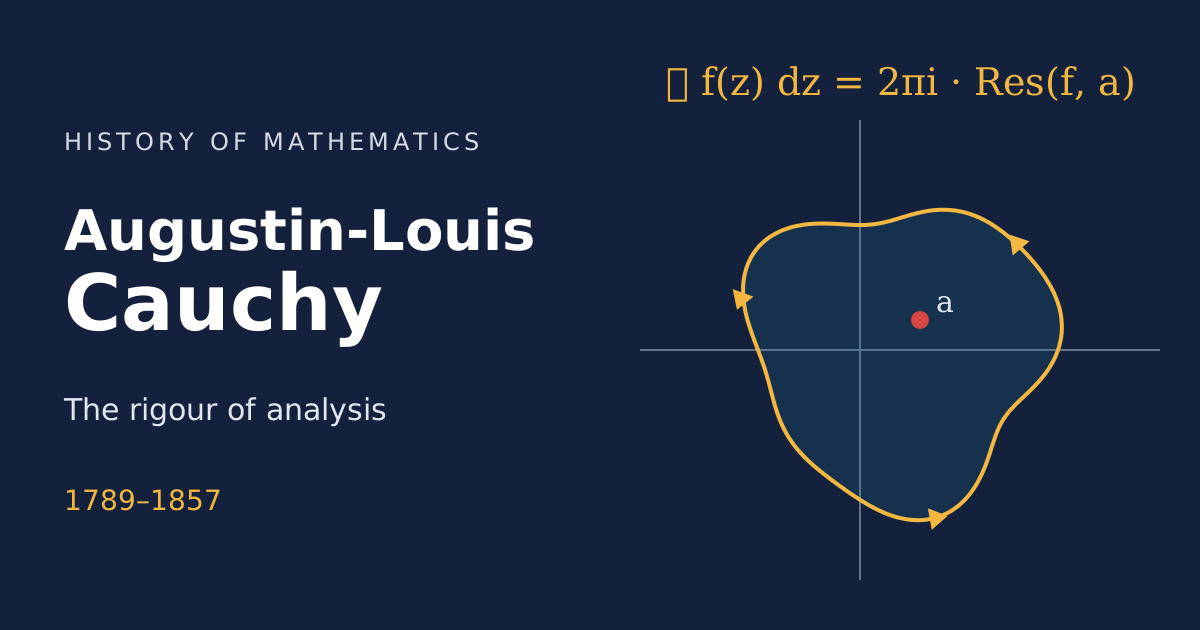
At the end of the eighteenth century, Euler and Laplace computed hard real integrals with a daring trick: they replaced the real variable with a complex one, did the calculations and returned to the real. Laplace called this “the passage from the real to the imaginary”. The results checked out, but nobody could say when the trick was legitimate. It was to answer this question that Cauchy, at 25, submitted a memoir on definite integrals to the Academy in 1814. It was only published in 1827, and it was only the beginning.