
Euler's Eyes
2026-10-31
Riemann surfaces
Riemann’s doctoral thesis, of 1851, has a modest title: Foundations for a General Theory of Functions of a Complex Variable. Inside it are two ideas that changed mathematics: the conditions a complex function must satisfy in order to have a derivative, and a geometric way of dealing with functions that have several values.
Functions that can be differentiated
A complex function $f(z)$, with $z = x + iy$, can be written as $f = u + iv$, where $u$ and $v$ are real functions of $x$ and $y$. For $f$ to have a derivative in the complex sense, that is, for the limit $\frac{f(z + h) - f(z)}{h}$ to be the same whatever the direction in which $h$ goes to zero, the parts $u$ and $v$ must satisfy the Cauchy–Riemann equations:
$$\frac{\partial u}{\partial x} = \frac{\partial v}{\partial y}, \qquad \frac{\partial u}{\partial y} = -\frac{\partial v}{\partial x}.$$Cauchy already knew them; Riemann put them at the centre of the theory. One consequence is that $u$ and $v$ are harmonic, they satisfy Laplace’s equation, and that is why complex functions are so good at describing electricity, heat and fluids.
The problem of the square root
Some complex functions have more than one value. The simplest example is $\sqrt{z}$. Write $z$ in polar form, $z = r\,e^{i\theta}$. One square root is $\sqrt{r}\,e^{i\theta/2}$. Now go once around the origin: $\theta$ increases by $2\pi$, and the point $z$ returns to where it started. But the root becomes
$$\sqrt{r}\,e^{i(\theta + 2\pi)/2} = \sqrt{r}\,e^{i\theta/2}\,e^{i\pi} = -\sqrt{r}\,e^{i\theta/2}.$$After one turn, the root has changed sign; after two, it is back to its initial value. The function is not well defined on the plane.
Two sheets glued together
Riemann’s solution was to change the place where the function lives. Instead of one plane, take two copies of the plane, two sheets, one above the other. Cut both along a ray leaving the origin and glue the upper edge of one sheet to the lower edge of the other, crosswise. Whoever goes once around the origin climbs or descends to the other sheet; after two turns, they are back on the starting sheet.
On this two-sheeted surface, $\sqrt{z}$ has a single value at each point. The root has stopped being a troublesome function on the plane and has become an ordinary function on a Riemann surface.
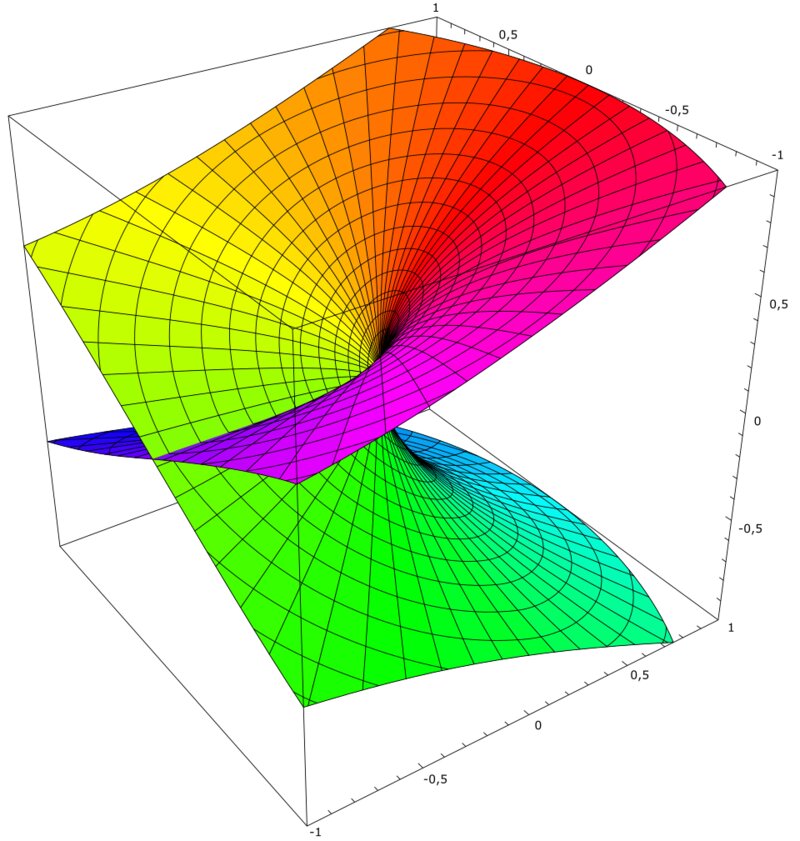
The idea goes far beyond the root. For more complicated functions, the surfaces can have many sheets and holes, like a doughnut or a pretzel. The number of holes, which Riemann studied in the theory of abelian functions of 1857, is called the genus, and it became one of the central concepts of topology.
The mapping theorem
The thesis also states a surprising result: any region of the plane without holes (other than the whole plane) can be deformed into a full circle, the disc of radius 1, by a complex function that preserves angles. A region shaped like a country, a star or a blot can be “straightened out” into a disc. This is the Riemann mapping theorem.
Exercise: Cauchy–Riemann for z²
Check the Cauchy–Riemann equations for $f(z) = z^2$.
$z^2 = (x + iy)^2 = x^2 - y^2 + 2ixy$, so $u = x^2 - y^2$ and $v = 2xy$. We have $u_x = 2x = v_y$ and $u_y = -2y = -v_x$. The equations hold at every point, as they should for a polynomial in $z$.
Exercise: a function without a derivative
Show that $f(z) = \bar{z} = x - iy$, the conjugate, does not satisfy the Cauchy–Riemann equations at any point.
$u = x$ and $v = -y$. Then $u_x = 1$ but $v_y = -1$. The first equation fails at every point. The conjugate is a perfectly continuous function, but it has no complex derivative: it mirrors the plane and therefore reverses the sense of angles.
Sources: Bernhard Riemann, Grundlagen für eine allgemeine Theorie der Functionen einer veränderlichen complexen Grösse (1851) · Bernhard Riemann, “Theorie der Abel’schen Functionen”, Journal für die reine und angewandte Mathematik 54 (1857) · Hermann Weyl, Die Idee der Riemannschen Fläche (1913) · Jeremy Gray, The Real and the Complex: A History of Analysis in the 19th Century (2015).
All topics on Bernhard Riemann · ← The rearrangement theorem · The hypotheses on which geometry is founded →