Logo Euler's Eyes
  • Materials
  • Dark Theme
    Light Theme Dark Theme System Theme
Logo Inverted Logo
  • Tags
  • 1 Phase
  • 1st Phase
  • 2 Phase
  • 2 Phase,
  • 2nd Phase
  • 2° Degree Equation
  • Accessibility
  • Addition Formulas
  • Alan Turing
  • Algebra
  • Algebraic Expressions
  • Algorithms
  • Ambiguous Case
  • Analysis
  • Analytic Geometry
  • Analytical Geometry
  • Ancient Greece
  • Angle Bisector
  • Angle Bisectors
  • Angles
  • Any Triangles
  • Apothem
  • Arc Capable
  • Arc Sine
  • Archimedes
  • Area
  • Areas
  • Arithmetic Progression
  • Artificial Intelligence
  • Astronomy
  • Augustin-Louis Cauchy
  • Axioms and Postulates
  • Basic Concepts of Statistics
  • Bayesian Statistics
  • Bernhard Riemann
  • Bernoulli
  • Bhaskara
  • Binary Numbers
  • Binomial
  • Biography
  • Biology
  • Black Holes
  • Bolzano
  • Bows
  • Braille
  • Brazil
  • Calculating Machine
  • Calculation
  • Calculus
  • Calculus of Variations
  • Cartesian Plane
  • Cartesian Product of Sets
  • Cauchy
  • Celestial Mechanics
  • Cellular Automata
  • Central Angle
  • Centroid
  • Chaos
  • Children
  • Circle
  • Circle Area
  • Circular Functions
  • Circumcenter
  • Circumference
  • Circumference Ratio
  • Circumferences
  • Classical Equations
  • Classification in Mathematics
  • Combinatorial Analysis
  • Combinatorics
  • Communities
  • Complement
  • Complementary Arcs
  • Complex Functions
  • Complex Numbers
  • Compound Interest
  • Computer Architecture
  • Computing
  • Congruence
  • Conics
  • Continuity
  • Conventions
  • Convergence
  • Correspondence Law
  • Cosecant
  • Cosine
  • Cosine of the Sum
  • Cotangent
  • Count
  • Cryptography
  • Culture
  • Cultures
  • Curvature
  • Curves
  • Decision Theory
  • Degree
  • Demo
  • Derivative
  • Derivatives
  • Descartes
  • Determinants
  • Determinism
  • Diagonals
  • Diagrams
  • Diamond
  • Differential Equations
  • Dispersion Measures
  • Distance
  • Division
  • Domain and Image
  • Double Bow
  • Drying
  • Economics
  • Einstein
  • Elasticity
  • Electromagnetism
  • Elementary Descriptive Statistics
  • Elementary School I
  • Elementary School II
  • ENEM 2021
  • ENEM 2022
  • ENEM 2023
  • ENEM 2024
  • ENEM 2025
  • Engineering
  • Entrance Exam
  • Equality
  • Equations
  • Equiprobable Events
  • Equivalence Between Sets
  • Equivalence Relations
  • Errors
  • Ethnomathematics
  • Euclid
  • Euclid's Postulate
  • Euler
  • Euler Project
  • Even and Odd Functions
  • Even Numbers
  • Exercises for Adding Natural Numbers
  • Exponential Function
  • External Angles
  • Fees
  • Fermat
  • Fermat's Last Theorem
  • Financial Mathematics
  • First Degree Equations
  • First Degree Functions
  • Flat
  • Flat Figures
  • Fourier
  • Fractions
  • French Revolution
  • Function Concept
  • Function Discovery
  • Functions
  • Fundamental Equations
  • Fundamental Relationships
  • FUVEST 2021
  • FUVEST 2022
  • FUVEST 2023
  • FUVEST 2024
  • FUVEST 2025
  • FUVEST 2026
  • Galois
  • Game Theory
  • Gauss
  • Geometric Constructions
  • Geometric Shapes
  • Geometry
  • Geometry With Natural Numbers
  • Geometry With Sequences of Numbers
  • Golden Segment
  • Graph Reading
  • Graph Theory
  • Graphics
  • Graphs
  • Graphs for Integers
  • Gravitation
  • Greatest Common Divisor
  • Group Theory
  • Groups
  • Göttingen
  • Half Bow
  • Hamilton
  • Height
  • Heron's Formula
  • History
  • History of Mathematics
  • Hydrostatics
  • Identities
  • Incenter
  • Increases and Discounts
  • Inequalities
  • Infinity
  • Inscribable Quadrilateral
  • Inscribed Angle
  • Integral
  • Integrals
  • Internal Angles
  • Interval Operations
  • Intervals
  • Introduction
  • Introduction to Function Theory
  • Introduction to Geometry
  • Introduction to Integers
  • Introduction to Logarithm Table
  • Introduction to Probability
  • Introduction to Radiciation
  • Introduction to Rational Numbers
  • Introduction to Real Numbers
  • Introduction to Sets
  • Introduction to Statistics
  • Inverse Functions
  • ITA 2022
  • ITA 2023
  • ITA 2024
  • ITA 2025
  • ITA 2026
  • Iverson
  • Johann Bernoulli
  • John Napier
  • John Nash
  • John Von Neumann
  • Lagrange
  • Language
  • Large Numbers
  • Latex
  • Law of Cosines
  • Law of Sines
  • Law of Tangents
  • Lean
  • Learning
  • Least Common Multiple
  • Legacy
  • Leibniz
  • Level 1
  • Level 2
  • Level 3
  • Limit
  • Limits
  • Linear Algebra
  • Linear Systems
  • Logarithm
  • Logarithm Properties
  • Logarithms
  • Logic
  • Magnification
  • Manuscripts
  • Maria Gaetana Agnesi
  • Math Elements
  • Mathematical Biology
  • Mathematical Logic
  • Mathematical Notation
  • Mathematical Physics
  • Mathematical Programming
  • Mathematics Education
  • Mathematics Elements
  • Mathematics for Children
  • Mathematics Teaching
  • Matrices
  • Maxwell
  • Measure
  • Mechanics
  • Medians
  • Medium Base
  • Mental Arithmetic
  • Metric Relationships
  • Metric System
  • Midpoint
  • Milan
  • Modular Function
  • Multiplication
  • Names
  • Napier
  • Napoleon
  • Natural Number Subtraction Exercises
  • Newton
  • Niels Henrik Abel
  • Notable Arcs
  • Notation
  • Notion of Infinity
  • Notions of Probability
  • Nth Root
  • Number And
  • Number Theory
  • Number Π
  • Numbering Systems
  • Numeration
  • Numerical Calculation
  • Numerical Methods
  • Obmep
  • OBMEP 2023
  • Obmep,
  • Odd Numbers
  • Operations With Rational Numbers
  • Operations With Sets
  • Operations With Venn-Euler Diagrams
  • Optics
  • Optimization
  • Orthocenter
  • Parallelism
  • Parallelogram
  • Parallels
  • Partial Derivatives
  • Pascal
  • Pascal's Triangle
  • Peano Axioms
  • Peirce
  • Percentage
  • Percentage Basics
  • Perimeter
  • Period
  • Periodic Functions
  • Perpendicular Bisector
  • Perpendicularity
  • Perpendiculars
  • Philosophy
  • Physical
  • Physics
  • Pi
  • Pi Number
  • Pi Numbers
  • Pierre-Simon Laplace
  • Pitot
  • Plane Geometry
  • Point
  • Point Power
  • Polygons
  • Polyhedra
  • Polynomials
  • Poncelet
  • Position Measurements
  • Postulates
  • Potentiation of Integers
  • Power With Negative Exponent
  • Prime Numbers
  • Primitive Notions
  • Principia
  • Probability
  • Problem Solving
  • Programming Languages
  • Progressions
  • Projective Geometry
  • Proof
  • Properties
  • Proportion
  • Proportionality
  • Proportions
  • Proportions and Geometry
  • Prostapheresis
  • Pure Mathematics
  • Pythagoras Theorem
  • Pythagorean Suits
  • Pólya
  • Quadrants
  • Quadratic Function
  • Quadrilateral
  • Quadrilaterals
  • Quantifier
  • Quantity Analysis
  • Quantum Mechanics
  • Quaternions
  • R Programming
  • Radian
  • Ramanujan
  • Randomness
  • Real Numbers
  • Rectangle Triangles
  • Reduction
  • Reduction to the First Quadrant
  • Reflection
  • Regular Polygons
  • Relations
  • Relationship Properties
  • Relativity
  • Residues
  • Riemann Hypothesis
  • Right Angle
  • Right Triangle
  • Rigour
  • Rule of 3
  • Rule of Three
  • Saussure
  • Semi-Straight
  • Semiotics
  • Sequences
  • Series
  • Set Family
  • Set Partition
  • Set Theory
  • Sets
  • Signal Rule
  • Similarity
  • Simple Interest
  • Simulation
  • Sine
  • Sine of the Sum
  • Solid Geometry
  • Solving Triangles
  • Sophie Germain
  • Spatial Geometry
  • Square Root
  • Statistic
  • Statistics
  • Stewart Ratio
  • Straight
  • Straight Segment
  • Sum of Angles
  • Supplement
  • Symmetry
  • Syracuse
  • Tangent
  • Tangentoid
  • Tests
  • Thales' Theorem
  • The Number Zero
  • Theorems
  • Thermodynamics
  • Transformation Into Product
  • Transformations
  • Transforms
  • Trapezium
  • Triangle
  • Triangle Area
  • Triangles
  • Triangular Inequality
  • Trigonometric Cycle
  • Trigonometric Equations
  • Trigonometric Inequalities
  • Trigonometric Table
  • Trigonometry
  • Triple Bow
  • Truth Table
  • Understanding Relationships
  • University of Bologna
  • Vectors
  • Venn-Euler Diagrams
  • Volumes
  • Werner's Formulas
  • Whole Numbers
  • Wiles
  • William Rowan Hamilton
  • Women in Mathematics
  • Writing
  • Year 2018
  • Year 2019
  • Year 2021
  • Year 2022
  • Zeta Function
  • École Polytechnique
  • Évariste Galois
Hero Image
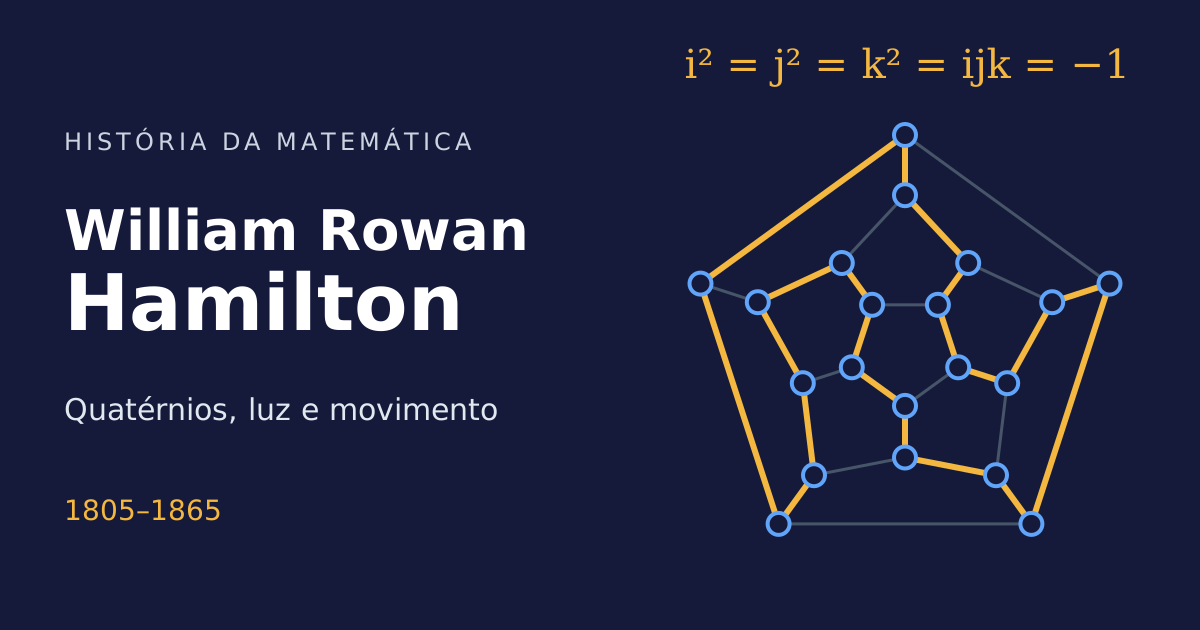
Complex numbers as couples

By the early nineteenth century complex numbers had been in use for three hundred years, since Cardano and Bombelli, and Euler had worked wonders with them. Wessel, Argand and Gauss had drawn them as points of the plane. But the unease remained: what, after all, is $\sqrt{-1}$? A number whose square is negative seemed a useful fiction, not an object of mathematics. Hamilton settled the question without drawing anything. In the essay Theory of Conjugate Functions, or Algebraic Couples, presented to the Royal Irish Academy in 1833 and 1835 and published in 1837, he proposed that a complex number is an ordered couple of real numbers, and nothing more.
October 27, 2026 Read
Hero Image
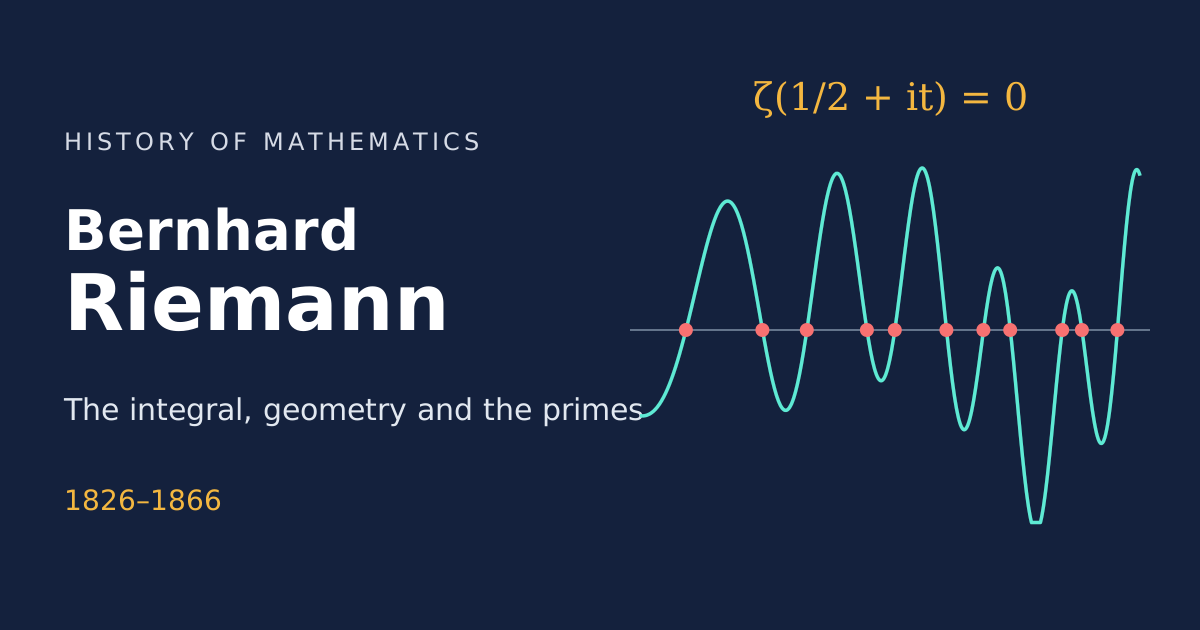
Riemann surfaces

Riemann’s doctoral thesis, of 1851, has a modest title: Foundations for a General Theory of Functions of a Complex Variable. Inside it are two ideas that changed mathematics: the conditions a complex function must satisfy in order to have a derivative, and a geometric way of dealing with functions that have several values. Functions that can be differentiated A complex function $f(z)$, with $z = x + iy$, can be written as $f = u + iv$, where $u$ and $v$ are real functions of $x$ and $y$. For $f$ to have a derivative in the complex sense, that is, for the limit $\frac{f(z + h) - f(z)}{h}$ to be the same whatever the direction in which $h$ goes to zero, the parts $u$ and $v$ must satisfy the Cauchy–Riemann equations:

October 31, 2026 Read
Hero Image
Quaternions: the formula on the bridge

After showing that complex numbers are couples of real numbers and that their multiplication rotates the plane, Hamilton wanted to do the same in space. He was looking for triplets $a + bi + cj$ with a multiplication that respected the law of the moduli: the size of the product should be the product of the sizes. He tried for years, above all in 1843, so much so that his children asked him every morning whether he could multiply triplets yet.

October 27, 2026 Read
Hero Image
ITA 2026 – 1st phase: Mathematics solved

Source: ITA – 1st phase exam and official answer key. Files on the ITA past exams page. The 1st phase of ITA 2026 had 48 multiple-choice questions: 12 in Mathematics, 12 in Physics, 12 in Chemistry and 12 in English. This post covers the mathematics questions, numbered 1 to 12 as in the exam. Exam conventions. $i^2 = -1$; $\bar{z}$ is the conjugate of $z$; $]a, b[$ is the open interval $a < x < b$.

October 28, 2026 Read
Hero Image
ITA 2025 – 1st phase: Mathematics solved

Source: ITA – 1st phase exam and official answer key. Files on the ITA past exams page. The 1st phase of ITA 2025 had 48 multiple-choice questions: 12 in Mathematics, 12 in Physics, 12 in Chemistry and 12 in English. This post covers the mathematics questions, numbered 1 to 12 as in the exam. Exam conventions. The horizontal and vertical axes are $O_x$ and $O_y$, and $O$ is the origin; $\mathbb{N} = \{1, 2, 3, \dots\}$; $i^2 = -1$; $\overline{AB}$ is the segment and $AB$ the line through $A$ and $B$.

October 28, 2026 Read
Hero Image
ITA 2024 – 1st phase: Mathematics solved

Source: ITA – 1st phase exam and official answer key. Files on the ITA past exams page. The 1st phase of ITA 2024 had 60 multiple-choice questions, 12 per subject (Physics, Portuguese, English, Mathematics and Chemistry). This post covers the mathematics questions, numbered 37 to 48 as in the exam. Exam conventions. $\mathbb{N} = \{1, 2, 3, \dots\}$; $A - B$ is the difference of the sets $A$ and $B$; $i^2 = -1$; $M_n(\mathbb{R})$ is the set of $n \times n$ real matrices; $\overline{AB}$ is the segment and $AB$ the line through $A$ and $B$; $m(\overline{AB})$ is the length of $\overline{AB}$; $A\hat{B}C$ is the angle with vertex $B$; $\det A$ is the determinant and $A^T$ the transpose of $A$.

October 28, 2026 Read
Hero Image
ITA 2023 – 1st phase: Mathematics solved

Source: ITA – 1st phase exam and official answer key. Files on the ITA past exams page. The 1st phase of ITA 2023 had 60 multiple-choice questions, 12 per subject (Physics, Portuguese, English, Mathematics and Chemistry). This post covers the mathematics questions, numbered 37 to 48 as in the exam. Exam conventions. $\mathbb{N} = \{1, 2, 3, \dots\}$; $i^2 = -1$; $M_n(\mathbb{R})$ is the set of $n \times n$ real matrices; $\overline{AB}$ is the segment and $AB$ the line through $A$ and $B$; $m(\overline{AB})$ is the length of $\overline{AB}$; $A\hat{O}B$ is the angle with vertex $O$; $\det A$ is the determinant of $A$.

October 28, 2026 Read
Hero Image
ITA 2022 – 2nd phase: Mathematics solved

Source: ITA – 2nd phase Mathematics exam. Files on the ITA past exams page. The 2nd phase Mathematics exam of ITA 2022 has 10 written questions. ITA does not publish official solutions for the 2nd phase; the solutions below are ours, and each answer was checked by a second route (substitution, another formula or a numerical check). The notation conventions are the same as in the 1st phase: $i^2 = -1$, $m(\overline{AB})$ is the length of segment $\overline{AB}$ and $A\hat{O}B$ is the angle with vertex $O$.

October 28, 2026 Read
Hero Image
ITA 2022 – 1st phase: Mathematics solved

Source: ITA – 1st phase exam and official answer key. Files on the ITA past exams page. The 1st phase of ITA 2022 had 70 multiple-choice questions: 15 in Physics, 15 in Portuguese, 10 in English, 15 in Mathematics and 15 in Chemistry. This post covers the mathematics questions, numbered 41 to 55 as in the exam. Exam conventions. $\mathbb{N} = \{1, 2, 3, \dots\}$; $i$ is the imaginary unit ($i^2 = -1$); $M_n(\mathbb{R})$ is the set of $n \times n$ real matrices; $\overline{AB}$ is the segment with endpoints $A$ and $B$, and $m(\overline{AB})$ is its length; $A\hat{O}B$ is the angle with vertex $O$ formed by the rays $\overrightarrow{OA}$ and $\overrightarrow{OB}$.

October 28, 2026 Read
Hero Image
Argand's plane: the imaginary number that found a place

Since the sixteenth century, the Italian algebraists had known that, to solve certain cubic equations, one had to pass through square roots of negative numbers, even when the final answer was a real number. They used $\sqrt{-1}$ uncomfortably. Descartes called such numbers imaginary, and the name stuck. Leibniz described them as “an amphibian between being and non-being”. The problem was semiotic. $\sqrt{-1}$ was a piece of writing that obeyed the rules of algebra but pointed to nothing that could be seen or measured. A real number has a place on the line; $\sqrt{-1}$ had no place at all.

October 19, 2026 Read
Hero Image
FUVEST 2023 – 2nd phase: Mathematics solved

Source: FUVEST – 2nd phase test, 2nd day (questions M01 to M06) and document expected approaches. The 2nd phase of FUVEST 2023 lasted two days. The 1st day was Portuguese and Writing; in 2nd day, the test had 6 questions from each subject, and Mathematics goes from M01 to M06. Each candidate answered only the subjects of their career (in some careers, only the first questions of each subject). FUVEST does not publish a template for the 2nd phase; the resolutions are ours. She disclosed an “expected approaches” document with the path expected of the candidates. Each resolution below was checked by a second path and compared to this document.

September 27, 2026 Read
Navigation
  • Start here
  • Recent posts
  • About Euler
  • App
  • Privacy
  • About us
  • Contact
Contact me:
  • hirowat2@gmail.com

Euler's Eyes
© 2021 Euler Eyes.
Powered by Hugo Logo