Hero Image
Image credits

Historical images and photographs All come from Wikimedia Commons. We use the thumbnails provided by Commons, unedited. Portrait of Laplace in the robes of chancellor of the Senate, posthumous painting by Jean-Baptiste Paulin Guérin (1838): source page · public domain. Beaumont-en-Auge, Place du Colonel Langlois and the church of Saint-Sauveur, photo by DimiTalen (2024): source page · CC0. Portrait of Jean le Rond d’Alembert, by Catherine Lusurier (1777): source page · public domain. The Military School in Paris at dawn, photo by DXR: source page · CC BY-SA 3.0. The calorimeter of Lavoisier and Laplace, engraving by John Pass after Henry Lascelles (1801): source page · public domain. Marble standard metre on rue de Vaugirard, Paris, photo by Airair: source page · CC BY-SA 3.0. Laplace’s tomb in the Colbert-Laplace mausoleum, Saint-Julien-de-Mailloc, photo by Antoine Rex: source page · CC0. Title page of the Exposition of the System of the World, second edition (1798), page 3 of the digitized file: source page · public domain. Title page and the page with the passage about the intelligence from the Philosophical Essay on Probabilities, 1840 edition, pages 3 and 12 of the digitized file: source page · public domain. Page 90 of the Philosophical Essay on Probabilities: source page · public domain. The first two volumes of the Treatise on Celestial Mechanics (1799), photo from the Niels Bohr Library & Archives, American Institute of Physics: source page · public domain. Statue of Laplace in Beaumont-en-Auge, photo by Roland Godefroy: source page · CC BY-SA 4.0. Figures made for the blog The cover and the four interactive figures (the conjunctions of Jupiter and Saturn, the relaxation of Laplace’s equation on a plate, the sum of dice compared with the normal curve, and the rule of succession) are original illustrations, with text in each of the site’s languages. The map and the graph of Laplace’s journey are generated from the file data/viagens/laplace.yaml.

Hero Image
Other contributions and legacy

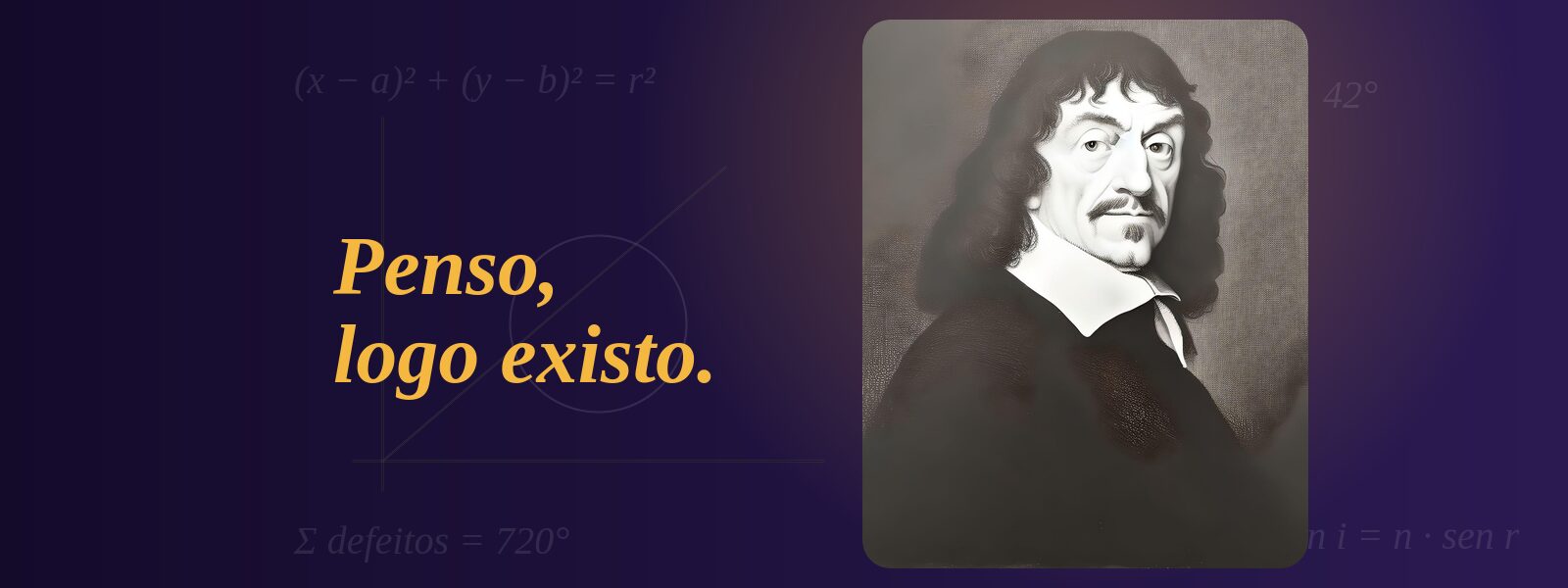
Other contributions Descartes’ vortices: for him, the planets were dragged by whirlpools of matter around each star.René Descartes, Principles of Philosophy · public domain Optics: in addition to the law of refraction, he studied the ideal shape of lenses, which should have a profile of ellipse or hyperbola to focus light on a point. Descartes’ Folio: the curve $x^3 + y^3 = 3axy$, which he proposed as a challenge to Fermat to find tangent lines. Physics: formulated a version of the principle of inertia, that a body in motion continues in straight line if nothing gets in your way. Philosophy: the Meditations and the Principles of Philosophy made it the starting point of modern philosophy. To remember Descartes lived between France, Holland and Sweden, and wrote the Discourse on the Method in French to be read by everyone. He created analytical geometry: points became pairs $(x, y)$ and figures became equations. He showed how to construct $\sqrt{a}$ with a ruler and compass and fixed the notation $x$, $y$, $z$ and $x^3$. The rule of signs tells how many positive roots a polynomial can have. The sum of the vertex defects of a polyhedron is 720°, which leads to the formula $V - A + F = 2$. He explained the rainbow: the rays accumulate at 42° from the point opposite the Sun. With it comes the idea of ​​function: a rule that “listens” to one number and “speaks” another. The word comes from Latin functus, and the symbol $f(x)$ is Euler (1734). There is no $1 \div 0$: close to zero, $\frac{1}{x}$ runs away to $+\infty$ on one side and to $-\infty$ on the other. All topics by René Descartes · ← Infinity and division by zero · Image credits →

Hero Image
Reading: Euler, analysis incarnate

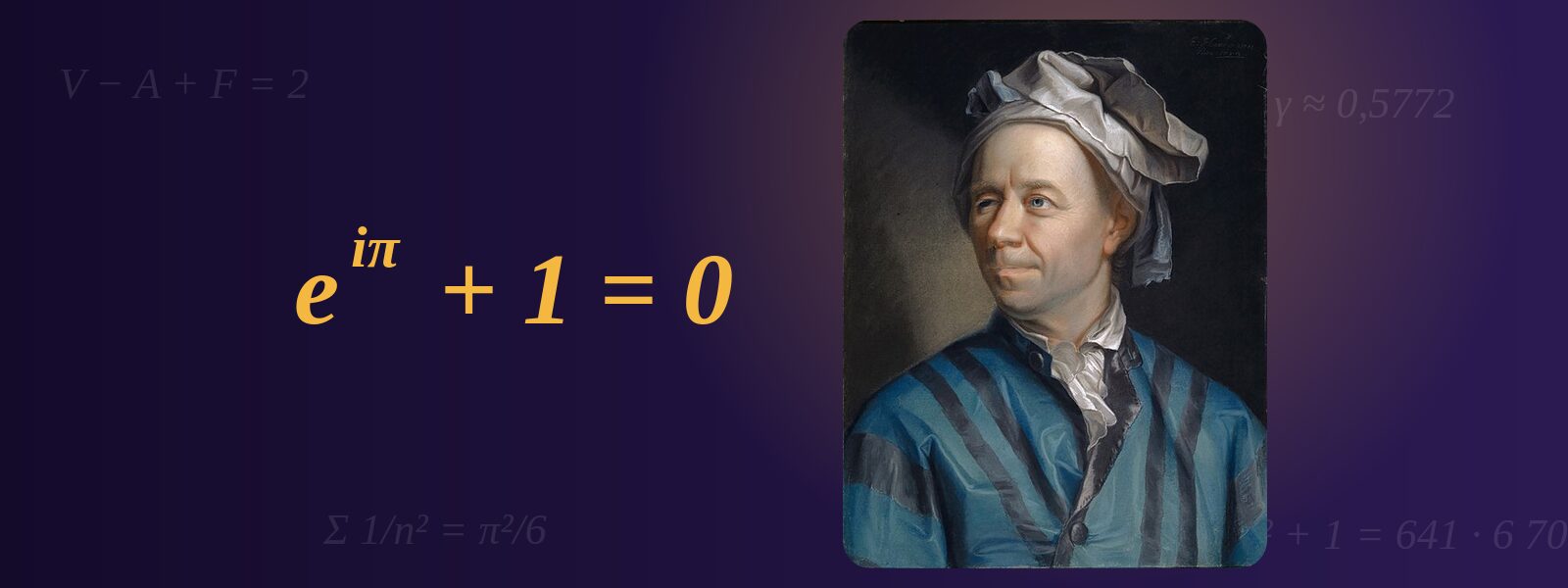
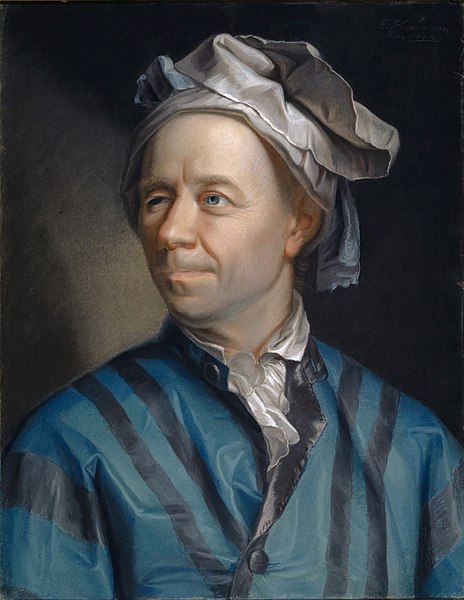
Further reading Leitura Euler, analysis incarnate Leonhard Euler (1707–1783) was born in Basel, Switzerland. His father, a Protestant pastor, wanted him to pursue a religious career, but the young man was a student of Johann Bernoulli, then the greatest mathematician in Europe, who soon recognized his talent and convinced the family to let him study mathematics. Leonhard Euler, pictured in 1753.Jakob Emanuel Handmann · Wikimedia Commons · Public domain In 1727, at the age of twenty, he went to the newly created Saint Petersburg Academy of Sciences, in Russia, where Daniel and Nicolau Bernoulli, sons of his master, already worked. Around 1738, after an illness, he lost the vision in his right eye. In 1741 he accepted the invitation of Frederick the Great, and spent 25 years at the Berlin Academy; in 1766 he returned to Saint Petersburg, where he stayed until he died. Shortly after his return, a cataract took away his sight in his other eye: Euler spent the last seventeen years of his life practically blind — and it was during this period that he produced almost half of his work, dictating to assistants and making enormous calculations in his head. Euler wrote about almost everything: analysis, number theory, geometry, mechanics, astronomy, optics, music, shipbuilding. His books were so widely read that many of the notations he used have become ours: $e$ for the base of natural logarithms, $\pi$ for the ratio of circumference to diameter, $i$ for $\sqrt{-1}$, $f(x)$ for a function, $\Sigma$ for a sum, and lowercase letters $a$, $b$, $c$ for the sides of a triangle opposite the angles $A$, $B$, $C$. For trigonometry, the decisive work was Introductio in analysin infiniterum (“Introduction to the analysis of infinities”), by 1748. In it, sine and cosine stopped being segments of a circle of arbitrary radius and became functions of a number, measured on a circle of radius 1 — exactly the trigonometric cycle of this book. There also appears the famous formula that links trigonometry to exponential: $$e^{ix} = \cos x + i\operatorname{sen} x.$$Euler died in Saint Petersburg, in 1783, aged 76. The astronomer François Arago said that he “calculated without apparent effort, as men breathe and eagles sustain themselves in the air”; and his contemporaries called him analysis incarnate.

Hero Image
Reading: Poncelet, geometry written in prison

Further reading Leitura Poncelet, geometry written in prison Jean-Victor Poncelet (1788–1867) was born in Metz, in eastern France. He studied at the Polytechnic School in Paris, where he was a student of Gaspard Monge, the creator of descriptive geometry, and then at the military engineering school in Metz. In 1812, as an engineering lieutenant, he accompanied Napoleon’s army in the invasion of Russia. Jean-Victor Poncelet.Smithsonian Libraries · Wikimedia Commons · Public domain During his retreat from Moscow, he was presumed dead in the battle of Krasnoi and ended up a prisoner. Taken on foot in winter to Saratov, on the banks of the Volga, he spent around eighteen months in captivity. Without books, he reconstructed from memory what he had learned with Monge and went further: he began to develop projective geometry, the study of the properties of figures that do not change when they are projected from one plane to another — the same properties that Desargues and Pascal had begun to explore in the 17th century. Released in 1814, he returned to France and began publishing his results, first on inscribed polygons circumscribed by conics. The great work, the Traité des propriétés projectives des figures (“Treatise on the projective properties of figures”), came out in 1822. In it, Poncelet showed that properties such as the alignment of points or tangency are preserved through projection, and systematically used the relationship between pole and polar of a conic, the basis of the duality principle: in flat projective geometry, every theorem about points and lines remains true when the words “point” and “line” are exchanged. These ideas paved the way for the study of projective invariants, such as the double ratio (or anharmonic) of four points, developed by Möbius and Chasles, and for the program of Felix Klein, which in 1872 classified geometries by the groups of transformations that preserve them. Poncelet was also an important engineer: he designed hydraulic wheels and taught applied mechanics. Died in Paris, in 1867.

Hero Image
Reading: Fourier and heat conduction

Further reading Leitura Fourier and heat conduction Jean-Baptiste Joseph Fourier (1768–1830) was born in Auxerre, France, the son of a tailor. Orphaned before 10 years of age, he was educated at the city’s military school, run by Benedictine monks. As a boy he wrote sermons that priests from other cities used, and at the 13 age he discovered mathematics, in which he quickly excelled. He prepared to enter the Benedictine order, but the Revolution of 1789 changed his plans. Joseph Fourier, in an engraving by Julien-Léopold Boilly.Julien-Léopold Boilly · Wikimedia Commons · Public domain Fourier enthusiastically joined the revolutionary cause—and was nearly guillotined in the Terror of 1794. With the creation of the Escola Normal and the Escola Politécnica in Paris, he became a professor and began the work that would make him famous; from this time is his method for separating the real roots of algebraic equations, a problem that Newton had initiated. In 1798 he accompanied Napoleon on the expedition to Egypt, where he was secretary of the Cairo Institute, directed engineering work and became an expert in Egyptology. Back in France, he was appointed prefect of the Isère department, in Grenoble, and there, between 1804 and 1807, he studied the heat propagation in a solid body. To solve the equations he found, he wrote temperature as an infinite sum of sines and cosines — a type of series development different from Taylor’s, because it uses periodic functions instead of powers. The idea that any functions, even those with “corners”, could be written in this way seemed absurd to Lagrange and other members of the Academy, who received the 1807 memoir with reservations. Fourier insisted, and in 1822 published the Théorie analytique de la chaleur, a landmark in mathematical physics. To the Fourier series They ended up demanding a complete revision of the concepts of function, convergence and integral — work to which Dirichlet, Riemann and Cantor dedicated themselves — and today they are everywhere: in the compression of music and images, in the analysis of earthquakes and in magnetic resonance. Fourier died in Paris in 1830.

Hero Image
Reading: Bolzano, the priest who took refuge in mathematics

Further reading Leitura Bolzano, the priest who took refuge in mathematics Bernard Bolzano (1781–1848) was born and died in Prague, then part of the Austrian Empire. He was a Catholic priest and professor of philosophy of religion, but his ideas — pacifist and critical of the social order — displeased the Church and the government: in 1819 he lost his professorship and began living away, writing. Mathematics became his refuge, and his contemporaries hardly read him. Bernard Bolzano.Unidentified author · Wikimedia Commons · Public domain In 1817 he published Rein analytischer Beweis (“Purely Analytical Proof”), in which he demonstrated without resorting to drawings that a continuous function that changes sign in an interval cancels out there — the current intermediate value theorem. To do this, he needed a definition of continuity that did not depend on geometric intuition. Bolzano realized the need for rigor in analysis so early that Felix Klein would call him the “father of arithmetization.” He and Cauchy never met, but they arrived at very similar definitions of limit, continuity and convergence; it was Cauchy, with more prestige, who made them known. In 1834, Bolzano constructed a function continuous on an interval and with no derivative at any point of it. The example was unpublished, and the credit ended up going to Weierstrass, who rediscovered these results decades later. Other works suffered the same fate: today we call it the Bolzano-Weierstrass theorem which guarantees that every limited set with infinite elements has at least one accumulation point, and one of the series convergence criteria is named after Cauchy. In the posthumous book Paradoxes of Infinity (1851), Bolzano showed that there are as many real numbers between 0 and 1 as between 0 and 2 — just associate $x$ with $2x$ —, or as many points in a segment of one centimeter or two. Resuming an observation by Galileo, he accepted that an infinite set can be put in correspondence with a part of itself. He seems to have intuited that the infinity of real numbers is of another kind than that of integers, an idea that only Cantor would make precise. It is not for nothing that it is said that Bolzano was “a voice crying in the desert”.

Hero Image
Chapter 1: references and credits

Further reading Cajori, Florian. A History of Mathematical Notations. 2 vols. Chicago: Open Court, 1928–1929. The reference work on the origin of each symbol; almost every date in this chapter can be checked in it. Mazur, Joseph. Enlightening Symbols: A Short History of Mathematical Notation and Its Hidden Powers. Princeton: Princeton University Press, 2014. An accessible history on the same theme as this book. Ifrah, Georges. The Universal History of Numbers. London: Harvill Press, 1998. On number systems and zero. Klein, Jacob. Greek Mathematical Thought and the Origin of Algebra. Cambridge, MA: MIT Press, 1968. On the passage from Diophantus to Viète. Boyer, Carl B.; Merzbach, Uta C. A History of Mathematics. 3rd ed. Hoboken: Wiley, 2011. Crowe, Michael J. A History of Vector Analysis. Notre Dame: University of Notre Dame Press, 1967. On the dispute between quaternions and vectors. Maor, Eli. Trigonometric Delights. Princeton: Princeton University Press, 1998. On the history of the sine and the names of trigonometry. Grabiner, Judith V. The Origins of Cauchy’s Rigorous Calculus. Cambridge, MA: MIT Press, 1981. On Berkeley, Cauchy and the limit. Miller, Jeff. Earliest Uses of Various Mathematical Symbols. A page maintained since the 1990s, with the earliest known occurrences of each sign. MacTutor History of Mathematics, University of St Andrews: biographies of al-Khwarizmi, Fibonacci, Recorde, Viète, Harriot, Oughtred, Cayley, Boole, Frege and Peano. The old texts on this site about geometry, trigonometry, the square root, quadratic equations, logarithms, derivatives, the chain rule, integrals, limits, functions, differential equations, groups, matrices, vectors and quaternions were the basis for rewriting this chapter. From them come the story of radix quadrati, the completing-the-square figure, Pythagoras’ theorem in Latin, the etymology of cathetus, hypotenuse, minute and second, the passage from $\Sigma$ to $\int$, the proof that $1=2$, Hooke’s law, the “canon of heat” and the propagation of errors, the abbreviation of logarithmus to $\log$, the etymology of derivative and function, reading a function as a sentence with a hole, the group table of the triangle’s moves, the dispute between quaternions and vectors, and the ideas of active and sterile notation.
Hero Image
+, −, × and =: a short history of the signs

The simplest signs in mathematics are also the youngest. Euclid never wrote a $+$. Al-Khwarizmi never wrote an $=$. Viète, who already used letters, still wrote aequatur in full. Almost all the operation signs a child learns in the first year of school were born in Europe between the end of the fifteenth century and the end of the seventeenth, in a span of about two hundred years. 1489Johannes Widmann prints $+$ and $-$ in a book of commercial arithmetic in Leipzig. 1525Christoff Rudolff uses $\surd$ for the square root in his algebra book, the Coss. 1557Robert Recorde invents $=$ in The Whetstone of Witte. 1591François Viète uses letters for known and unknown quantities. 1631William Oughtred uses $\times$ for multiplication; in the same year Thomas Harriot’s posthumous book appears with $<$ and $>$. 1637René Descartes writes powers as exponents: $x^3$, $x^4$. 1659Johann Rahn uses $\div$ for division. 1698Leibniz proposes the dot $\cdot$ for multiplication, so as not to confuse $\times$ with the letter $x$. Plus and minus: warehouse marks The signs $+$ and $-$ first appear in print in 1489, in an arithmetic manual for merchants written by Johannes Widmann. There they do not quite mean an operation yet: they mark excess and shortfall. A crate of goods that weighed more than it should was marked $+$; one that weighed less, $-$. The most accepted hypothesis is that $+$ is an abbreviation of et (“and”, in Latin), written quickly until it became a cross.