Logo Euler's Eyes
  • Materials
  • Dark Theme
    Light Theme Dark Theme System Theme
Logo Inverted Logo
  • Tags
  • 1 Phase
  • 1st Phase
  • 2 Phase
  • 2 Phase,
  • 2nd Phase
  • 2° Degree Equation
  • Accessibility
  • Addition Formulas
  • Alan Turing
  • Algebra
  • Algebraic Expressions
  • Algorithms
  • Ambiguous Case
  • Analysis
  • Analytic Geometry
  • Analytical Geometry
  • Ancient Greece
  • Angle Bisector
  • Angle Bisectors
  • Angles
  • Any Triangles
  • Apothem
  • Arc Capable
  • Arc Sine
  • Archimedes
  • Area
  • Areas
  • Arithmetic Progression
  • Artificial Intelligence
  • Astronomy
  • Augustin-Louis Cauchy
  • Axioms and Postulates
  • Basic Concepts of Statistics
  • Bayesian Statistics
  • Bernhard Riemann
  • Bernoulli
  • Bhaskara
  • Binary Numbers
  • Binomial
  • Biography
  • Biology
  • Black Holes
  • Bolzano
  • Bows
  • Braille
  • Brazil
  • Calculating Machine
  • Calculation
  • Calculus
  • Calculus of Variations
  • Cartesian Plane
  • Cartesian Product of Sets
  • Cauchy
  • Celestial Mechanics
  • Cellular Automata
  • Central Angle
  • Centroid
  • Chaos
  • Children
  • Circle
  • Circle Area
  • Circular Functions
  • Circumcenter
  • Circumference
  • Circumference Ratio
  • Circumferences
  • Classical Equations
  • Classification in Mathematics
  • Combinatorial Analysis
  • Combinatorics
  • Communities
  • Complement
  • Complementary Arcs
  • Complex Functions
  • Complex Numbers
  • Compound Interest
  • Computer Architecture
  • Computing
  • Congruence
  • Conics
  • Continuity
  • Conventions
  • Convergence
  • Correspondence Law
  • Cosecant
  • Cosine
  • Cosine of the Sum
  • Cotangent
  • Count
  • Cryptography
  • Culture
  • Cultures
  • Curvature
  • Curves
  • Decision Theory
  • Degree
  • Demo
  • Derivative
  • Derivatives
  • Descartes
  • Determinants
  • Determinism
  • Diagonals
  • Diagrams
  • Diamond
  • Differential Equations
  • Dispersion Measures
  • Distance
  • Division
  • Domain and Image
  • Double Bow
  • Drying
  • Economics
  • Einstein
  • Elasticity
  • Electromagnetism
  • Elementary Descriptive Statistics
  • Elementary School I
  • Elementary School II
  • ENEM 2021
  • ENEM 2022
  • ENEM 2023
  • ENEM 2024
  • ENEM 2025
  • Engineering
  • Entrance Exam
  • Equality
  • Equations
  • Equiprobable Events
  • Equivalence Between Sets
  • Equivalence Relations
  • Errors
  • Ethnomathematics
  • Euclid
  • Euclid's Postulate
  • Euler
  • Euler Project
  • Even and Odd Functions
  • Even Numbers
  • Exercises for Adding Natural Numbers
  • Exponential Function
  • External Angles
  • Fees
  • Fermat
  • Fermat's Last Theorem
  • Financial Mathematics
  • First Degree Equations
  • First Degree Functions
  • Flat
  • Flat Figures
  • Fourier
  • Fractions
  • French Revolution
  • Function Concept
  • Function Discovery
  • Functions
  • Fundamental Equations
  • Fundamental Relationships
  • FUVEST 2021
  • FUVEST 2022
  • FUVEST 2023
  • FUVEST 2024
  • FUVEST 2025
  • FUVEST 2026
  • Galois
  • Game Theory
  • Gauss
  • Geometric Constructions
  • Geometric Shapes
  • Geometry
  • Geometry With Natural Numbers
  • Geometry With Sequences of Numbers
  • Golden Segment
  • Graph Reading
  • Graph Theory
  • Graphics
  • Graphs
  • Graphs for Integers
  • Gravitation
  • Greatest Common Divisor
  • Group Theory
  • Groups
  • Göttingen
  • Half Bow
  • Hamilton
  • Height
  • Heron's Formula
  • History
  • History of Mathematics
  • Hydrostatics
  • Identities
  • Incenter
  • Increases and Discounts
  • Inequalities
  • Infinity
  • Inscribable Quadrilateral
  • Inscribed Angle
  • Integral
  • Integrals
  • Internal Angles
  • Interval Operations
  • Intervals
  • Introduction
  • Introduction to Function Theory
  • Introduction to Geometry
  • Introduction to Integers
  • Introduction to Logarithm Table
  • Introduction to Probability
  • Introduction to Radiciation
  • Introduction to Rational Numbers
  • Introduction to Real Numbers
  • Introduction to Sets
  • Introduction to Statistics
  • Inverse Functions
  • ITA 2022
  • ITA 2023
  • ITA 2024
  • ITA 2025
  • ITA 2026
  • Iverson
  • Johann Bernoulli
  • John Napier
  • John Nash
  • John Von Neumann
  • Lagrange
  • Language
  • Large Numbers
  • Latex
  • Law of Cosines
  • Law of Sines
  • Law of Tangents
  • Lean
  • Learning
  • Least Common Multiple
  • Legacy
  • Leibniz
  • Level 1
  • Level 2
  • Level 3
  • Limit
  • Limits
  • Linear Algebra
  • Linear Systems
  • Logarithm
  • Logarithm Properties
  • Logarithms
  • Logic
  • Magnification
  • Manuscripts
  • Maria Gaetana Agnesi
  • Math Elements
  • Mathematical Biology
  • Mathematical Logic
  • Mathematical Notation
  • Mathematical Physics
  • Mathematical Programming
  • Mathematics Education
  • Mathematics Elements
  • Mathematics for Children
  • Mathematics Teaching
  • Matrices
  • Maxwell
  • Measure
  • Mechanics
  • Medians
  • Medium Base
  • Mental Arithmetic
  • Metric Relationships
  • Metric System
  • Midpoint
  • Milan
  • Modular Function
  • Multiplication
  • Names
  • Napier
  • Napoleon
  • Natural Number Subtraction Exercises
  • Newton
  • Niels Henrik Abel
  • Notable Arcs
  • Notation
  • Notion of Infinity
  • Notions of Probability
  • Nth Root
  • Number And
  • Number Theory
  • Number Π
  • Numbering Systems
  • Numeration
  • Numerical Calculation
  • Numerical Methods
  • Obmep
  • OBMEP 2023
  • Obmep,
  • Odd Numbers
  • Operations With Rational Numbers
  • Operations With Sets
  • Operations With Venn-Euler Diagrams
  • Optics
  • Optimization
  • Orthocenter
  • Parallelism
  • Parallelogram
  • Parallels
  • Partial Derivatives
  • Pascal
  • Pascal's Triangle
  • Peano Axioms
  • Peirce
  • Percentage
  • Percentage Basics
  • Perimeter
  • Period
  • Periodic Functions
  • Perpendicular Bisector
  • Perpendicularity
  • Perpendiculars
  • Philosophy
  • Physical
  • Physics
  • Pi
  • Pi Number
  • Pi Numbers
  • Pierre-Simon Laplace
  • Pitot
  • Plane Geometry
  • Point
  • Point Power
  • Polygons
  • Polyhedra
  • Polynomials
  • Poncelet
  • Position Measurements
  • Postulates
  • Potentiation of Integers
  • Power With Negative Exponent
  • Prime Numbers
  • Primitive Notions
  • Principia
  • Probability
  • Problem Solving
  • Programming Languages
  • Progressions
  • Projective Geometry
  • Proof
  • Properties
  • Proportion
  • Proportionality
  • Proportions
  • Proportions and Geometry
  • Prostapheresis
  • Pure Mathematics
  • Pythagoras Theorem
  • Pythagorean Suits
  • Pólya
  • Quadrants
  • Quadratic Function
  • Quadrilateral
  • Quadrilaterals
  • Quantifier
  • Quantity Analysis
  • Quantum Mechanics
  • Quaternions
  • R Programming
  • Radian
  • Ramanujan
  • Randomness
  • Real Numbers
  • Rectangle Triangles
  • Reduction
  • Reduction to the First Quadrant
  • Reflection
  • Regular Polygons
  • Relations
  • Relationship Properties
  • Relativity
  • Residues
  • Riemann Hypothesis
  • Right Angle
  • Right Triangle
  • Rigour
  • Rule of 3
  • Rule of Three
  • Saussure
  • Semi-Straight
  • Semiotics
  • Sequences
  • Series
  • Set Family
  • Set Partition
  • Set Theory
  • Sets
  • Signal Rule
  • Similarity
  • Simple Interest
  • Simulation
  • Sine
  • Sine of the Sum
  • Solid Geometry
  • Solving Triangles
  • Sophie Germain
  • Spatial Geometry
  • Square Root
  • Statistic
  • Statistics
  • Stewart Ratio
  • Straight
  • Straight Segment
  • Sum of Angles
  • Supplement
  • Symmetry
  • Syracuse
  • Tangent
  • Tangentoid
  • Tests
  • Thales' Theorem
  • The Number Zero
  • Theorems
  • Thermodynamics
  • Transformation Into Product
  • Transformations
  • Transforms
  • Trapezium
  • Triangle
  • Triangle Area
  • Triangles
  • Triangular Inequality
  • Trigonometric Cycle
  • Trigonometric Equations
  • Trigonometric Inequalities
  • Trigonometric Table
  • Trigonometry
  • Triple Bow
  • Truth Table
  • Understanding Relationships
  • University of Bologna
  • Vectors
  • Venn-Euler Diagrams
  • Volumes
  • Werner's Formulas
  • Whole Numbers
  • Wiles
  • William Rowan Hamilton
  • Women in Mathematics
  • Writing
  • Year 2018
  • Year 2019
  • Year 2021
  • Year 2022
  • Zeta Function
  • École Polytechnique
  • Évariste Galois
Hero Image
Fermat's legacy

The father of number theory Title page of the 1670 edition of Diophantus’s Arithmetica, printed in Toulouse “with the observations of P. de Fermat”. It was through this book, published by his son five years after his death, that the margin notes reached Euler.Bernard Bosc, Toulouse (1670) · Wikimedia Commons · public domain Before Fermat, problems about whole numbers were seen as riddles, Diophantus’s puzzles. Fermat turned them into an area of mathematics, with deep questions and methods of its own. For almost a century hardly anyone followed him. It was Euler, from 1730 onwards, who read Fermat’s notes, proved many of them and made number theory a central branch of mathematics. Then came Lagrange, Legendre and Gauss.

October 7, 2026 Read
Hero Image
Image credits

Historical portrait The portrait of Leibniz painted by Christoph Bernhard Francke around 1695 comes from Wikimedia Commons and is in the public domain. We use the 960-pixel thumbnail provided by Commons, without editing. Source page. Public domain mark. Blog figures The cover and the sketch of the multiplication $23\times14$ are original illustrations. The sketch explains the calculation and does not reproduce the mechanism of the historical machine. The interactive figures for the eight bits, the terms of the product rule and the sums of the series for π were created for this trail. The examples in the text let you follow the calculations even without JavaScript.

October 7, 2026 Read
Hero Image
Image credits

Historical images The two historical images come from Wikimedia Commons and are in the public domain. We use the thumbnails provided by Commons, without editing. Portrait of Isaac Newton, Godfrey Kneller, 1689: source page · public domain. Title page of the Principia, 1687: source page · public domain. Blog figures The cover and the prism sketch are original illustrations. The interactive figures for the secant, the approximations of √2 and the orbits were created for this trail. They are teaching aids, not reproductions of manuscripts or simulations of Newton’s experiments.

October 6, 2026 Read
Hero Image
Systems of equations: the determinant and Gaussian elimination

To calculate orbits using least squares, Gauss needed to solve systems of equations with many unknowns. Two names that every student knows come from this story: the determinant and the Gaussian elimination. The determinant. Take a system with two equations: $$\begin{cases} a\,x + b\,y = e \\ c\,x + d\,y = f \end{cases} \quad\Longrightarrow\quad x = \frac{e\,d - b\,f}{a\,d - b\,c}, \qquad y = \frac{a\,f - e\,c}{a\,d - b\,c}.$$ It all depends on the number $ad - bc$ in the denominator: if it is not zero, the system has a single solution. This number “determines” the system.

October 1, 2026 Read
Hero Image
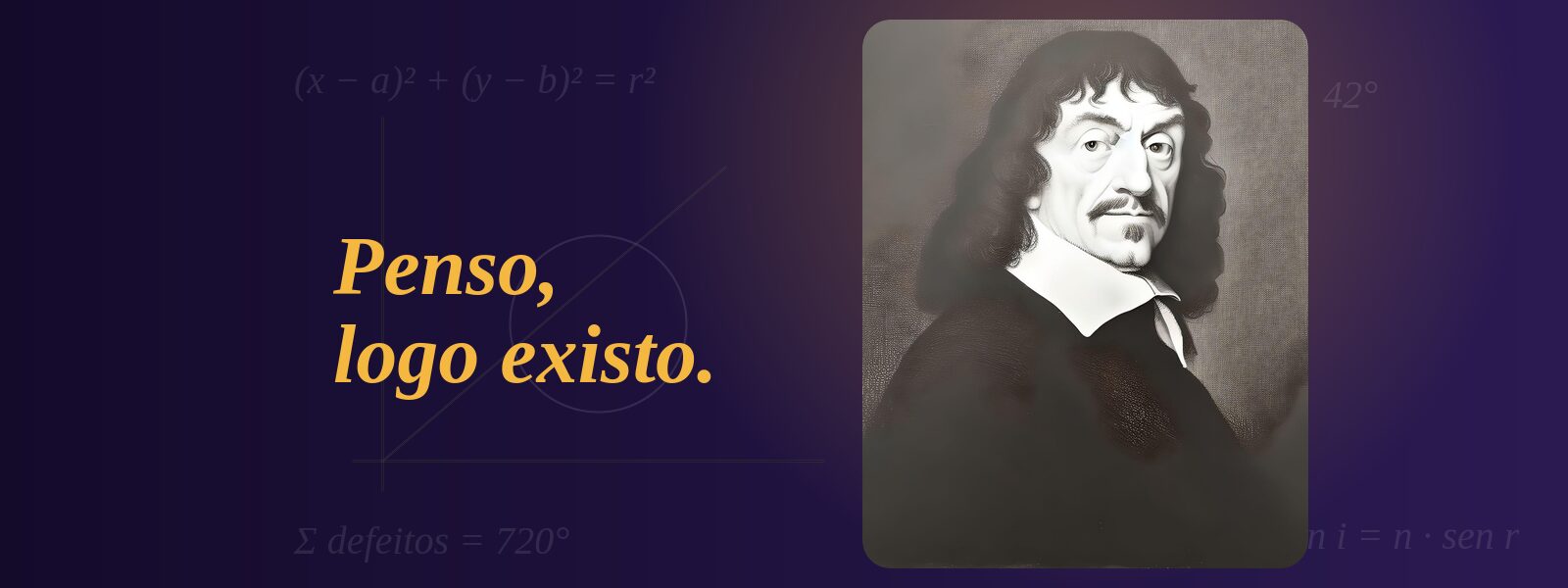
Descartes and the problem of cannons

Descartes experienced war up close. In 1618 he served as a volunteer in the army of Maurice of Nassau and, according to his first biographer, Adrien Baillet, he was in 1628 at the siege of La Rochelle, led by Cardinal Richelieu. On the battlefields, a practical problem occupied the artillerymen: with what angle tilt the cannon to hit a target at a certain distance? A man in front of a board on the table.Crop from the original engraving; improved sharpness for the Euler’s Eyes collection Two men next to the cannon and the bullets.Crop from the original engraving; improved sharpness for the Euler’s Eyes collection An angel next to a balanced scale.Crop from the original engraving; improved sharpness for the Euler’s Eyes collection It is a relationship between two numbers: the distance to the target (what the gunner “hears”) and the angle of the gun. (what he “says”). Galileo showed in 1638 that, without air resistance, the bullet describes a parabola, and the range $R$ depends on the angle $\theta$ and the exit speed $v$:

September 30, 2026 Read
Hero Image
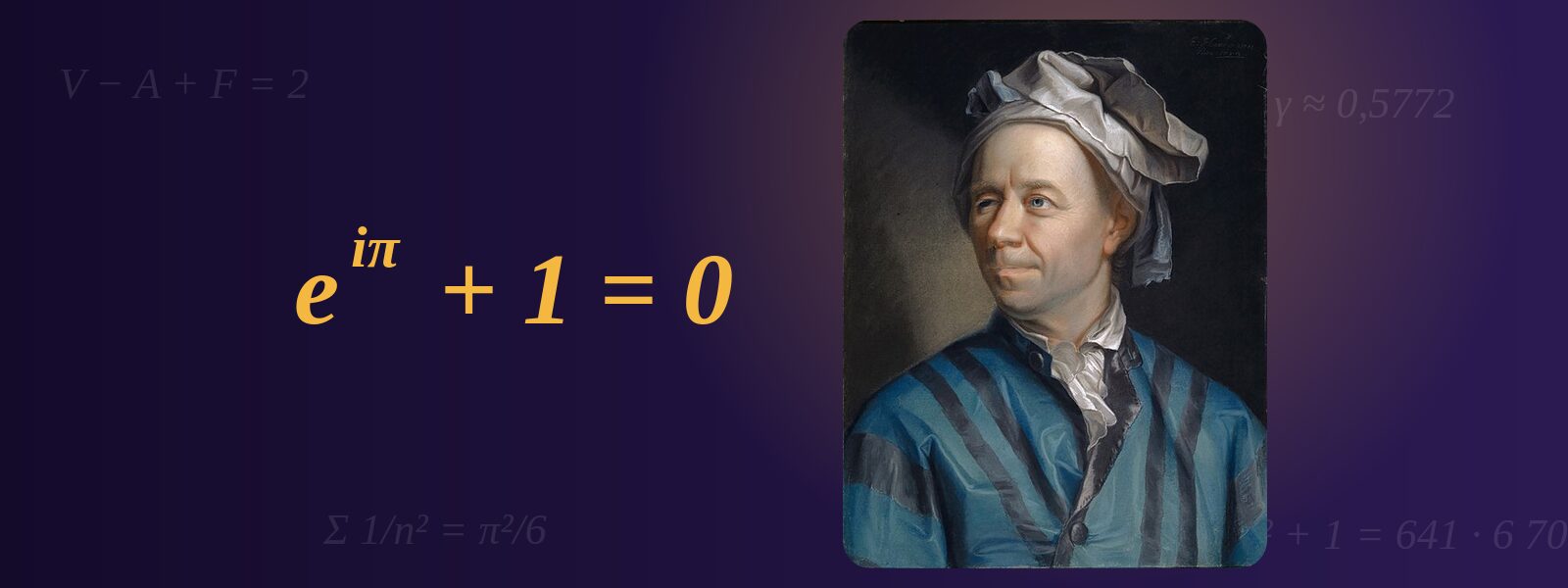
Fermat's number that was not prime

Pierre de Fermat believed that all numbers of the form $2^{2^n} + 1$ were prime. For $n = 0, 1, 2, 3, 4$ works: 3, 5, 17, 257 and 65 537 are primes. The next one is $$2^{32} + 1 = 4\,294\,967\,297.$$ Testing all dividers by hand is impractical. In 1732, Euler showed that this number is divisible by 641. An elegant way to look at this uses two ways of writing 641:

September 30, 2026 Read
Hero Image
Image credits

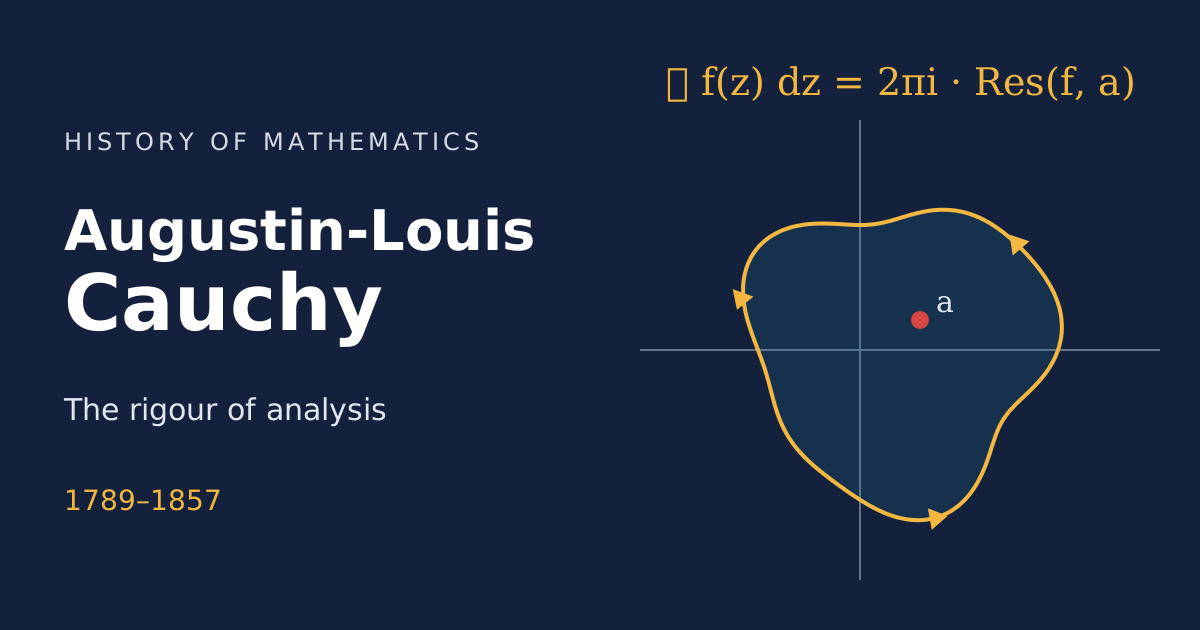
Historical images and photographs All come from Wikimedia Commons. We use the files or thumbnails provided by Commons, reduced to at most 800 pixels wide, with no other editing. Portrait of Augustin-Louis Cauchy, lithograph by Rudolf Hoffmann (1856) after a photograph by Bertsch: source page · public domain. Oil portrait of Cauchy, around 1840, attributed to Jean Roller, Château de Sceaux: source page · public domain. Lithograph of Cauchy by Louis Grégoire and Deneux, around 1840, Dibner collection of the Smithsonian Libraries: source page · public domain. Bronze medallion by Pierre-Jean David d’Angers (1843): source page · CC0. Title page of the Cours d’analyse (1821), cleaned version (converted from GIF to JPEG): source page · CC0. Cauchy’s name on the Eiffel Tower, photo by Juanedc: source page · CC BY 2.0. Cauchy’s grave in the cemetery of Sceaux, photo by Antoine Rex: source page · CC0. Figures made for the blog The cover and the four interactive figures (bisection, the band of width ε in Cauchy’s criterion, the integral of 1/(1 + z²) around a circle and the stress vector on a rotating cut) are original illustrations, with text in each of the site’s languages.

October 31, 2026 Read
Hero Image
The speed of sound

Sound is a compression wave: the air is pushed, compresses, pushes the next air and decompresses. The speed of this wave depends on two properties of the air: how much it resists being compressed and how heavy it is. Newton’s formula In the Principia, of 1687, Newton calculated the speed of sound for the first time. Assuming that, when compressed, air obeys Boyle’s law, that is, that pressure is proportional to density, he obtained

October 30, 2026 Read
Hero Image
The legacy of Archimedes

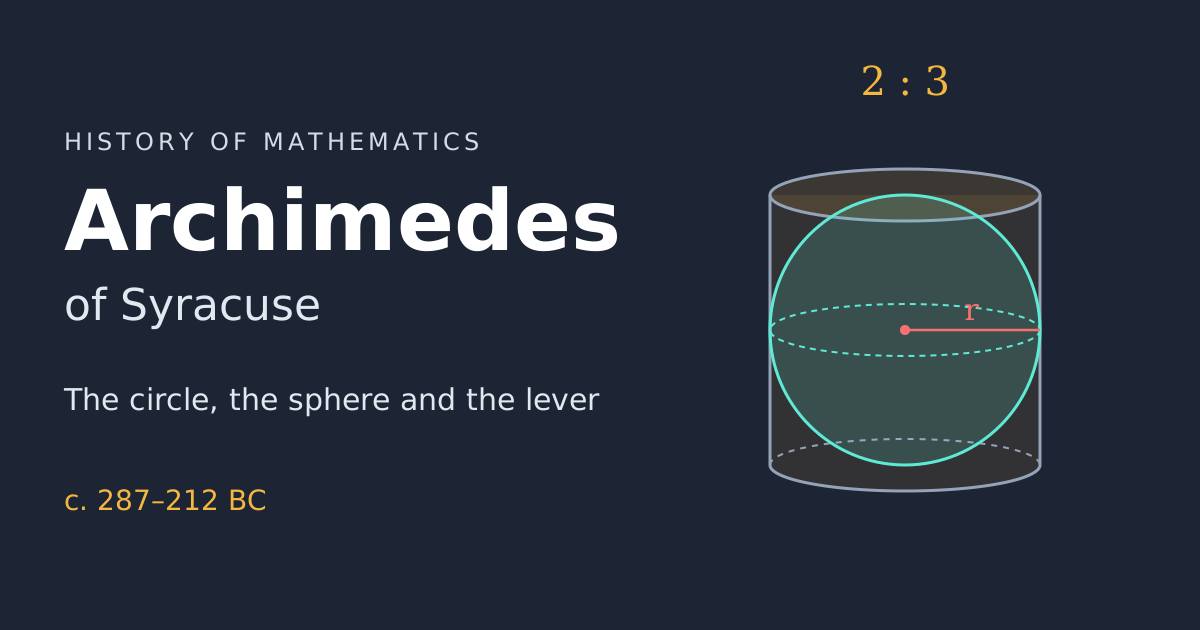
Whoever understands Archimedes and Apollonius will admire less the discoveries of the greatest men of today. — Gottfried Wilhelm Leibniz The manuscripts What remains of Archimedes reached us by a thread. Almost all of his work depended on three Byzantine Greek manuscripts. Two of them, which scholars call codices A and B, were lost after being copied or translated in the Renaissance; the third is the palimpsest, which stayed hidden under a prayer book. In 1269 the Dominican William of Moerbeke translated the Greek texts into Latin, and through this translation Archimedes came to be read in European universities. The first printed edition of the Greek text came out in Basel in 1544.

October 29, 2026 Read
Hero Image
Image credits

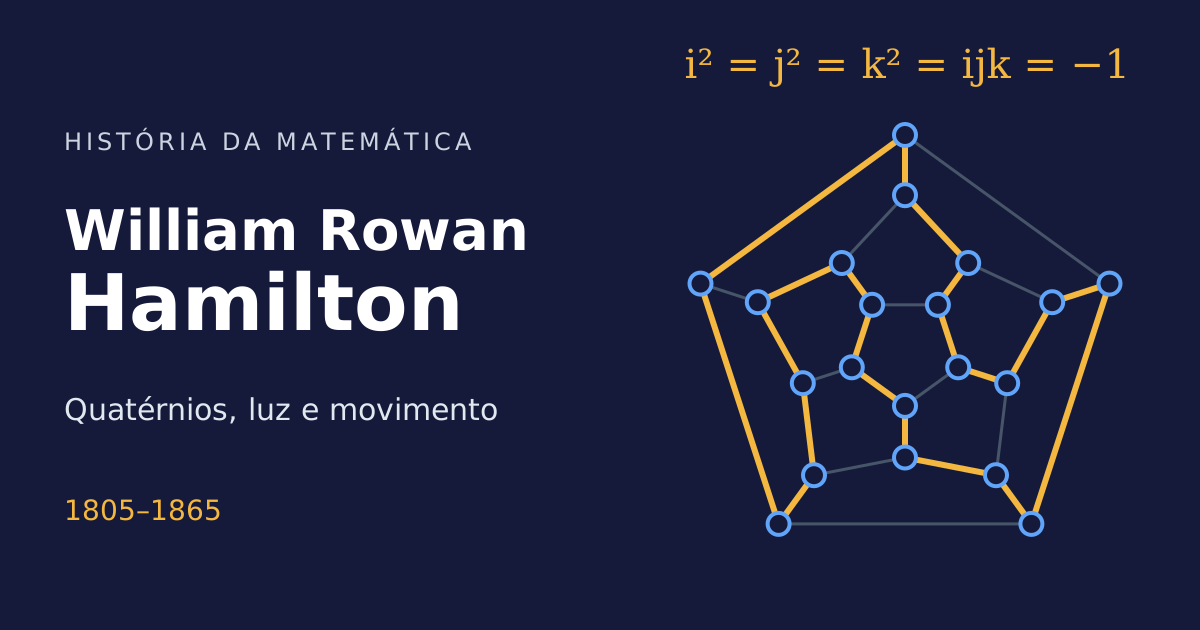
Historical images and photographs All come from Wikimedia Commons. We use the thumbnails provided by Commons; the Kirkwood etching was reduced in size and the conical refraction diagram had its colour palette reduced, with no other editing. Portrait of Hamilton, Library of Congress: source page · public domain. Oil portrait of Hamilton, unknown author: source page · public domain. Etching by J. Kirkwood, Wellcome Collection: source page · CC BY 4.0. Irish stamp of 1943: source page · public domain. The plaque on Broom Bridge, photo by Cone83: source page · CC BY-SA 4.0. Broom Bridge, photo by Johnflan: source page · CC BY-SA 4.0. Dunsink Observatory, photo by David Malone: source page · CC BY-SA 2.5. Trinity College Dublin, photo by JoachimKohler-HB: source page · CC BY-SA 4.0. Wordsworth on Helvellyn, painting by Benjamin Robert Haydon: source page · public domain. Internal conical refraction, by Thomas Preston and William Edward Thrift: source page · public domain. Replica of the Icosian game at the Matemateca IME-USP, Estes Objethos Atelier, photo by Alisson Ricardo: source page · CC BY-SA 4.0. Figures made for the blog The cover and the interactive figures for the pendulum’s phase space, rotations with quaternions and the Icosian game were made for this trail and work in all four languages of the site.

October 27, 2026 Read
Hero Image
Image credits

Historical images and photographs All come from Wikimedia Commons. We use the thumbnails provided by Commons, with no editing beyond compression. Von Neumann’s Los Alamos badge photo, Los Alamos National Laboratory: source page · free use with attribution to the laboratory. Von Neumann in New Mexico, Los Alamos National Laboratory: source page · free use with attribution to the laboratory. The plaque on his birthplace in Budapest, photo by Misibacsi: source page · CC BY-SA 3.0. The Lutheran gymnasium of Budapest, photo by VinceB: source page · CC BY-SA 3.0. Fuld Hall, Princeton, photo by Zeete: source page · CC BY-SA 4.0. Two programmers at the ENIAC, United States Army: source page · public domain. The title page of the EDVAC report: source page · public domain. The EDVAC at Aberdeen, United States Army: source page · public domain. Oppenheimer and von Neumann in front of the IAS machine, Jeremy Norman Collection of Images: source page · CC BY 4.0. Ulam with the FERMIAC, Los Alamos National Laboratory: source page · public domain. Ulam’s Los Alamos badge: source page · public domain. Figures made for the blog The cover and the interactive figures for the minimax theorem, the Monte Carlo method and merge sort were made for this trail and work in all four languages of the site.

October 27, 2026 Read
Hero Image
Image credits

Historical images and photographs All of them come from Wikimedia Commons. We use the thumbnails provided by Commons, with no editing beyond compression. Turing at 16, passport photo attributed to Arthur Reginald Chaffin: source page · public domain. Turing in 1951, portrait by the Elliott & Fry studio: source page · public domain. King’s College chapel, photo by Martinvl: source page · CC BY-SA 4.0. The Bletchley Park mansion, photo by DeFacto: source page · CC BY-SA 4.0. A three-rotor Enigma, National Security Agency: source page · public domain. The bombe rebuild, photo by Mike Peel: source page · CC BY-SA 4.0. The Pilot ACE, photo by Philafrenzy: source page · CC BY 2.0. Replica of the Manchester Baby, photo by Parrot of Doom: source page · CC BY-SA 3.0. The Sackville Park statue, photo by David Dixon: source page · CC BY-SA 2.0. The skin of the giant pufferfish, photo by Chiswick Chap: source page · CC BY-SA 3.0. Turing’s patterns and the cheetah, figure by Philip Ball: source page · CC BY 4.0. Figures made for the site The cover, the interactive Turing machine and the reaction–diffusion simulation were made for this trail. The simulation uses the Gray–Scott model, computed on a 200 by 200 grid of cells, and contains no text, so it serves all the languages of the site. The interactive machine works in all four languages.
October 18, 2026 Read
  • ««
  • «
  • 19
  • 20
  • 21
  • 22
  • 23
  • »
  • »»
Navigation
  • Start here
  • Recent posts
  • About Euler
  • App
  • Privacy
  • About us
  • Contact
Contact me:
  • hirowat2@gmail.com

Euler's Eyes
© 2021 Euler Eyes.
Powered by Hugo Logo