Logo Euler's Eyes
  • Materials
  • Dark Theme
    Light Theme Dark Theme System Theme
Logo Inverted Logo
  • Tags
  • 1 Phase
  • 1st Phase
  • 2 Phase
  • 2 Phase,
  • 2nd Phase
  • 2° Degree Equation
  • Accessibility
  • Addition Formulas
  • Alan Turing
  • Algebra
  • Algebraic Expressions
  • Algorithms
  • Ambiguous Case
  • Analysis
  • Analytic Geometry
  • Analytical Geometry
  • Ancient Greece
  • Angle Bisector
  • Angle Bisectors
  • Angles
  • Any Triangles
  • Apothem
  • Arc Capable
  • Arc Sine
  • Archimedes
  • Area
  • Areas
  • Arithmetic Progression
  • Artificial Intelligence
  • Astronomy
  • Augustin-Louis Cauchy
  • Axioms and Postulates
  • Basic Concepts of Statistics
  • Bayesian Statistics
  • Bernhard Riemann
  • Bernoulli
  • Bhaskara
  • Binary Numbers
  • Binomial
  • Biography
  • Biology
  • Black Holes
  • Bolzano
  • Bows
  • Braille
  • Brazil
  • Calculating Machine
  • Calculation
  • Calculus
  • Calculus of Variations
  • Cartesian Plane
  • Cartesian Product of Sets
  • Cauchy
  • Celestial Mechanics
  • Cellular Automata
  • Central Angle
  • Centroid
  • Chaos
  • Children
  • Circle
  • Circle Area
  • Circular Functions
  • Circumcenter
  • Circumference
  • Circumference Ratio
  • Circumferences
  • Classical Equations
  • Classification in Mathematics
  • Combinatorial Analysis
  • Combinatorics
  • Communities
  • Complement
  • Complementary Arcs
  • Complex Functions
  • Complex Numbers
  • Compound Interest
  • Computer Architecture
  • Computing
  • Congruence
  • Conics
  • Continuity
  • Conventions
  • Convergence
  • Correspondence Law
  • Cosecant
  • Cosine
  • Cosine of the Sum
  • Cotangent
  • Count
  • Cryptography
  • Culture
  • Cultures
  • Curvature
  • Curves
  • Decision Theory
  • Degree
  • Demo
  • Derivative
  • Derivatives
  • Descartes
  • Determinants
  • Determinism
  • Diagonals
  • Diagrams
  • Diamond
  • Differential Equations
  • Dispersion Measures
  • Distance
  • Division
  • Domain and Image
  • Double Bow
  • Drying
  • Economics
  • Einstein
  • Elasticity
  • Electromagnetism
  • Elementary Descriptive Statistics
  • Elementary School I
  • Elementary School II
  • ENEM 2021
  • ENEM 2022
  • ENEM 2023
  • ENEM 2024
  • ENEM 2025
  • Engineering
  • Entrance Exam
  • Equality
  • Equations
  • Equiprobable Events
  • Equivalence Between Sets
  • Equivalence Relations
  • Errors
  • Ethnomathematics
  • Euclid
  • Euclid's Postulate
  • Euler
  • Euler Project
  • Even and Odd Functions
  • Even Numbers
  • Exercises for Adding Natural Numbers
  • Exponential Function
  • External Angles
  • Fees
  • Fermat
  • Fermat's Last Theorem
  • Financial Mathematics
  • First Degree Equations
  • First Degree Functions
  • Flat
  • Flat Figures
  • Fourier
  • Fractions
  • French Revolution
  • Function Concept
  • Function Discovery
  • Functions
  • Fundamental Equations
  • Fundamental Relationships
  • FUVEST 2021
  • FUVEST 2022
  • FUVEST 2023
  • FUVEST 2024
  • FUVEST 2025
  • FUVEST 2026
  • Galois
  • Game Theory
  • Gauss
  • Geometric Constructions
  • Geometric Shapes
  • Geometry
  • Geometry With Natural Numbers
  • Geometry With Sequences of Numbers
  • Golden Segment
  • Graph Reading
  • Graph Theory
  • Graphics
  • Graphs
  • Graphs for Integers
  • Gravitation
  • Greatest Common Divisor
  • Group Theory
  • Groups
  • Göttingen
  • Half Bow
  • Hamilton
  • Height
  • Heron's Formula
  • History
  • History of Mathematics
  • Hydrostatics
  • Identities
  • Incenter
  • Increases and Discounts
  • Inequalities
  • Infinity
  • Inscribable Quadrilateral
  • Inscribed Angle
  • Integral
  • Integrals
  • Internal Angles
  • Interval Operations
  • Intervals
  • Introduction
  • Introduction to Function Theory
  • Introduction to Geometry
  • Introduction to Integers
  • Introduction to Logarithm Table
  • Introduction to Probability
  • Introduction to Radiciation
  • Introduction to Rational Numbers
  • Introduction to Real Numbers
  • Introduction to Sets
  • Introduction to Statistics
  • Inverse Functions
  • ITA 2022
  • ITA 2023
  • ITA 2024
  • ITA 2025
  • ITA 2026
  • Iverson
  • Johann Bernoulli
  • John Napier
  • John Nash
  • John Von Neumann
  • Lagrange
  • Language
  • Large Numbers
  • Latex
  • Law of Cosines
  • Law of Sines
  • Law of Tangents
  • Lean
  • Learning
  • Least Common Multiple
  • Legacy
  • Leibniz
  • Level 1
  • Level 2
  • Level 3
  • Limit
  • Limits
  • Linear Algebra
  • Linear Systems
  • Logarithm
  • Logarithm Properties
  • Logarithms
  • Logic
  • Magnification
  • Manuscripts
  • Maria Gaetana Agnesi
  • Math Elements
  • Mathematical Biology
  • Mathematical Logic
  • Mathematical Notation
  • Mathematical Physics
  • Mathematical Programming
  • Mathematics Education
  • Mathematics Elements
  • Mathematics for Children
  • Mathematics Teaching
  • Matrices
  • Maxwell
  • Measure
  • Mechanics
  • Medians
  • Medium Base
  • Mental Arithmetic
  • Metric Relationships
  • Metric System
  • Midpoint
  • Milan
  • Modular Function
  • Multiplication
  • Names
  • Napier
  • Napoleon
  • Natural Number Subtraction Exercises
  • Newton
  • Niels Henrik Abel
  • Notable Arcs
  • Notation
  • Notion of Infinity
  • Notions of Probability
  • Nth Root
  • Number And
  • Number Theory
  • Number Π
  • Numbering Systems
  • Numeration
  • Numerical Calculation
  • Numerical Methods
  • Obmep
  • OBMEP 2023
  • Obmep,
  • Odd Numbers
  • Operations With Rational Numbers
  • Operations With Sets
  • Operations With Venn-Euler Diagrams
  • Optics
  • Optimization
  • Orthocenter
  • Parallelism
  • Parallelogram
  • Parallels
  • Partial Derivatives
  • Pascal
  • Pascal's Triangle
  • Peano Axioms
  • Peirce
  • Percentage
  • Percentage Basics
  • Perimeter
  • Period
  • Periodic Functions
  • Perpendicular Bisector
  • Perpendicularity
  • Perpendiculars
  • Philosophy
  • Physical
  • Physics
  • Pi
  • Pi Number
  • Pi Numbers
  • Pierre-Simon Laplace
  • Pitot
  • Plane Geometry
  • Point
  • Point Power
  • Polygons
  • Polyhedra
  • Polynomials
  • Poncelet
  • Position Measurements
  • Postulates
  • Potentiation of Integers
  • Power With Negative Exponent
  • Prime Numbers
  • Primitive Notions
  • Principia
  • Probability
  • Problem Solving
  • Programming Languages
  • Progressions
  • Projective Geometry
  • Proof
  • Properties
  • Proportion
  • Proportionality
  • Proportions
  • Proportions and Geometry
  • Prostapheresis
  • Pure Mathematics
  • Pythagoras Theorem
  • Pythagorean Suits
  • Pólya
  • Quadrants
  • Quadratic Function
  • Quadrilateral
  • Quadrilaterals
  • Quantifier
  • Quantity Analysis
  • Quantum Mechanics
  • Quaternions
  • R Programming
  • Radian
  • Ramanujan
  • Randomness
  • Real Numbers
  • Rectangle Triangles
  • Reduction
  • Reduction to the First Quadrant
  • Reflection
  • Regular Polygons
  • Relations
  • Relationship Properties
  • Relativity
  • Residues
  • Riemann Hypothesis
  • Right Angle
  • Right Triangle
  • Rigour
  • Rule of 3
  • Rule of Three
  • Saussure
  • Semi-Straight
  • Semiotics
  • Sequences
  • Series
  • Set Family
  • Set Partition
  • Set Theory
  • Sets
  • Signal Rule
  • Similarity
  • Simple Interest
  • Simulation
  • Sine
  • Sine of the Sum
  • Solid Geometry
  • Solving Triangles
  • Sophie Germain
  • Spatial Geometry
  • Square Root
  • Statistic
  • Statistics
  • Stewart Ratio
  • Straight
  • Straight Segment
  • Sum of Angles
  • Supplement
  • Symmetry
  • Syracuse
  • Tangent
  • Tangentoid
  • Tests
  • Thales' Theorem
  • The Number Zero
  • Theorems
  • Thermodynamics
  • Transformation Into Product
  • Transformations
  • Transforms
  • Trapezium
  • Triangle
  • Triangle Area
  • Triangles
  • Triangular Inequality
  • Trigonometric Cycle
  • Trigonometric Equations
  • Trigonometric Inequalities
  • Trigonometric Table
  • Trigonometry
  • Triple Bow
  • Truth Table
  • Understanding Relationships
  • University of Bologna
  • Vectors
  • Venn-Euler Diagrams
  • Volumes
  • Werner's Formulas
  • Whole Numbers
  • Wiles
  • William Rowan Hamilton
  • Women in Mathematics
  • Writing
  • Year 2018
  • Year 2019
  • Year 2021
  • Year 2022
  • Zeta Function
  • École Polytechnique
  • Évariste Galois
Hero Image
Sine, leg and hypotenuse: trigonometry and its lost names

Almost every student learns to say “sine”, “cosine”, “leg” (or cathetus) and “hypotenuse” without knowing what these words mean. They are labels to memorise, like street names in a strange city. But each of them was once a description, and some hide unexpected stories. The sine, for example, is the result of a translation that went wrong. Pythagoras in Latin The most famous theorem of geometry was for a long time a sentence about real squares, drawn on the sides of a triangle. The old texts on this site wrote it in the medieval manner:
October 9, 2026 Read
Hero Image
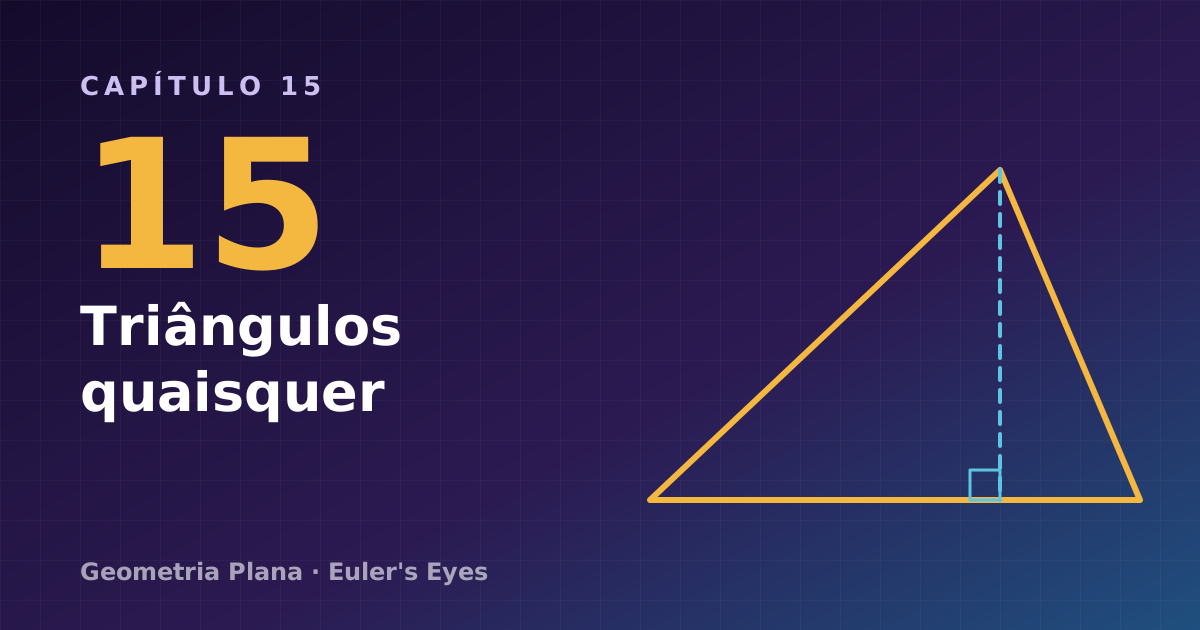
Exercises from chapter 15 — Any triangles

Law of sines 624 Knowing that $\operatorname{sen}(180^{\circ} - x) = \operatorname{sen}x$ and $\cos(180^{\circ} - x) = -\cos x$, determine: a) $\operatorname{sen}120^{\circ}$; b) $\cos 150^{\circ}$; c) $\cos 135^{\circ}$; d) $\operatorname{sen}150^{\circ}$; e) $\operatorname{sen}135^{\circ}$; f) $\cos 120^{\circ}$. Ver respostaa) $\dfrac{\sqrt{3}}{2}$ · b) $-\dfrac{\sqrt{3}}{2}$ · c) $-\dfrac{\sqrt{2}}{2}$ · d) $\dfrac{1}{2}$ · e) $\dfrac{\sqrt{2}}{2}$ · f) $-\dfrac{1}{2}$ 625 Determine the value of $x$ in the following cases: Ver respostaa) $6\sqrt{2}$ · b) $6\sqrt{6}$

October 9, 2026 Read
Hero Image
Calculation of notable lines

Medians, heights and angle bisectors can only be calculated from the three sides. All formulas come out of metric relations — and a single relation, Stewart’s, solves them all at once. Who discovered The median formula is known as Apollonius’ theorem: Papo of Alexandria attributes it to Apollonius of Perga (3rd century BC). The height formula uses the area of ​​the triangle as a function of the sides, the Heron’s formula, demonstrated by Heron of Alexandria in the 1st century, in the Metric (the Arabs attributed it to Archimedes). The relation that holds for any segment connecting a vertex to the opposite side was published by the Scotsman Matthew Stewart in 1746, in the book Some General Theorems of Considerable Use in the Higher Parts of Mathematics.

October 9, 2026 Read
Hero Image
Metric relations and cosine theorem

The Pythagorean theorem has a correction term when the angle is not right. This term is the law of cosines. Who discovered The metric relations of this topic are in The Elements of Euclid (c. 300 BC), in area language: the proposition II.12 deals with the side opposite to an obtuse angle and II.13, opposite an acute angle. The cosine form, $a^2 = b^2 + c^2 - 2bc\cos A$, appeared much later, along with the trigonometric tables. The Persian astronomer Jamshid al-Kashi presented it in 1427, in The Key to Arithmetic; in France, the law of cosines is still called théorème d’Al-Kashi. François Viète wrote it with cosines in 1593.

October 9, 2026 Read
Hero Image
Sines theorem

In any triangle, each side divided by the sine of the opposite angle always gives the same number: the diameter of the circumscribed circle. Who discovered The law of sines was born in astronomy, for triangles drawn on the celestial sphere. The spherical version was obtained in the 10th century by astronomers from the Islamic world — including Abu al-Wafa and Abu Nasr Mansur. The form for flat triangles appears systematically in the Treatise on the quadrilateral (1260) by the Persian Nasir al-Din al-Tusi, who made trigonometry a discipline independent of astronomy. In Europe, it spread with the book On triangles of all kinds, by Regiomontanus, written in 1464 and printed in 1533.

October 9, 2026 Read
Hero Image
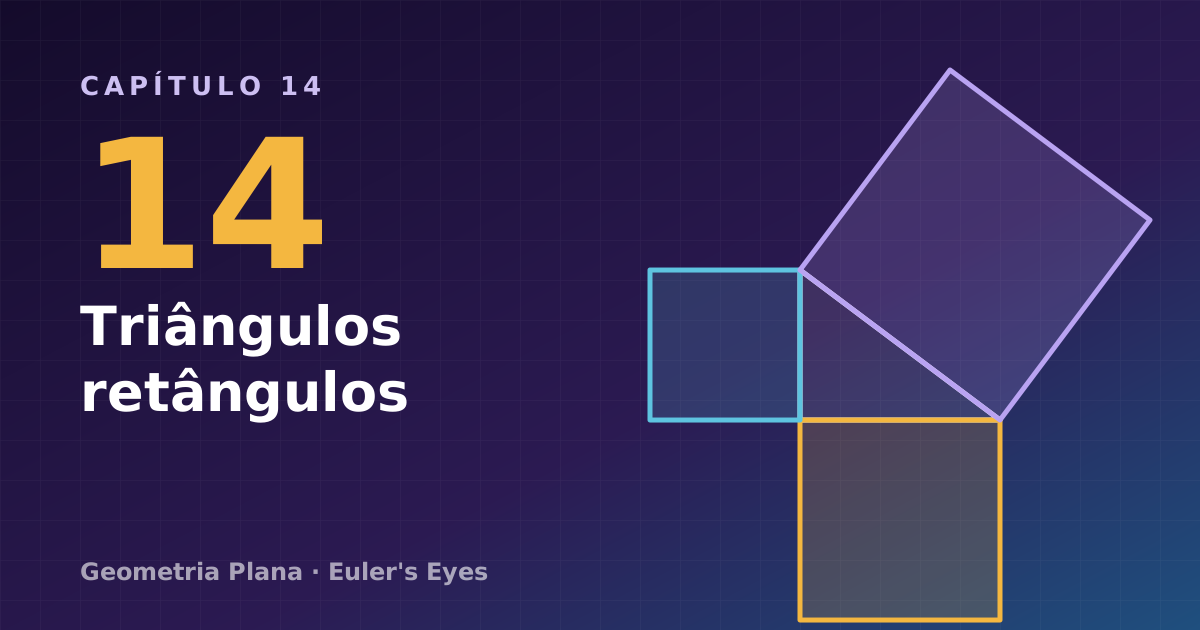
Chapter exercises 14 — Right triangles

Metric relationships 506 Determine the value of $x$ in the following cases: Ver respostaa) 5 · b) 12 · c) $\sqrt{7}$ · d) $3\sqrt{3}$ 507 Determine $x$ as a function of $a$ in the following cases: Ver respostaa) $a\sqrt{3}$ · b) $\dfrac{a}{2}$ 508 Determine $x$ in cases: Ver respostaa) 12 · b) 24 · c) 20 · d) 8

October 9, 2026 Read
Hero Image
Applications of the Pythagorean theorem

The diagonal of the square, the height of equilateral triangle and the trigonometric ratios of 30°, 45° and 60° all come from the same theorem. Who discovered The diagonal of the square has already been calculated by Babylonians: tablet YBC 7289 (c. 1800–1600 B.C.) gives $\sqrt{2}$ with six correct decimal places. The ratios between the sides of a right triangle began as astronomical tables: Hipparchus of Nicaea (2nd century BC) set up a string table, the Indian Aryabhata (499) started to use the half-rope — our sine — and Islamic astronomers like Abu al-Wafa (10th century) organized shadow tables, our tangents. The formula that generates all Pythagorean triangles, with sides $x^2 - y^2$, $2xy$ and $x^2 + y^2$, appears in a motto from book Elements of Euclid.

October 9, 2026 Read
Hero Image
Metric relationships

The square of the hypotenuse is the sum of the squares of the legs. But this is just one of several relationships that height reveals within the right triangle. Who discovered The relationship between the sides of the right triangle is much older than Pythagoras of Samos (6th century BC). Tablets from Babylon from around 1800 BC use terms like 3, 4, 5 and calculate the diagonal of the square; the Sulba Sutras of India (c. 800–500 B.C.) enunciate the rule for building altars; and the Chinese text Zhoubi Suanjing provides visual proof. Greek tradition associated the theorem with Pythagoras, but there is no documentary proof that he demonstrated it. The oldest demonstration that has come down to us is in the The Elements of Euclid (c. 300 BC): the proposition I.47 proves the theorem by areas, and the I.48 proves the reciprocal. The relations with height — each leg and height as proportional averages — are in the proposition VI.8 and its corollary.

October 9, 2026 Read
Hero Image
FUVEST 2026 – 1st phase: Mathematics solved

Source: FUVEST – test V1 and template of the General Knowledge Test (1st phase), applied in 23/11/2025. Files in FUVEST collection 2026. The 1st phase of FUVEST 2026 had 90 multiple choice questions from all disciplines. This post brings mathematics questions. The numbering used here is that of Proof V1; in versions V2, V3 and V4 the same issues appear in another order (the official template includes the correspondence table). Template Question Subject Template 3 Logical reasoning: election with tiebreaker Canceled 4 Logarithms: Shannon entropy A 6 Spatial geometry: regular pyramid E 7 Trigonometry: double arc equation D 18 Exponential function and logarithms E 30 Spatial geometry: cylinder volume B 36 Trigonometry in the right triangle E 37 Analytical geometry: circle equation A 55 Perfect numbers, primes and progressions B 74 Function graph transformations D Question 3: How many votes guarantee the election? Question canceled by FUVEST. In the official answer sheet, question 3 from Test V1 appears with an asterisk (nullified). FUVEST did not disclose the reason for the cancellation.

September 28, 2026 Read
Hero Image
FUVEST 2025 – 2nd phase: Mathematics solved

Source: FUVEST – 2nd phase test, 2nd day (questions M01 to M06), available in the FUVEST collection 2025. The 2nd phase of FUVEST 2025 had, on the 2nd day, specific discursive questions for career; The Mathematics test has six questions, M01 to M06. Each candidate solved only the subjects of your career (the six questions, or just the four or first three). The 2nd phase does not have a multiple choice answer sheet: FUVEST published a Answer Guide with the answers expected by the panel. The resolutions below are ours, and each The result was checked with this guide and through a second path.

September 27, 2026 Read
Hero Image
ENEM 2025 – Solved mathematics: questions 151 to 165

Source: INEP – proof and template of the 2nd day, Notebook 5 – Yellow. The ENEM Mathematics and Technologies test 2025 was administered on the 2nd day and will from question 136 to 180. This post addresses questions 151 to 165. The numbering used here is that of the Notebook 5 – Yellow; us In other notebooks the same questions appear in a different order. Template Question Subject Template 151 Polyhedra: number of vertices B 152 Proportionality: production D 153 Numeric code (rules reading) D 154 Probability: permutations D 155 Reading charts: bars and sectors B 156 Trigonometry: law of cosines and directions A 157 Statistics: mean and standard deviation D 158 Average (running pace) E 159 Tangent function: period and displacement E 160 Mesh localization (orientation) A 161 Percentage and inequality of the 1st degree B 162 Combinatorial analysis: multiplicative principle B 163 Scale E 164 Reason C 165 Percentage: cost and profit C Question 151: Vertices of the gyroelongated pentagonal dome Statement The gyroelongated pentagonal dome is a Johnson polyhedron, whose faces are regular polygons, but it is not a polyhedron of Plato, Archimedes, prism or antiprism.

September 27, 2026 Read
  • ««
  • «
  • 5
  • 6
  • 7
  • 8
  • 9
  • »
  • »»
Navigation
  • Start here
  • Recent posts
  • About Euler
  • App
  • Privacy
  • About us
  • Contact
Contact me:
  • hirowat2@gmail.com

Euler's Eyes
© 2021 Euler Eyes.
Powered by Hugo Logo