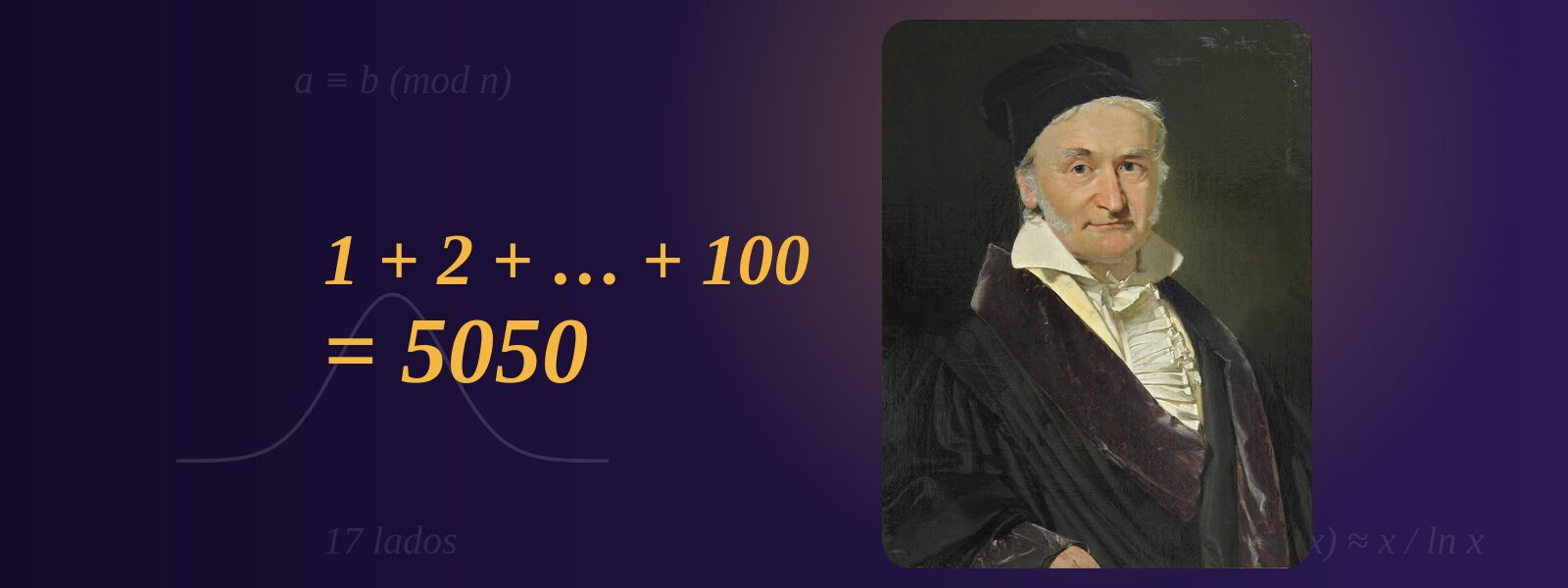
Other contributions Physics: Gauss’s law of electromagnetism, the study of Earth’s magnetism and the Gauss unit. Complex numbers: Gaussian integers, numbers $a + bi$ with $a$ and $b$ integers. Astronomy and geodesy: orbits of planets and comets, the heliotrope and the Hannover measurement. Algorithms: a method for calculating the date of Easter and, in a manuscript by 1805, a version of the fast Fourier transform, rediscovered in 1965 and used today in every cell phone. To remember Gauss was born poor in Braunschweig, studied under a duke and spent his life in Göttingen. Added from 1 to 100 by joining pairs: $1 + 2 + \cdots + n = \frac{n(n+1)}{2}$. At 18 years he showed how to construct a polygon with 17 sides, using only square roots. He created the congruence notation, $a \equiv b \pmod n$, the mathematics of the clock and nines-out. He proved that every polynomial of degree $n$ has $n$ complex roots. Estimated the number of primes: $\pi(x) \approx x / \ln x$. He rediscovered Ceres with the least squares method, which shows why the average is the best estimate. He gave the name to the normal curve, the Gaussian bell. He showed that curvature can be measured from within the surface: this is why there is no perfect flat map. He named the determinant and organized the elimination that solves systems of equations. With two well-chosen points, $\pm 1/\sqrt{3}$, he calculated exact integrals for polynomials up to degree 3. All topics by Carl Friedrich Gauss · ← Gaussian quadrature: integrate with two points · Image credits →
Images from Wikimedia Commons, all in the public domain: Gauss at 1840: Christian Albrecht Jensen. Gauss at 1803: Johann Christian August Schwartz. Gauss's birthplace, photo by 1914. Gauss's diary: Göttinger Digitalisierungszentrum. Disquisitiones Arithmeticae, 1801. Giuseppe Piazzi: F. Bordiga. Sophie Germain: Berthe Chégaray. Gaussian heliotrope. Triangle network: Reinhold Gerstetter for the Deutsche Bundesbank. Theoria motus corporum coelestium, 1809. Wilhelm Weber: Rudolph Hoffmann. The images of the 10 mark note, the squaring of the circle, and the determinant and matrix notations are from Euler’s Eyes collection. The interactive figures were made for this website.
All mathematical writing has a reader. Sometimes the reader is another person; sometimes it is the author, days or years later. The two call for very different kinds of writing, and two famous notebooks show what happens when a text written for oneself falls into other people’s hands. Gauss’s diary On 30 March 1796, an 18-year-old student in Göttingen opened a small notebook and noted, in Latin, that he had discovered how to divide the circle into 17 equal parts with straightedge and compass, a problem open since the Greeks. It was Carl Friedrich Gauss, and it was this result that made him choose mathematics over philology. Over the next eighteen years he wrote 146 short entries in the notebook, almost always a single sentence, sometimes a formula.