
Euler's Eyes
2026-10-25
Writing to think: the notebooks of Gauss and Ramanujan
All mathematical writing has a reader. Sometimes the reader is another person; sometimes it is the author, days or years later. The two call for very different kinds of writing, and two famous notebooks show what happens when a text written for oneself falls into other people’s hands.
Gauss’s diary
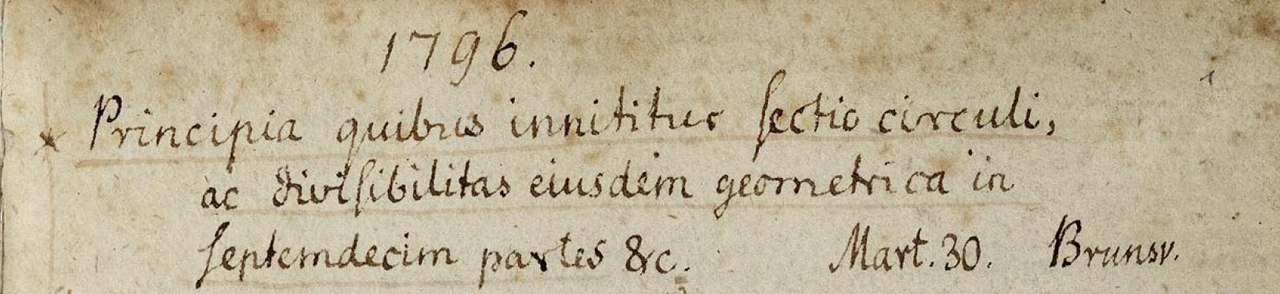
On 30 March 1796, an 18-year-old student in Göttingen opened a small notebook and noted, in Latin, that he had discovered how to divide the circle into 17 equal parts with straightedge and compass, a problem open since the Greeks. It was Carl Friedrich Gauss, and it was this result that made him choose mathematics over philology. Over the next eighteen years he wrote 146 short entries in the notebook, almost always a single sentence, sometimes a formula.
The entry of 10 July 1796 is the most famous:

Five signs and one Greek word. For Gauss they were enough: he knew that $\Delta$ meant a triangular number ($0, 1, 3, 6, 10, 15, \ldots$, the numbers of the form $\frac{n(n+1)}{2}$), that “num” meant any positive whole number, and that the “eureka” celebrated the proof of a claim Fermat had made in 1638 without proof. The full proof came out five years later, in the Disquisitiones arithmeticae.
Other entries were not so lucky. The one of 21 October 1796 says only Vicimus GEGAN, “we have conquered GEGAN”, and to this day nobody knows what GEGAN means. The diary stayed with the family and was only found in 1897; Felix Klein published it in 1903, and historians still debate some of its lines. A notation that is excellent for the writer can be mute for the reader.
Ramanujan’s notebooks
The Indian Srinivasa Ramanujan learned mathematics almost on his own, from a book of formulas without proofs, and he wrote in the same way. Between 1903 and 1914 he filled three notebooks with about 3,900 results, almost all without proof: identities, continued fractions, series for $\pi$. Many were right and new; some were wrong; several were so surprising that G. H. Hardy, on seeing the first ones, said they had to be true, because no one would have had the imagination to invent them.
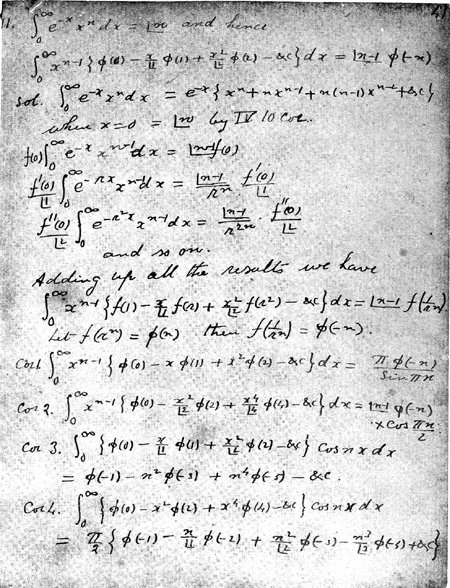
Turning these notebooks into readable mathematics took almost a century. Between 1985 and 1998 the American Bruce Berndt published five volumes devoted solely to proving or correcting the results in the notebooks. And in 1976 George Andrews found, in the library of Trinity College, Cambridge, a bundle of sheets from the last year of Ramanujan’s life, the “lost notebook”, which also took decades to decipher.
Writing for others
Gauss’s diary and Ramanujan’s notebooks are writing for thinking: fast, compressed, full of signs whose meaning only the author knew. Such writing is precious, and every student should have their own. But it is not writing for communicating.
The basic problem in writing mathematics is the same as in writing biology, writing a novel, or writing directions for assembling a harpsichord: the problem is to communicate an idea.
— Paul Halmos, “How to write mathematics” (1970)
The Hungarian-American Paul Halmos and, in 1989, the American Donald Knuth, creator of TeX, gathered advice that applies to any written solution of an exercise:
- Write complete sentences. Signs and words form a single sentence, with punctuation.
- Do not start a sentence with a symbol. Instead of “$x$ is positive”, “The number $x$ is positive”.
- Separate two formulas with words. “If $x > 2$, then $x^2 > 4$”, not “$x > 2$, $x^2 > 4$”.
- Use words instead of $\Rightarrow$, $\forall$, $\exists$ in running text. Signs serve formulas; text has verbs.
- Say what you are going to do before doing it. “We shall show that $n^2$ is odd” guides the reader through the rest of the paragraph.
Exercise: a eureka for 20
Write $20$ as a sum of three triangular numbers. Is there more than one way?
The triangular numbers up to $20$ are $0, 1, 3, 6, 10, 15$. With $15$, $5$ would be missing, and $5$ is not a sum of two triangular numbers ($0+3$, $1+3$ and $3+3$ do not give $5$). With two $10$s, the $0$ is enough: $10 + 10 + 0 = 20$. With a single $10$, we would need $10$ from two smaller triangular numbers, and $6+3 = 9$ and $6+6 = 12$ do not work. Without $10$ or $15$, the most we can get is $6+6+6 = 18$. The only way is $10 + 10 + 0$, as the figure confirms.
Exercise: translating the diary
Rewrite “ΕΥΡΗΚΑ num = Δ + Δ + Δ” as a complete sentence, in the style of Halmos and Knuth.
“Every positive whole number $n$ can be written as $n = \frac{a(a+1)}{2} + \frac{b(b+1)}{2} + \frac{c(c+1)}{2}$, with $a$, $b$ and $c$ whole numbers greater than or equal to zero; that is, every positive whole number is the sum of three triangular numbers.” The sentence is twenty times longer, and that is what a reader needs in order not to depend on Gauss’s head.
Chapter index · ← Errors that make sense: false rules · Reading with the hands and the ears: Braille and the Nemeth code →