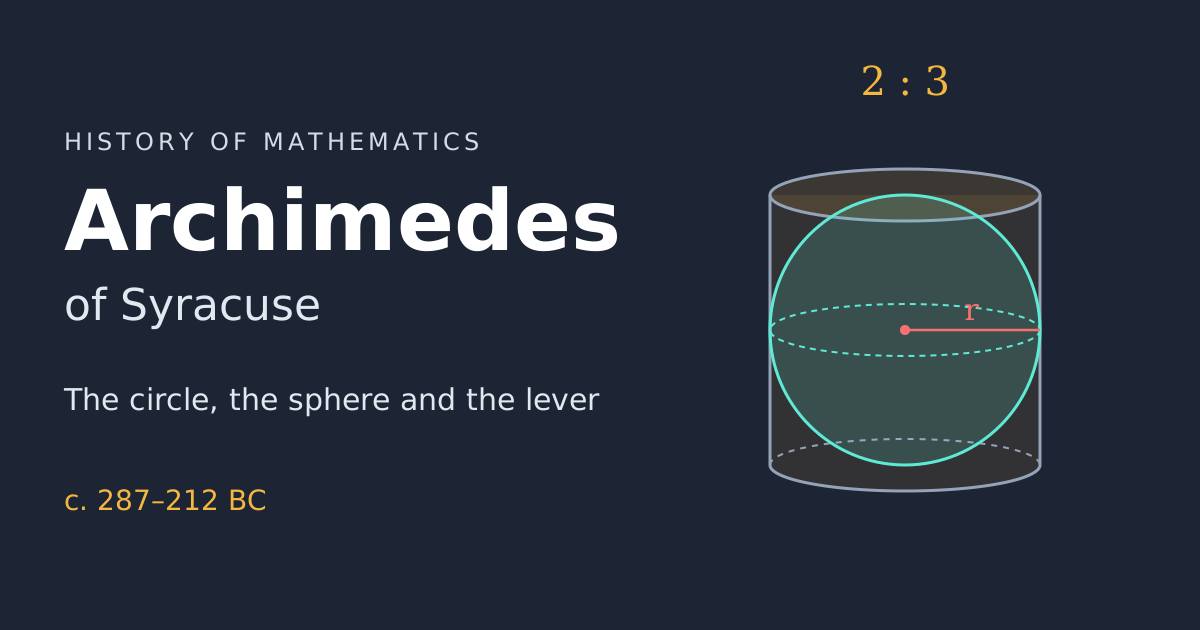
Greek geometers knew how to compute the volume of prisms, pyramids, cylinders and cones. The sphere resisted. In the two-book treatise On the Sphere and Cylinder, Archimedes solved the problem and found relations of surprising simplicity. The theorems Call a great circle the circle that passes through the centre of the sphere, like the equator. Archimedes proved that: the surface of the sphere is four times the area of the great circle: $S = 4\pi r^2$; the volume of the sphere is four times that of a cone whose base is the great circle and whose height is the radius: $V = 4 \cdot \frac{1}{3}\pi r^2 \cdot r = \frac{4}{3}\pi r^3$. And from this he drew the consequence that delighted him most. Consider the cylinder that exactly encloses the sphere, with radius $r$ and height $2r$. Its volume is $\pi r^2 \cdot 2r = 2\pi r^3$, and its total surface, counting both lids, is $2\pi r \cdot 2r + 2\pi r^2 = 6\pi r^2$. So