
Euler's Eyes
2026-10-29
The sphere and the cylinder
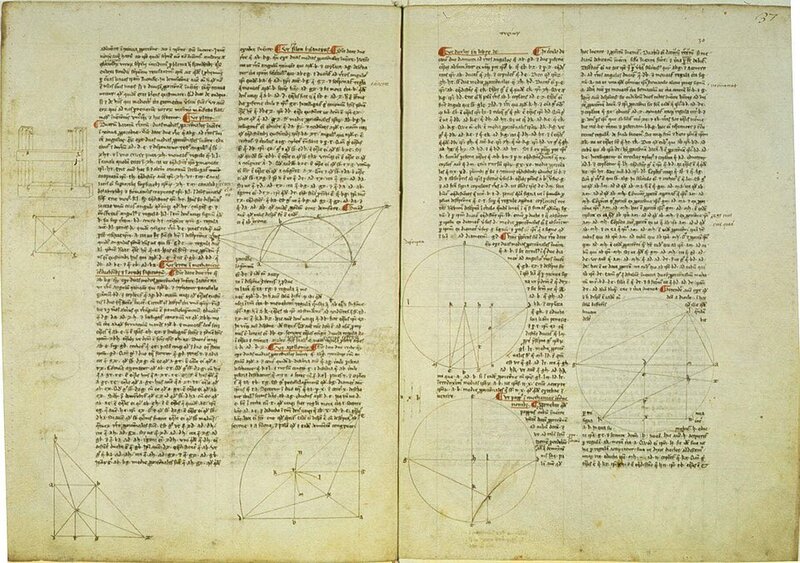
Greek geometers knew how to compute the volume of prisms, pyramids, cylinders and cones. The sphere resisted. In the two-book treatise On the Sphere and Cylinder, Archimedes solved the problem and found relations of surprising simplicity.
The theorems
Call a great circle the circle that passes through the centre of the sphere, like the equator. Archimedes proved that:
- the surface of the sphere is four times the area of the great circle: $S = 4\pi r^2$;
- the volume of the sphere is four times that of a cone whose base is the great circle and whose height is the radius: $V = 4 \cdot \frac{1}{3}\pi r^2 \cdot r = \frac{4}{3}\pi r^3$.
And from this he drew the consequence that delighted him most. Consider the cylinder that exactly encloses the sphere, with radius $r$ and height $2r$. Its volume is $\pi r^2 \cdot 2r = 2\pi r^3$, and its total surface, counting both lids, is $2\pi r \cdot 2r + 2\pi r^2 = 6\pi r^2$. So
$$\frac{V_{\text{sphere}}}{V_{\text{cylinder}}} = \frac{\frac{4}{3}\pi r^3}{2\pi r^3} = \frac{2}{3}, \qquad \frac{S_{\text{sphere}}}{S_{\text{cylinder}}} = \frac{4\pi r^2}{6\pi r^2} = \frac{2}{3}.$$Both the volume and the surface of the sphere are two thirds of those of the cylinder.
The surface as a can label
There is a way of seeing the surface result that Archimedes himself knew. Cut the sphere and the cylinder with two very close horizontal planes. The band of sphere between them has the same area as the band of cylinder: where the sphere is narrower, the band is more slanted and therefore wider, and the two effects cancel exactly. Adding up all the bands, the surface of the sphere equals the lateral surface of the cylinder, $2\pi r \cdot 2r = 4\pi r^2$.
This fact has a practical consequence: the projection that carries each point of the sphere horizontally to the cylinder preserves areas. It is the basis of Lambert’s cylindrical equal-area projection, used in maps that respect the size of countries.
Exercise: the ball in the cylindrical box
A ball of radius 3 cm is inside a cylindrical can that exactly encloses it. What volume of air is in the can?
Cylinder: $\pi \cdot 3^2 \cdot 6 = 54\pi$ cm³. Sphere: $\frac{4}{3}\pi \cdot 27 = 36\pi$ cm³, which is $\frac{2}{3}$ of $54\pi$. The air takes up $54\pi - 36\pi = 18\pi \approx 56.5$ cm³: exactly one third of the can.
Exercise: the area of the Earth
Taking the Earth as a sphere of radius 6371 km, compute the area of its surface. What fraction of it lies between the equator and the 30° north parallel?
$S = 4\pi \cdot 6371^2 \approx 5.10 \times 10^8$ km². By the label argument, the area of a band of the sphere depends only on its height: it is $2\pi r h$. The 30° parallel lies at height $h = r \sin 30° = \frac{r}{2}$ above the equator. The band has area $2\pi r \cdot \frac{r}{2} = \pi r^2$, that is, $\frac{1}{4}$ of the total surface. A quarter of the Earth lies between the equator and the 30° north parallel.
Sources: Archimedes, On the Sphere and Cylinder, book I, propositions 33–34 and corollary · Plutarch, Life of Marcellus, 17 · Cicero, Tusculan Disputations, V, 64–66 · Thomas L. Heath, The Works of Archimedes (1897).
All topics on Archimedes · ← The quadrature of the parabola · The Method and the palimpsest →