
Euler's Eyes
2026-10-29
The legacy of Archimedes
Whoever understands Archimedes and Apollonius will admire less the discoveries of the greatest men of today.
— Gottfried Wilhelm Leibniz
The manuscripts
What remains of Archimedes reached us by a thread. Almost all of his work depended on three Byzantine Greek manuscripts. Two of them, which scholars call codices A and B, were lost after being copied or translated in the Renaissance; the third is the palimpsest, which stayed hidden under a prayer book. In 1269 the Dominican William of Moerbeke translated the Greek texts into Latin, and through this translation Archimedes came to be read in European universities. The first printed edition of the Greek text came out in Basel in 1544.
The heirs
The scientists of the Renaissance and the scientific revolution read him as a master. Galileo began his career with The Little Balance, an essay on Hiero’s crown, and studied the centres of gravity of solids following in his footsteps. Kepler used ideas of infinitesimal slices to compute the volume of wine barrels. Cavalieri, Fermat, Pascal and Wallis, as they developed the methods that would lead to the calculus, started from the areas and volumes of Archimedes. When the Method was rediscovered in 1906, it became clear how close he had come: the slices weighed on the lever were, in essence, integrals.
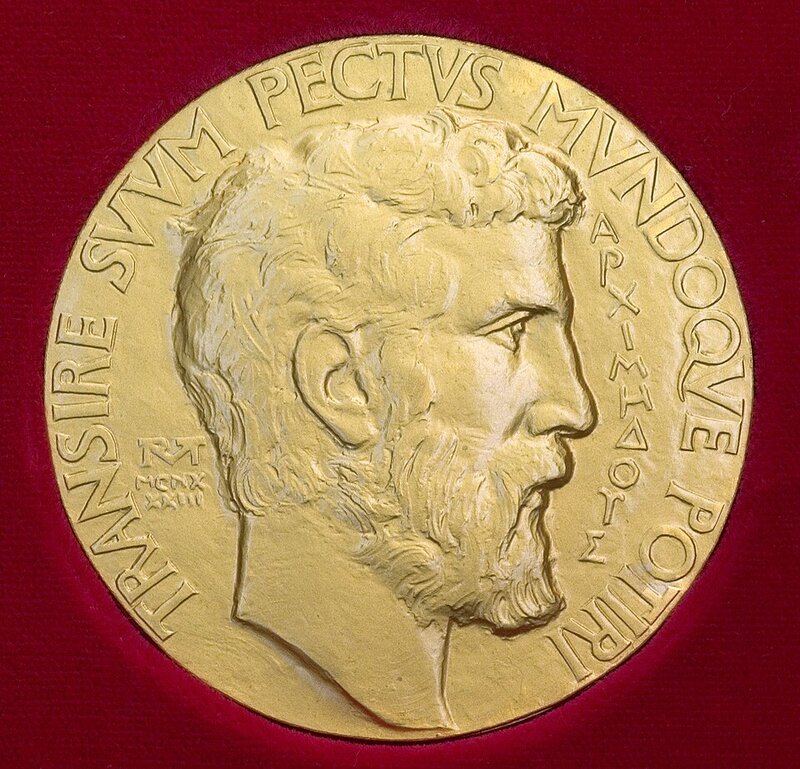
The face on the medal
The Fields Medal, awarded every four years to mathematicians aged up to 40, bears the profile of Archimedes, created by the Canadian sculptor Robert Tait McKenzie in 1933. On the reverse, a sphere inscribed in a cylinder, as on the tomb at Syracuse, and the Latin inscription: “the mathematicians gathered from the whole world gave this prize for outstanding writings”.
The names
The crater Archimedes, on the Moon, is 82 km in diameter and lies at the edge of the Sea of Rains. The asteroid 3600 Archimedes bears his name, as do the screw, the principle, the spiral and the constant, sometimes called Archimedes’s constant, which is $\pi$ itself. The word eureka has entered almost every language as the cry of discovery, and it is the motto of the American state of California.
Exercise: the crater
The crater Archimedes is 82 km in diameter. Assuming it is circular, what is its area? Use Archimedes’s bound $\pi < \frac{22}{7}$ to obtain an overestimate.
The area is $\pi r^2$ with $r = 41$ km. With $\pi \approx 3.1416$: $3.1416 \times 1681 \approx 5281$ km². With $\frac{22}{7}$: $\frac{22}{7} \times 1681 \approx 5283$ km², slightly larger, as it should be. The difference is only 2 km² in more than 5000.
Exercise: the time down to us
How many years separate the death of Archimedes (212 BC) from the first printed edition of his works in Greek (1544) and from the rediscovery of the Method (1906)?
Since there is no year zero, from 212 BC to AD 1 is 212 years. To 1544: $212 + 1544 - 1 = 1755$ years. To 1906: $212 + 1906 - 1 = 2117$ years. The Method stayed out of readers’ reach for more than two millennia.
Sources: Marshall Clagett, Archimedes in the Middle Ages, 5 vols. (1964–1984) · Reviel Netz and William Noel, The Archimedes Codex (2007) · Alfred North Whitehead, An Introduction to Mathematics (1911) · International Mathematical Union, “Fields Medal” · E. J. Dijksterhuis, Archimedes (1956).
All topics on Archimedes · ← The screw, the claw and the mirrors · Image credits →