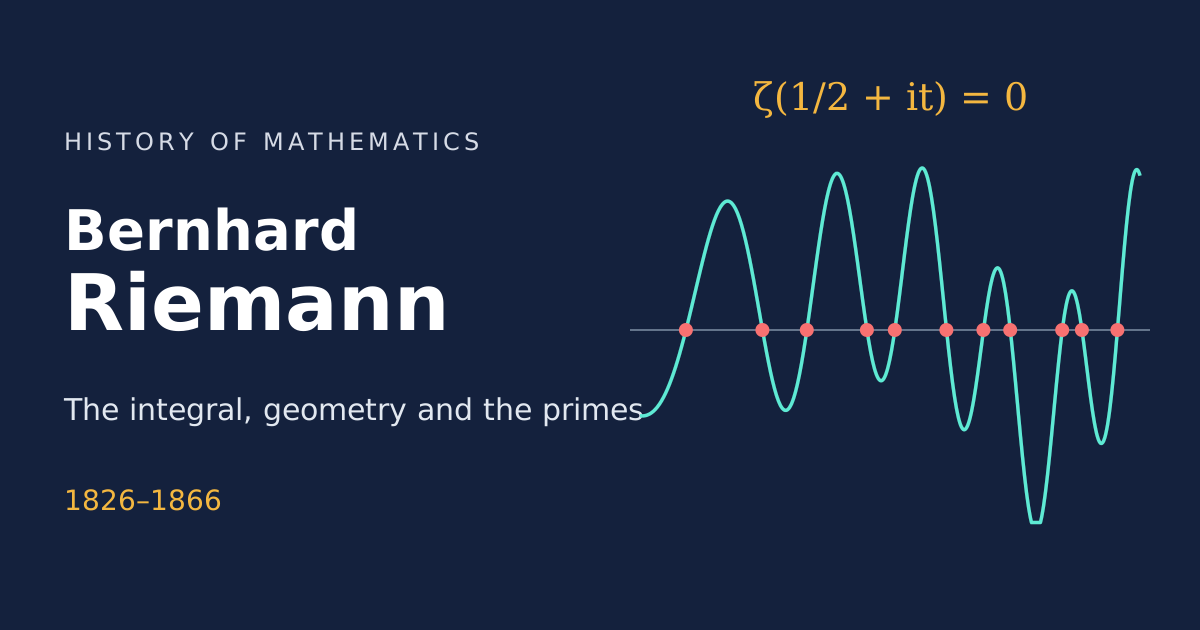
Riemann is the man of brilliant intuition. — Felix Klein, Lectures on the Development of Mathematics in the 19th Century (1926) Riemann’s collected works, edited by Dedekind and Weber in 1876, fit into a volume of a little over five hundred pages, including the posthumous works and the notes. Few mathematicians left so little text and so many consequences. What bears his name The Riemann integral and Riemann sums, the definition of the integral in calculus courses. Riemann surfaces and the Riemann sphere, the complex plane with a point at infinity, closed up like a sphere. The Cauchy–Riemann equations and the Riemann mapping theorem. Riemannian geometry, Riemannian manifolds, the metric and the Riemann curvature tensor, the language of general relativity. The Riemann–Roch theorem, which counts the functions that can be defined on a Riemann surface, completed by his student Gustav Roch in 1865. The Riemann zeta function and the Riemann hypothesis. The Riemann rearrangement theorem, on conditionally convergent series. A new style More than the results, Riemann changed the style of mathematics. Before him, a function was above all a formula, and mathematicians worked by manipulating formulas. Riemann thought in concepts: a complex function defined by its properties, not by its expression; a surface defined without being drawn anywhere; a space defined by its rule of measurement. Twentieth-century mathematicians, from Hilbert to Weyl, saw in him the founder of the “conceptual” mathematics that became dominant.
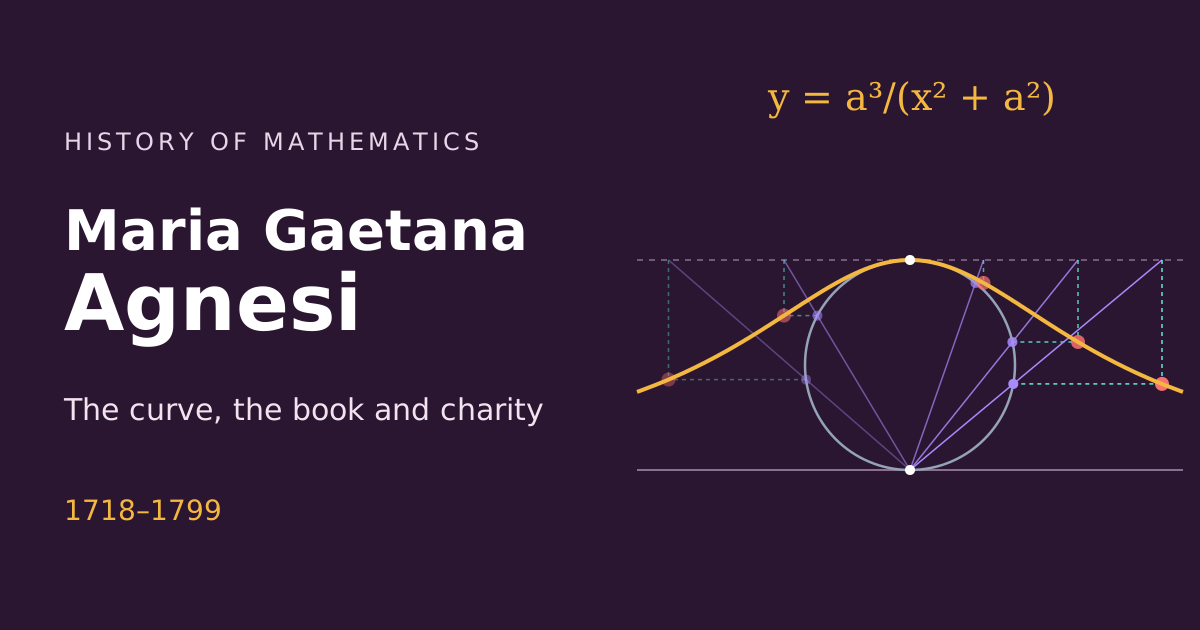
For a long time Agnesi was remembered in two ways that had little to do with what she did. For English-speaking mathematicians, she was the name of a curve with a witch’s nickname. For the Milanese, she was a saint of charity who, as a young woman, had written a difficult book. Both images hid the author of one of the most influential mathematics books of the eighteenth century. The book For decades the Instituzioni analitiche were the most complete calculus course available in Europe. In Italy they were used by generations of students. The French translation of the second volume, of 1775, and John Colson’s English translation, of 1801, carried the book to other readers. The order Agnesi chose, from algebra to curves, from derivatives to integrals and differential equations, is essentially that of calculus courses to this day.
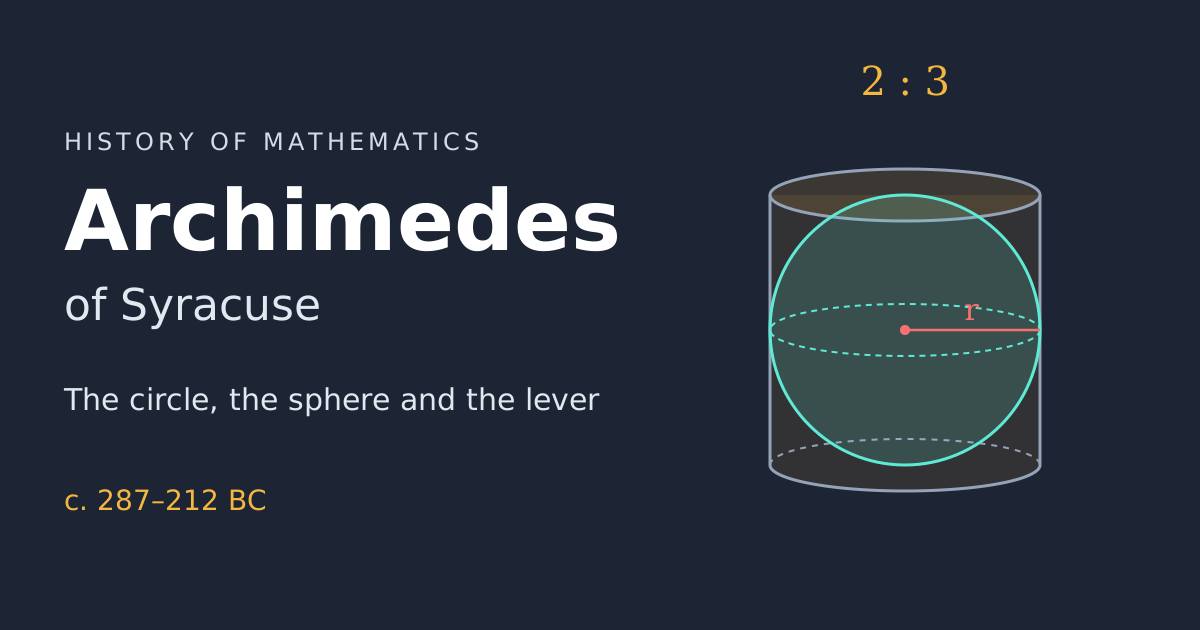
Whoever understands Archimedes and Apollonius will admire less the discoveries of the greatest men of today. — Gottfried Wilhelm Leibniz The manuscripts What remains of Archimedes reached us by a thread. Almost all of his work depended on three Byzantine Greek manuscripts. Two of them, which scholars call codices A and B, were lost after being copied or translated in the Renaissance; the third is the palimpsest, which stayed hidden under a prayer book. In 1269 the Dominican William of Moerbeke translated the Greek texts into Latin, and through this translation Archimedes came to be read in European universities. The first printed edition of the Greek text came out in Basel in 1544.
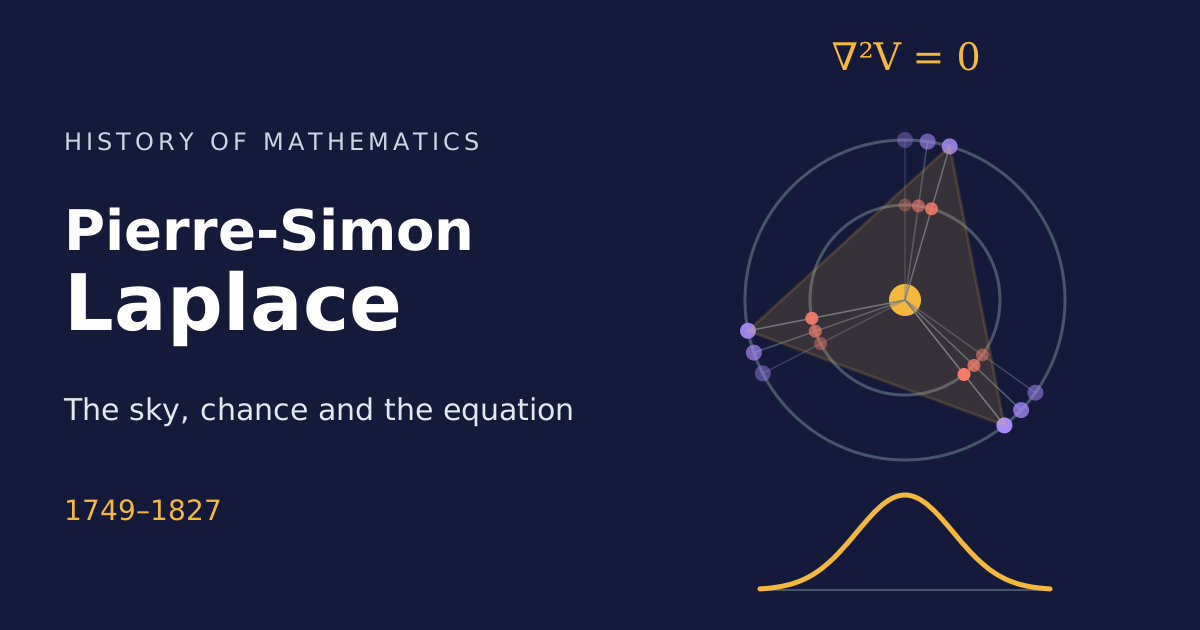
I never come across one of Laplace’s “Thus it plainly appears” without feeling sure that I have hours of hard work before me to fill up the chasm and find out and show how it plainly appears. — Nathaniel Bowditch, on Celestial Mechanics Few mathematicians have their name on so many objects. An engineering student meets Laplace three or four times before finishing the degree, almost always without knowing who he was.