Euler's Eyes
2026-10-29
The legacy of Maria Gaetana Agnesi
For a long time Agnesi was remembered in two ways that had little to do with what she did. For English-speaking mathematicians, she was the name of a curve with a witch’s nickname. For the Milanese, she was a saint of charity who, as a young woman, had written a difficult book. Both images hid the author of one of the most influential mathematics books of the eighteenth century.
The book
For decades the Instituzioni analitiche were the most complete calculus course available in Europe. In Italy they were used by generations of students. The French translation of the second volume, of 1775, and John Colson’s English translation, of 1801, carried the book to other readers. The order Agnesi chose, from algebra to curves, from derivatives to integrals and differential equations, is essentially that of calculus courses to this day.
The curve
The curve of Agnesi keeps turning up where it is least expected:
- in statistics, as the Cauchy distribution, the classic example of a distribution with no mean;
- in physics, as the Lorentzian curve, the shape of spectral lines and resonances;
- in numerical analysis, as Runge’s function, $\frac{1}{1 + 25x^2}$. In 1901 Carl Runge showed that, when this function is approximated by polynomials passing through equally spaced points, the error near the ends grows as more points are used. This is “Runge’s phenomenon”, which every course in numerical methods teaches as a warning;
- in geography and meteorology, as a simple model of the profile of a hill, used in studies of wind flowing over mountains.
The names
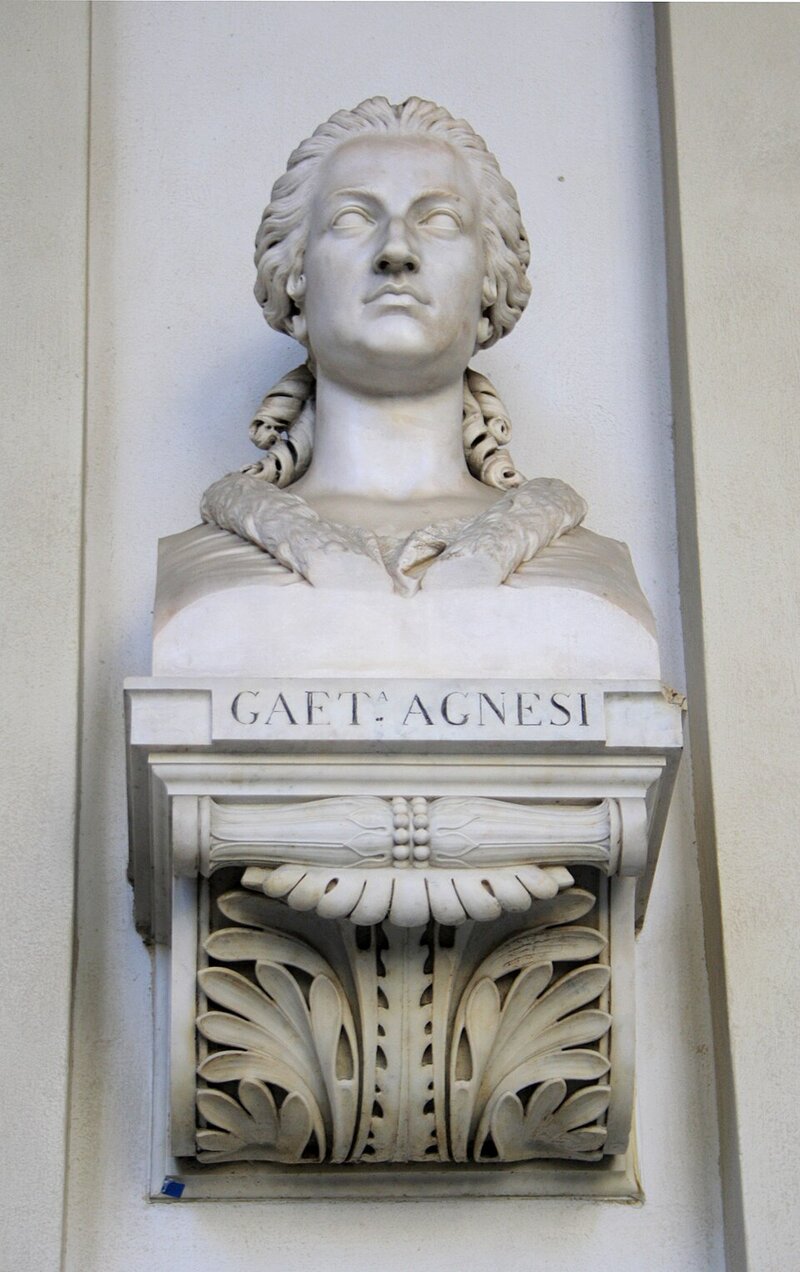
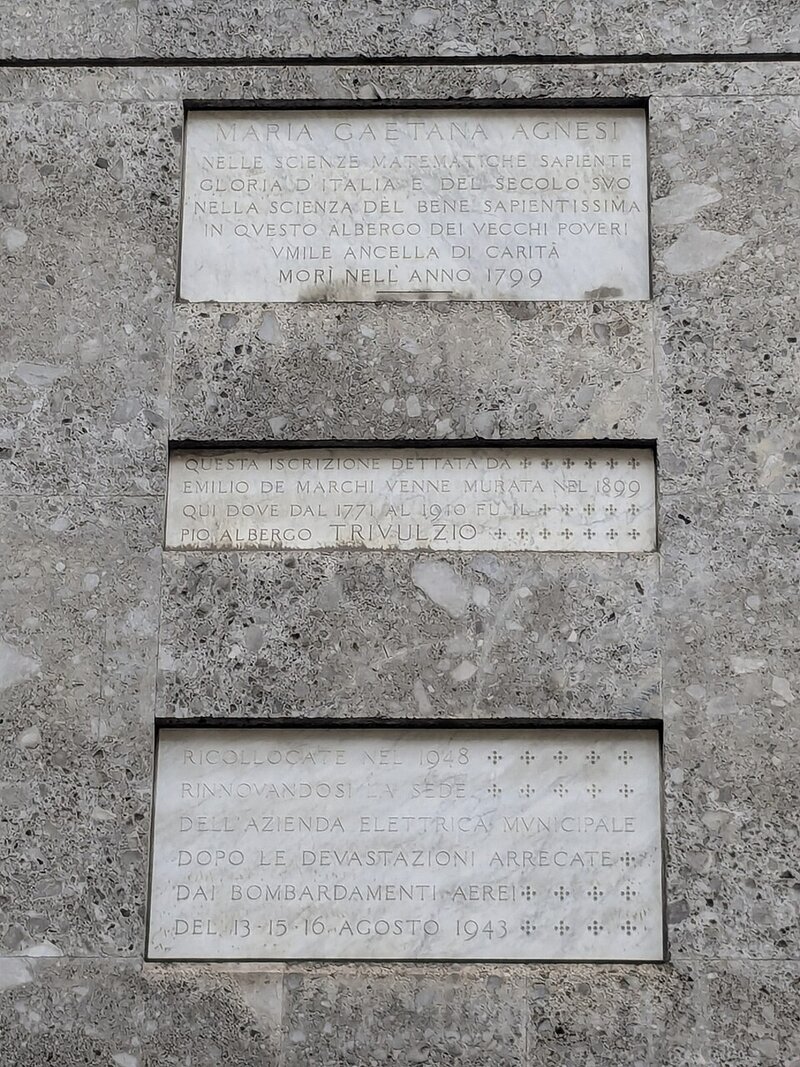
The asteroid 16765 Agnesi and a crater on Venus bear her name. In Milan there are streets and schools named after her, a bust in the courtyard of the Palazzo di Brera, a profile in the Famedio of the Monumental Cemetery and a plaque at the place where she died.
The mathematician of God
In recent decades, historians such as Massimo Mazzotti and Paula Findlen have reconstructed Agnesi’s world, the Catholic and enlightened Milan of the eighteenth century, and shown that mathematics and charity were not two separate lives. For Agnesi, studying geometry was a way of exercising the reason that led to God, and serving the poor was the consequence of that same faith. The subtitle of Mazzotti’s book sums up this reading: Agnesi, mathematician of God.
What remains, for anyone studying calculus today, is the example of someone who wrote, at thirty, the book she would have liked to have when she was learning, and wrote it so well that mathematicians all over Europe used it to teach.
Exercise: Runge's function
Runge’s function is $y = \frac{1}{1 + 25x^2}$. Show that it is a curve of Agnesi, find the diameter $a$ of the generating circle and compute the total area under it.
Write $\frac{1}{1 + 25x^2} = \frac{1/25}{x^2 + 1/25}$. The curve of Agnesi with diameter $a$ is $\frac{a^3}{x^2 + a^2}$; with $a^2 = \frac{1}{25}$, $a = \frac{1}{5}$, it becomes $\frac{1/125}{x^2 + 1/25}$, which is $\frac{1}{5}$ of Runge’s function. So Runge’s function is a versiera stretched vertically by a factor of 5. The area is $5 \cdot \pi a^2 = 5 \cdot \frac{\pi}{25} = \frac{\pi}{5}$. One also gets there with the substitution $u = 5x$: $\int \frac{dx}{1 + 25x^2} = \frac{1}{5}\int \frac{du}{1 + u^2} = \frac{\pi}{5}$.
Exercise: the width of a spectral line
A spectral line has the Lorentzian shape $I(x) = \frac{I_0}{1 + \left(\frac{x - x_0}{\gamma}\right)^2}$. At which values of $x$ does the intensity fall to half its maximum? What is the width of the line at half height?
The maximum is $I_0$, at $x = x_0$. Half of it, $\frac{I_0}{2}$, occurs when $\left(\frac{x - x_0}{\gamma}\right)^2 = 1$, that is, $x = x_0 \pm \gamma$. The width at half height is $2\gamma$. It is the same result we saw for the versiera, which is at half height at $x = \pm a$.
Sources: Massimo Mazzotti, The World of Maria Gaetana Agnesi, Mathematician of God (2007) · Paula Findlen, “Calculations of Faith: Mathematics, Philosophy, and Sanctity in Eighteenth-Century Italy (New Work on Maria Gaetana Agnesi)”, Historia Mathematica 38 (2011) · Carl Runge, “Über empirische Funktionen und die Interpolation zwischen äquidistanten Ordinaten”, Zeitschrift für Mathematik und Physik 46 (1901) · biography of Agnesi, MacTutor.
All topics on Maria Gaetana Agnesi · ← A woman at the university · Image credits →