
Euler's Eyes
2026-10-30
The legacy of Pierre-Simon Laplace
I never come across one of Laplace’s “Thus it plainly appears” without feeling sure that I have hours of hard work before me to fill up the chasm and find out and show how it plainly appears.
— Nathaniel Bowditch, on Celestial Mechanics
Few mathematicians have their name on so many objects. An engineering student meets Laplace three or four times before finishing the degree, almost always without knowing who he was.
What bears his name
- The Laplacian, $\nabla^2 = \frac{\partial^2}{\partial x^2} + \frac{\partial^2}{\partial y^2} + \frac{\partial^2}{\partial z^2}$, which appears in the equations of heat, waves, electricity and quantum mechanics, and in image filters that sharpen edges.
- The Laplace transform, a standard tool of circuits, control and signals.
- The Laplace distribution, with density $\frac{1}{2}e^{-|x|}$, which he proposed in 1774 as a law of errors. It has the shape of two exponentials glued at a peak; today it is used in robust statistics and in differential privacy, to add noise to data without revealing individual information.
- The Young–Laplace pressure, $\Delta P = \gamma\left(\frac{1}{R_1} + \frac{1}{R_2}\right)$, which gives the pressure difference across a curved surface with surface tension $\gamma$ and radii of curvature $R_1$ and $R_2$. Thomas Young reached the idea in 1805 and Laplace gave the mathematical form in 1806. It explains why small bubbles have greater internal pressure and why water rises in thin tubes.
- Laplace’s expansion of determinants, Laplace’s method for integrals and the Laplace–Runge–Lenz vector, which always points to the perihelion of an orbit.
The Arcueil school
Laplace wanted to explain all of physics as he had astronomy: with forces between particles, calculated precisely. At his country house in Arcueil, next to that of the chemist Claude Louis Berthollet, he gathered from 1806 a group of young scientists, the Society of Arcueil. Siméon-Denis Poisson, Jean-Baptiste Biot and François Arago worked there; Joseph Fourier had been his student. Laplace’s programme was ultimately defeated on several points, as with light, where Augustin Fresnel’s wave theory beat the corpuscular one, and with heat, where caloric was abandoned. But the demand for precise mathematics in all of physics remained.
The translators
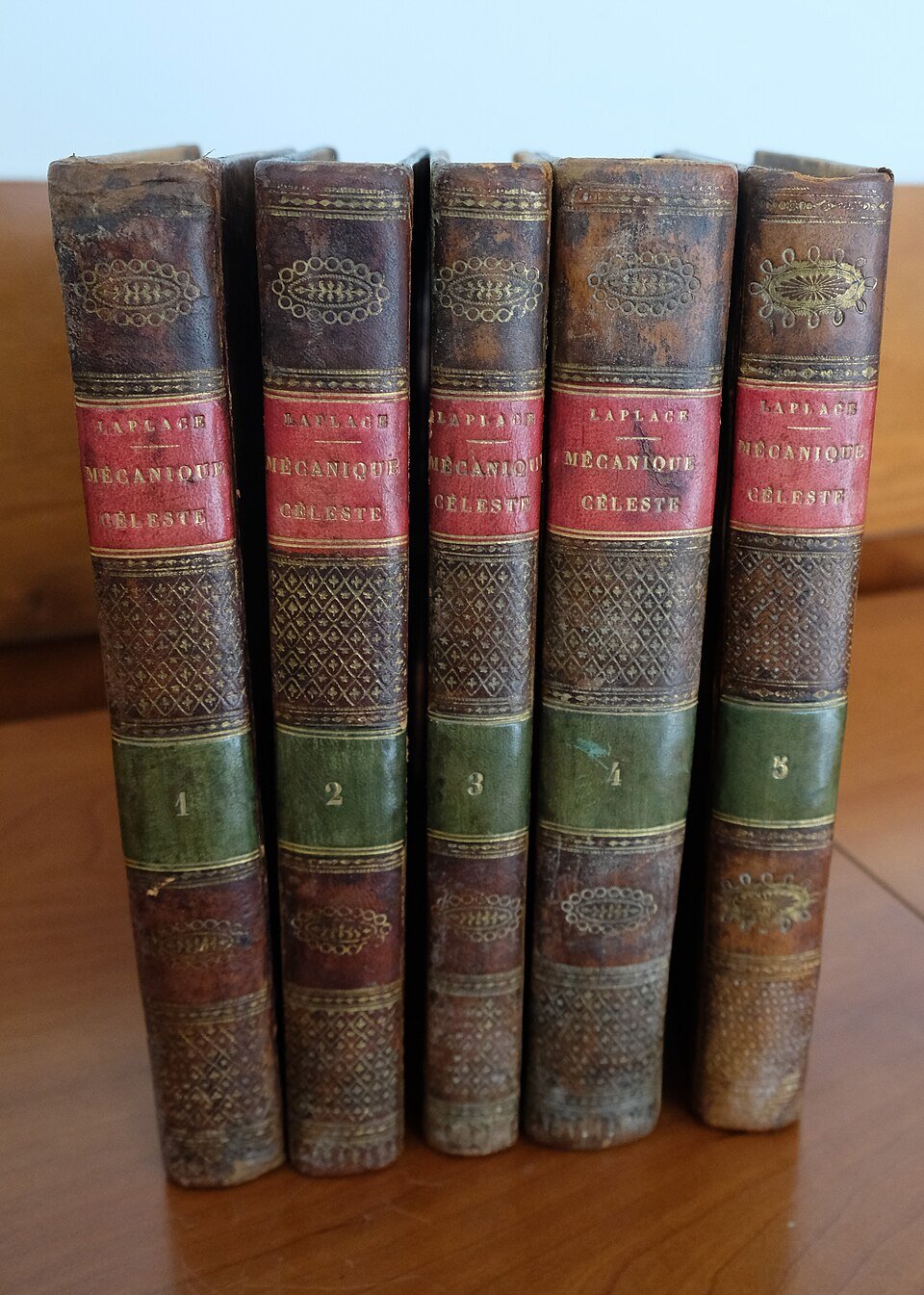
Celestial Mechanics was famous for being hard. Laplace skipped steps and wrote “it is easy to see” where there were pages of calculations. The American Nathaniel Bowditch, a self-taught navigator and actuary from Salem, Massachusetts, translated the first four volumes into English between 1829 and 1839, adding commentary that filled the gaps: the commentary takes up more space than the original text. In Britain, the Scottish Mary Somerville published in 1831 The Mechanism of the Heavens, an explained version of the work that was used at Cambridge for decades. Through these two books, generations of English-speaking readers learned celestial mechanics.
Places
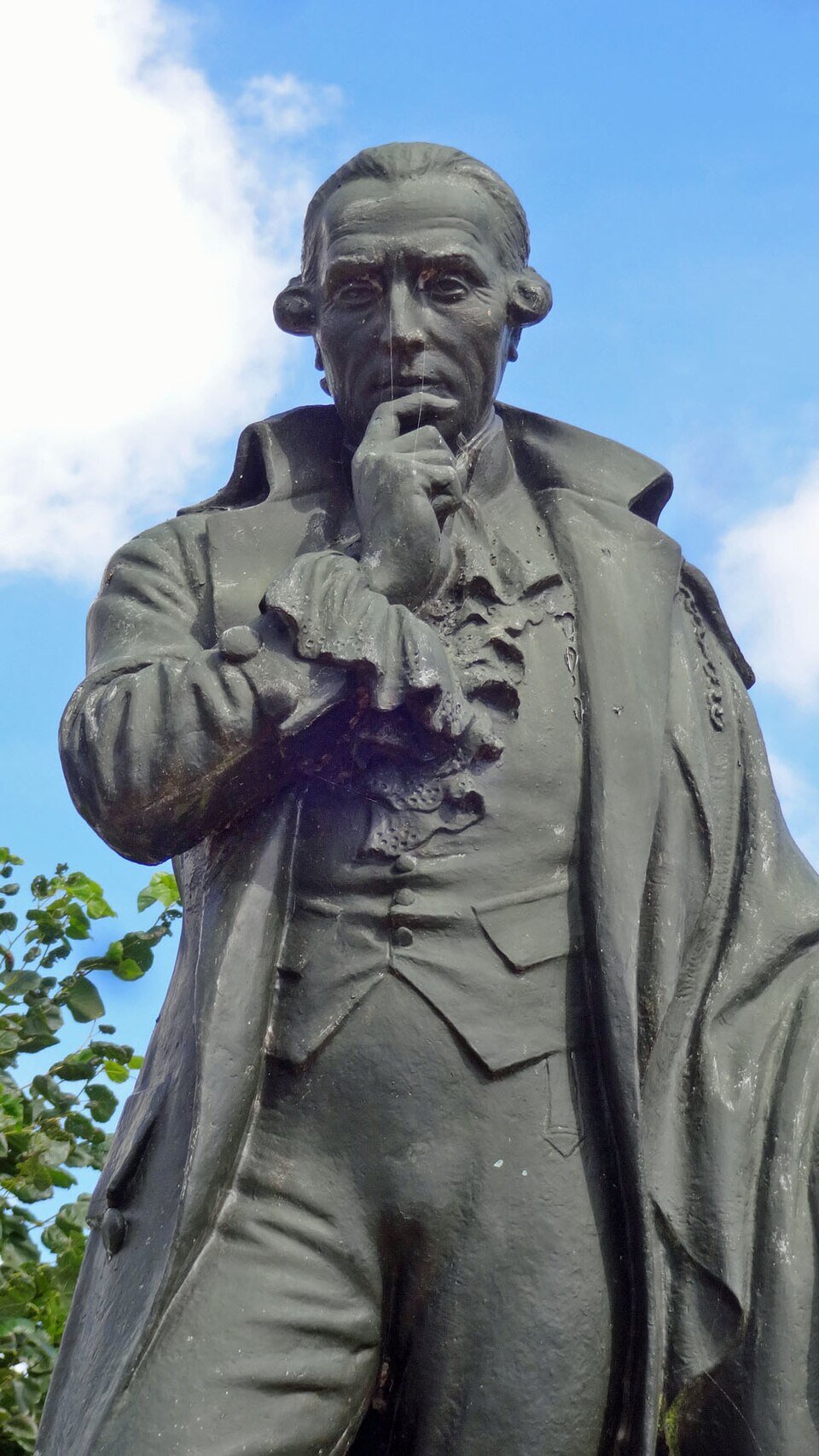
Laplace is one of the 72 French scientists and engineers whose names are engraved on the Eiffel Tower. On the Moon, Promontorium Laplace is a cape on the edge of the Sea of Rains, and the asteroid 4628 Laplace bears his name. In his home village, Beaumont-en-Auge, a statue remembers him.
The deepest legacy, however, may be an attitude. Laplace showed that the sky can be predicted and that uncertainty can be measured. The two halves of his work, celestial mechanics and probability, seem opposed, one of determinism and the other of chance. For him they were the same thing: mathematics applied to everything that can be known, and also to what is not known. Probability, he wrote, is “common sense reduced to calculation”.
Exercise: the area of the Laplace distribution
Show that $\int_{-\infty}^{\infty} \frac{1}{2}e^{-|x|}\,dx = 1$.
The function is symmetric, so the integral is twice the integral from 0 to $\infty$:
$$2 \cdot \frac{1}{2}\int_0^{\infty} e^{-x}\,dx = \Big[-e^{-x}\Big]_0^{\infty} = 0 - (-1) = 1.$$Exercise: the pressure in a soap bubble
A soap bubble has radius $R = 1$ cm and the film has surface tension $\gamma = 0.025$ N/m. What is the pressure difference between the inside and the outside?
On a sphere, $R_1 = R_2 = R$, and each surface contributes $\frac{2\gamma}{R}$. A soap film has two surfaces, the inner and the outer, so $\Delta P = \frac{4\gamma}{R} = \frac{4 \times 0.025}{0.01} = 10$ Pa. With $R = 2$ cm, the difference would fall to 5 Pa: the smaller the bubble, the greater the internal pressure. That is why, if two bubbles of different sizes are connected by a tube, the small one empties into the large one.
Sources: Nathaniel Bowditch (trans.), Mécanique céleste by the Marquis de La Place, 4 vols. (1829–1839), with the translator’s memoir by N. I. Bowditch · Mary Somerville, The Mechanism of the Heavens (1831) · Robert Fox, “The Rise and Fall of Laplacian Physics”, Historical Studies in the Physical Sciences 4 (1974) · Stephen M. Stigler, The History of Statistics (1986) · Charles C. Gillispie, Pierre-Simon Laplace (1997).
All topics on Pierre-Simon Laplace · ← Laplace’s demon · Image credits →