Logo Euler's Eyes
  • Materials
  • Dark Theme
    Light Theme Dark Theme System Theme
Logo Inverted Logo
  • Tags
  • 1 Phase
  • 1st Phase
  • 2 Phase
  • 2 Phase,
  • 2nd Phase
  • 2° Degree Equation
  • Accessibility
  • Addition Formulas
  • Alan Turing
  • Algebra
  • Algebraic Expressions
  • Algorithms
  • Ambiguous Case
  • Analysis
  • Analytic Geometry
  • Analytical Geometry
  • Ancient Greece
  • Angle Bisector
  • Angle Bisectors
  • Angles
  • Any Triangles
  • Apothem
  • Arc Capable
  • Arc Sine
  • Archimedes
  • Area
  • Areas
  • Arithmetic Progression
  • Artificial Intelligence
  • Astronomy
  • Augustin-Louis Cauchy
  • Axioms and Postulates
  • Basic Concepts of Statistics
  • Bayesian Statistics
  • Bernhard Riemann
  • Bernoulli
  • Bhaskara
  • Binary Numbers
  • Binomial
  • Biography
  • Biology
  • Black Holes
  • Bolzano
  • Bows
  • Braille
  • Brazil
  • Calculating Machine
  • Calculation
  • Calculus
  • Calculus of Variations
  • Cartesian Plane
  • Cartesian Product of Sets
  • Cauchy
  • Celestial Mechanics
  • Cellular Automata
  • Central Angle
  • Centroid
  • Chaos
  • Children
  • Circle
  • Circle Area
  • Circular Functions
  • Circumcenter
  • Circumference
  • Circumference Ratio
  • Circumferences
  • Classical Equations
  • Classification in Mathematics
  • Combinatorial Analysis
  • Combinatorics
  • Communities
  • Complement
  • Complementary Arcs
  • Complex Functions
  • Complex Numbers
  • Compound Interest
  • Computer Architecture
  • Computing
  • Congruence
  • Conics
  • Continuity
  • Conventions
  • Convergence
  • Correspondence Law
  • Cosecant
  • Cosine
  • Cosine of the Sum
  • Cotangent
  • Count
  • Cryptography
  • Culture
  • Cultures
  • Curvature
  • Curves
  • Decision Theory
  • Degree
  • Demo
  • Derivative
  • Derivatives
  • Descartes
  • Determinants
  • Determinism
  • Diagonals
  • Diagrams
  • Diamond
  • Differential Equations
  • Dispersion Measures
  • Distance
  • Division
  • Domain and Image
  • Double Bow
  • Drying
  • Economics
  • Einstein
  • Elasticity
  • Electromagnetism
  • Elementary Descriptive Statistics
  • Elementary School I
  • Elementary School II
  • ENEM 2021
  • ENEM 2022
  • ENEM 2023
  • ENEM 2024
  • ENEM 2025
  • Engineering
  • Entrance Exam
  • Equality
  • Equations
  • Equiprobable Events
  • Equivalence Between Sets
  • Equivalence Relations
  • Errors
  • Ethnomathematics
  • Euclid
  • Euclid's Postulate
  • Euler
  • Euler Project
  • Even and Odd Functions
  • Even Numbers
  • Exercises for Adding Natural Numbers
  • Exponential Function
  • External Angles
  • Fees
  • Fermat
  • Fermat's Last Theorem
  • Financial Mathematics
  • First Degree Equations
  • First Degree Functions
  • Flat
  • Flat Figures
  • Fourier
  • Fractions
  • French Revolution
  • Function Concept
  • Function Discovery
  • Functions
  • Fundamental Equations
  • Fundamental Relationships
  • FUVEST 2021
  • FUVEST 2022
  • FUVEST 2023
  • FUVEST 2024
  • FUVEST 2025
  • FUVEST 2026
  • Galois
  • Game Theory
  • Gauss
  • Geometric Constructions
  • Geometric Shapes
  • Geometry
  • Geometry With Natural Numbers
  • Geometry With Sequences of Numbers
  • Golden Segment
  • Graph Reading
  • Graph Theory
  • Graphics
  • Graphs
  • Graphs for Integers
  • Gravitation
  • Greatest Common Divisor
  • Group Theory
  • Groups
  • Göttingen
  • Half Bow
  • Hamilton
  • Height
  • Heron's Formula
  • History
  • History of Mathematics
  • Hydrostatics
  • Identities
  • Incenter
  • Increases and Discounts
  • Inequalities
  • Infinity
  • Inscribable Quadrilateral
  • Inscribed Angle
  • Integral
  • Integrals
  • Internal Angles
  • Interval Operations
  • Intervals
  • Introduction
  • Introduction to Function Theory
  • Introduction to Geometry
  • Introduction to Integers
  • Introduction to Logarithm Table
  • Introduction to Probability
  • Introduction to Radiciation
  • Introduction to Rational Numbers
  • Introduction to Real Numbers
  • Introduction to Sets
  • Introduction to Statistics
  • Inverse Functions
  • ITA 2022
  • ITA 2023
  • ITA 2024
  • ITA 2025
  • ITA 2026
  • Iverson
  • Johann Bernoulli
  • John Napier
  • John Nash
  • John Von Neumann
  • Lagrange
  • Language
  • Large Numbers
  • Latex
  • Law of Cosines
  • Law of Sines
  • Law of Tangents
  • Lean
  • Learning
  • Least Common Multiple
  • Legacy
  • Leibniz
  • Level 1
  • Level 2
  • Level 3
  • Limit
  • Limits
  • Linear Algebra
  • Linear Systems
  • Logarithm
  • Logarithm Properties
  • Logarithms
  • Logic
  • Magnification
  • Manuscripts
  • Maria Gaetana Agnesi
  • Math Elements
  • Mathematical Biology
  • Mathematical Logic
  • Mathematical Notation
  • Mathematical Physics
  • Mathematical Programming
  • Mathematics Education
  • Mathematics Elements
  • Mathematics for Children
  • Mathematics Teaching
  • Matrices
  • Maxwell
  • Measure
  • Mechanics
  • Medians
  • Medium Base
  • Mental Arithmetic
  • Metric Relationships
  • Metric System
  • Midpoint
  • Milan
  • Modular Function
  • Multiplication
  • Names
  • Napier
  • Napoleon
  • Natural Number Subtraction Exercises
  • Newton
  • Niels Henrik Abel
  • Notable Arcs
  • Notation
  • Notion of Infinity
  • Notions of Probability
  • Nth Root
  • Number And
  • Number Theory
  • Number Π
  • Numbering Systems
  • Numeration
  • Numerical Calculation
  • Numerical Methods
  • Obmep
  • OBMEP 2023
  • Obmep,
  • Odd Numbers
  • Operations With Rational Numbers
  • Operations With Sets
  • Operations With Venn-Euler Diagrams
  • Optics
  • Optimization
  • Orthocenter
  • Parallelism
  • Parallelogram
  • Parallels
  • Partial Derivatives
  • Pascal
  • Pascal's Triangle
  • Peano Axioms
  • Peirce
  • Percentage
  • Percentage Basics
  • Perimeter
  • Period
  • Periodic Functions
  • Perpendicular Bisector
  • Perpendicularity
  • Perpendiculars
  • Philosophy
  • Physical
  • Physics
  • Pi
  • Pi Number
  • Pi Numbers
  • Pierre-Simon Laplace
  • Pitot
  • Plane Geometry
  • Point
  • Point Power
  • Polygons
  • Polyhedra
  • Polynomials
  • Poncelet
  • Position Measurements
  • Postulates
  • Potentiation of Integers
  • Power With Negative Exponent
  • Prime Numbers
  • Primitive Notions
  • Principia
  • Probability
  • Problem Solving
  • Programming Languages
  • Progressions
  • Projective Geometry
  • Proof
  • Properties
  • Proportion
  • Proportionality
  • Proportions
  • Proportions and Geometry
  • Prostapheresis
  • Pure Mathematics
  • Pythagoras Theorem
  • Pythagorean Suits
  • Pólya
  • Quadrants
  • Quadratic Function
  • Quadrilateral
  • Quadrilaterals
  • Quantifier
  • Quantity Analysis
  • Quantum Mechanics
  • Quaternions
  • R Programming
  • Radian
  • Ramanujan
  • Randomness
  • Real Numbers
  • Rectangle Triangles
  • Reduction
  • Reduction to the First Quadrant
  • Reflection
  • Regular Polygons
  • Relations
  • Relationship Properties
  • Relativity
  • Residues
  • Riemann Hypothesis
  • Right Angle
  • Right Triangle
  • Rigour
  • Rule of 3
  • Rule of Three
  • Saussure
  • Semi-Straight
  • Semiotics
  • Sequences
  • Series
  • Set Family
  • Set Partition
  • Set Theory
  • Sets
  • Signal Rule
  • Similarity
  • Simple Interest
  • Simulation
  • Sine
  • Sine of the Sum
  • Solid Geometry
  • Solving Triangles
  • Sophie Germain
  • Spatial Geometry
  • Square Root
  • Statistic
  • Statistics
  • Stewart Ratio
  • Straight
  • Straight Segment
  • Sum of Angles
  • Supplement
  • Symmetry
  • Syracuse
  • Tangent
  • Tangentoid
  • Tests
  • Thales' Theorem
  • The Number Zero
  • Theorems
  • Thermodynamics
  • Transformation Into Product
  • Transformations
  • Transforms
  • Trapezium
  • Triangle
  • Triangle Area
  • Triangles
  • Triangular Inequality
  • Trigonometric Cycle
  • Trigonometric Equations
  • Trigonometric Inequalities
  • Trigonometric Table
  • Trigonometry
  • Triple Bow
  • Truth Table
  • Understanding Relationships
  • University of Bologna
  • Vectors
  • Venn-Euler Diagrams
  • Volumes
  • Werner's Formulas
  • Whole Numbers
  • Wiles
  • William Rowan Hamilton
  • Women in Mathematics
  • Writing
  • Year 2018
  • Year 2019
  • Year 2021
  • Year 2022
  • Zeta Function
  • École Polytechnique
  • Évariste Galois
Hero Image
The life of Archimedes

Timeline c. 287 BCBorn in Syracuse, the son of the astronomer Phidias. c. 270 BCHiero II becomes master of Syracuse; later he proclaims himself king. c. 250 BCAround this time, he writes to Conon of Samos and to Dositheus, in Alexandria, sending them his results. c. 240 BCWrites to Eratosthenes, in Alexandria, the letter we know as The Method. 215 BCHiero dies. Syracuse allies itself with Carthage against Rome. 214 BCThe Roman general Marcellus begins the siege of Syracuse. Archimedes’s machines defend the city. 212 BCSyracuse falls. Archimedes is killed by a Roman soldier. 75 BCCicero, a Roman magistrate in Sicily, finds his tomb again. A Greek city in Sicily Archimedes was born around 287 BC in Syracuse, on the east coast of Sicily. The date comes from a twelfth-century Byzantine author, John Tzetzes, who says he died at 75. Syracuse was then one of the largest cities in the Greek world, with two harbours and a fortified island, Ortygia, at the heart of the ancient city.

October 29, 2026 Read
Hero Image
Eureka: the king's crown and Archimedes's principle

The most famous story about Archimedes does not appear in any of his books. It was told two centuries later by the Roman architect Vitruvius, in book IX of his treatise On Architecture. Hiero’s crown King Hiero had commissioned a votive crown to offer to the gods and had given the goldsmith an exact quantity of gold. The crown was finished and weighed the same as the gold supplied. But a rumour spread that the goldsmith had kept part of the gold and put the same mass of silver in its place. Hiero asked Archimedes to find out the truth without damaging the crown.

October 29, 2026 Read
Hero Image
The law of the lever

Levers had been used long before Archimedes, to lift stones, draw water from wells and weigh goods. What Archimedes did that was new was to turn the lever into a theorem. In the treatise On the Equilibrium of Planes, he starts from a few simple axioms, such as “equal weights at equal distances balance”, and deduces the general law in the manner of the Elements of Euclid. The law Magnitudes, whether commensurable or incommensurable, balance at distances inversely proportional to their weights. — Archimedes, On the Equilibrium of Planes, book I, propositions 6 and 7

October 29, 2026 Read
Hero Image
The measurement of the circle and the number π

That every circle has the same ratio between circumference and diameter was known before Archimedes. What was uncertain was the value of this ratio, which we now call $\pi$: the Babylonians sometimes used $3\frac{1}{8}$, the Egyptians something close to $3.16$. In the short treatise Measurement of a Circle, Archimedes did two things: he related the area of the circle to its circumference, and he showed how to compute $\pi$ to any desired precision.

October 29, 2026 Read
Hero Image
The quadrature of the parabola

To “square” a figure, for the Greeks, was to find a square, or another rectilinear figure, with the same area. Squaring the circle was the impossible problem par excellence. Archimedes managed to square a curved figure: the segment of a parabola, the region between a parabola and a chord. Every segment bounded by a straight line and a section of a right-angled cone is four thirds of the triangle that has the same base and the same height as the segment. — Archimedes, Quadrature of the Parabola, letter to Dositheus

October 29, 2026 Read
Hero Image
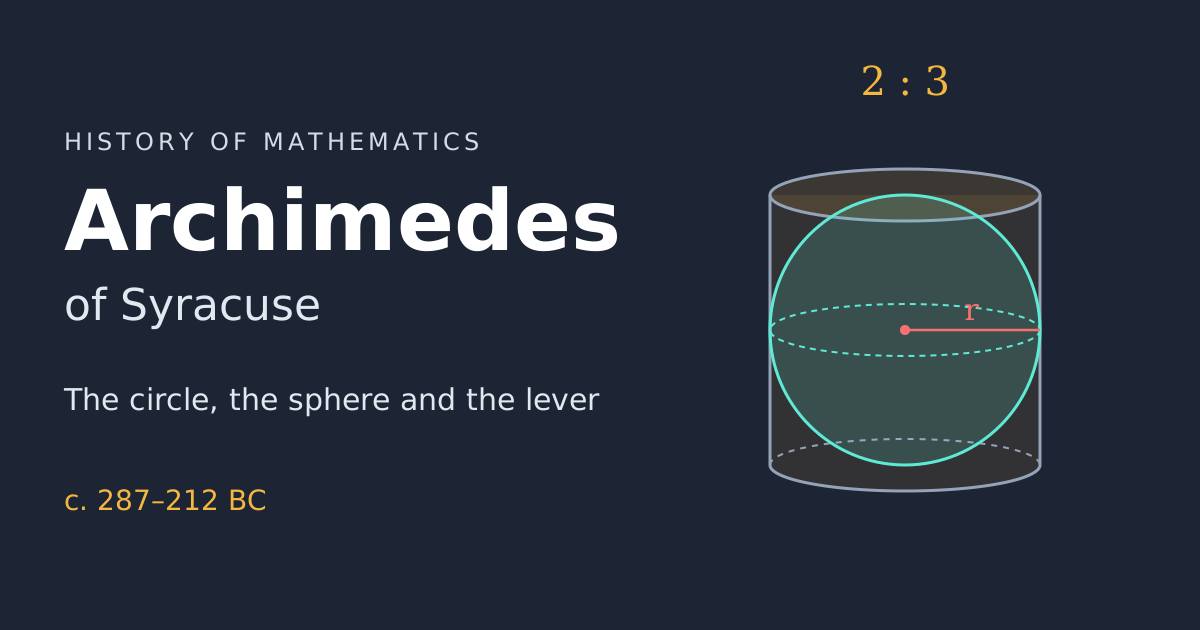
The sphere and the cylinder

Greek geometers knew how to compute the volume of prisms, pyramids, cylinders and cones. The sphere resisted. In the two-book treatise On the Sphere and Cylinder, Archimedes solved the problem and found relations of surprising simplicity. The theorems Call a great circle the circle that passes through the centre of the sphere, like the equator. Archimedes proved that: the surface of the sphere is four times the area of the great circle: $S = 4\pi r^2$; the volume of the sphere is four times that of a cone whose base is the great circle and whose height is the radius: $V = 4 \cdot \frac{1}{3}\pi r^2 \cdot r = \frac{4}{3}\pi r^3$. And from this he drew the consequence that delighted him most. Consider the cylinder that exactly encloses the sphere, with radius $r$ and height $2r$. Its volume is $\pi r^2 \cdot 2r = 2\pi r^3$, and its total surface, counting both lids, is $2\pi r \cdot 2r + 2\pi r^2 = 6\pi r^2$. So

October 29, 2026 Read
Hero Image
The Method and the palimpsest

Archimedes’s books present perfect proofs, but they do not say how he reached the results. For centuries, mathematicians suspected he had a secret method. They were right, and the method was found in the most unlikely place. The letter to Eratosthenes Certain things first became clear to me by a mechanical method, although they had to be demonstrated by geometry afterwards, because their investigation by this method did not furnish an actual proof. But it is of course easier, when we have previously acquired, by the method, some knowledge of the questions, to supply the proof than it is to find it without any previous knowledge. — Archimedes, The Method, letter to Eratosthenes

October 29, 2026 Read
Hero Image
The spiral of Archimedes

In the treatise On Spirals, also dedicated to Dositheus, Archimedes studies a new curve, defined by a motion. If a straight line in a plane revolves at a uniform rate about one of its extremities, which remains fixed, and returns to the position from which it started, and if, at the same time, a point moves at a uniform rate along the line, starting from the fixed extremity, the point will describe a spiral in the plane. — Archimedes, On Spirals, definition

October 29, 2026 Read
Hero Image
The Sand Reckoner

There are some, King Gelon, who think that the number of the sand is infinite. I will try to show you that some of the numbers I have named exceed not only the number of the sand that would fill the Earth, but also that of the sand that would fill the universe. — Archimedes, The Sand Reckoner, letter to King Gelon The Sand Reckoner is a letter to Gelon, son of King Hiero, and the only book by Archimedes written for a reader who was not a mathematician. The problem is to prove that there is a number larger than the quantity of grains of sand needed to fill the whole universe.

October 29, 2026 Read
Hero Image
The screw, the claw and the mirrors

Plutarch writes that Archimedes considered engineering a lesser activity, and that he left no book about his machines. Even so, it was they that made him famous among his contemporaries. The ancient sources describe several, with very different degrees of reliability. The screw of Archimedes An inclined cylinder, with a helix inside or a tube wound spirally around the outside, has its lower end dipped in water. As the cylinder turns, each portion of water is trapped in a fold of the helix and rises, turn by turn, until it comes out at the top. The historian Diodorus of Sicily, in the first century BC, attributes the invention to Archimedes, during a stay in Egypt, where the machine was used to irrigate the fields along the Nile and to drain water from mines.

October 29, 2026 Read
Hero Image
The legacy of Archimedes

Whoever understands Archimedes and Apollonius will admire less the discoveries of the greatest men of today. — Gottfried Wilhelm Leibniz The manuscripts What remains of Archimedes reached us by a thread. Almost all of his work depended on three Byzantine Greek manuscripts. Two of them, which scholars call codices A and B, were lost after being copied or translated in the Renaissance; the third is the palimpsest, which stayed hidden under a prayer book. In 1269 the Dominican William of Moerbeke translated the Greek texts into Latin, and through this translation Archimedes came to be read in European universities. The first printed edition of the Greek text came out in Basel in 1544.

October 29, 2026 Read
Hero Image
Image credits

Historical images and photographs All come from Wikimedia Commons. We use the files or the thumbnails provided by Commons, reduced to at most 800 pixels wide, with no other editing. Archimedes thoughtful, painting by Domenico Fetti (c. 1620): source page · public domain. Ortygia, Syracuse, photo by Andrea Schaffer: source page · CC BY 2.0. Archimedes and the Roman soldier, eighteenth-century mosaic in the ancient style: source page · public domain. Archimedes moving the Earth with a lever, engraving from the Mechanics Magazine (London, 1824): source page · public domain. Latin manuscript of On the Sphere and Cylinder (c. 1270): source page · public domain. Cicero discovering the tomb of Archimedes, painting by Pierre-Henri de Valenciennes (1787): source page · public domain. A leaf of the Archimedes palimpsest, The Walters Art Museum: source page · CC BY 3.0. The screw of Archimedes, illustration from Chambers’s Twentieth Century Dictionary (1908): source page · public domain. The Fields Medal, photo by Stefan Zachow for the International Mathematical Union: source page · public domain. Figures made for the blog The cover and the four interactive figures (the lever, the polygons that enclose π, the triangles of the quadrature of the parabola and the spiral) are original illustrations, with text in each of the site’s languages.
October 30, 2026 Read
  • ««
  • «
  • 1
  • 2
  • »
  • »»
Navigation
  • Start here
  • Recent posts
  • About Euler
  • App
  • Privacy
  • About us
  • Contact
Contact me:
  • hirowat2@gmail.com

Euler's Eyes
© 2021 Euler Eyes.
Powered by Hugo Logo