
Euler's Eyes
2026-10-29
The Method and the palimpsest
Archimedes’s books present perfect proofs, but they do not say how he reached the results. For centuries, mathematicians suspected he had a secret method. They were right, and the method was found in the most unlikely place.
The letter to Eratosthenes
Certain things first became clear to me by a mechanical method, although they had to be demonstrated by geometry afterwards, because their investigation by this method did not furnish an actual proof. But it is of course easier, when we have previously acquired, by the method, some knowledge of the questions, to supply the proof than it is to find it without any previous knowledge.
— Archimedes, The Method, letter to Eratosthenes
The treatise we call The Method of Mechanical Theorems is a letter to the geographer Eratosthenes of Cyrene. In it Archimedes reveals his procedure: imagine the figures as made of infinitely many very thin slices and weigh them on a lever, comparing slice by slice with those of a known figure.
Weighing the sphere
The finest example is that of the sphere. Place the sphere of radius $r$, a cone and a cylinder, both with base radius $2r$ and height $2r$, with their axis along the arm of a lever. Cut everything by a plane perpendicular to the arm, at distance $x$ from the fulcrum. With a little geometry, the slice of the sphere has area $\pi\left(2rx - x^2\right)$, that of the cone $\pi x^2$ and that of the cylinder $\pi (2r)^2 = 4\pi r^2$. So
$$\text{slice of sphere} + \text{slice of cone} = \pi \cdot 2rx.$$Archimedes carries the slices of the sphere and the cone to the other end of the lever, at distance $2r$ from the fulcrum, and leaves the slice of the cylinder where it is, at distance $x$. The moments are equal:
$$2r \cdot \pi \cdot 2rx = x \cdot 4\pi r^2.$$Since this holds for every slice, the whole sphere and cone, hung at distance $2r$, balance the whole cylinder, whose centre of gravity is at distance $r$. By the law of the lever:
$$2r\,(V_{\text{sphere}} + V_{\text{cone}}) = r\,V_{\text{cylinder}} \quad\Longrightarrow\quad V_{\text{sphere}} = \frac{1}{2}\cdot 8\pi r^3 - \frac{8}{3}\pi r^3 = \frac{4}{3}\pi r^3.$$It is exactly the volume he would later prove rigorously in The sphere and the cylinder. Adding infinitely many slices is the central idea of integral calculus, eighteen centuries before Newton and Leibniz.
The prayer book
Around the year 950, a scribe in Constantinople copied several works of Archimedes onto parchment. In 1229, a monk needed parchment for a prayer book: he took the manuscript apart, scraped off the ink, cut the leaves in half, turned them sideways and wrote the prayers on top. A manuscript reused in this way is called a palimpsest.
In 1906, the Danish philologist Johan Ludvig Heiberg examined the prayer book in a library in Constantinople and, with a magnifying glass, read Archimedes’s text beneath the prayers. It was the only known copy of The Method and the only Greek copy of On Floating Bodies.
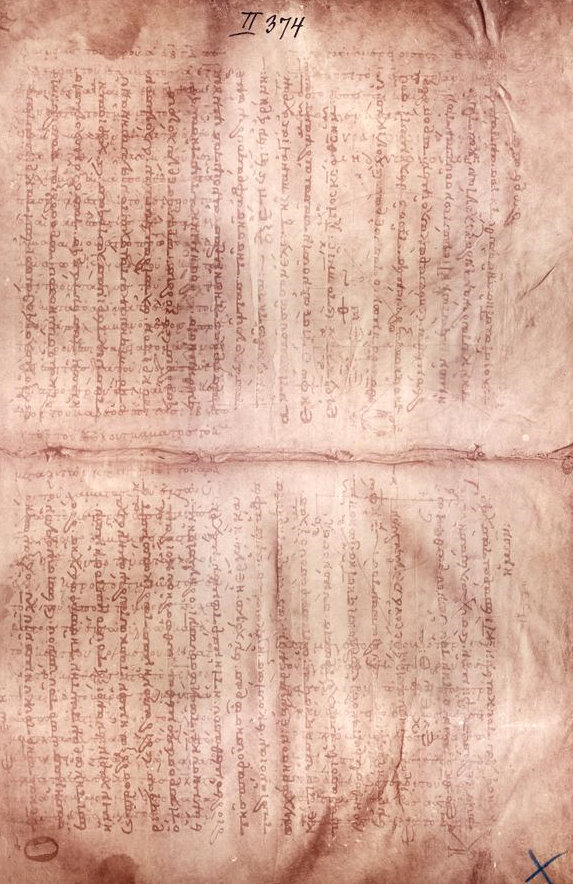
The book disappeared again in the early twentieth century and reappeared in 1998 at an auction in New York, badly damaged by mould and by forged illuminations painted on top. It was bought by an anonymous buyer for 2 million dollars and deposited at the Walters Art Museum in Baltimore. From 1999 to 2008, a team of scientists and philologists used images in several bands of light, ultraviolet and even X-rays from a particle accelerator to read the erased text. They found passages Heiberg had not been able to read.
Exercise: the slices
Check the sum of the slices. Place the sphere with its pole at $x = 0$ and its centre at $x = r$. Show that the radius $\rho$ of the slice of the sphere at $x$ satisfies $\rho^2 = 2rx - x^2$, and conclude that the slice of the sphere plus that of the cone (of radius $x$) add up to $\pi \cdot 2rx$.
The slice is at distance $|x - r|$ from the centre, and by Pythagoras’s theorem $\rho^2 = r^2 - (x - r)^2 = 2rx - x^2$. The cone has its vertex at the fulcrum and opens with slope 1, so its slice has radius $x$. Adding the areas: $\pi(2rx - x^2) + \pi x^2 = 2\pi r x$.
Exercise: the final balance
With $V_{\text{cylinder}} = \pi (2r)^2 \cdot 2r = 8\pi r^3$ and $V_{\text{cone}} = \frac{1}{3}\pi (2r)^2 \cdot 2r = \frac{8}{3}\pi r^3$, solve $2r\,(V_{\text{sphere}} + V_{\text{cone}}) = r\,V_{\text{cylinder}}$.
Dividing by $r$: $2\,(V_{\text{sphere}} + \frac{8}{3}\pi r^3) = 8\pi r^3$, so $V_{\text{sphere}} = 4\pi r^3 - \frac{8}{3}\pi r^3 = \frac{4}{3}\pi r^3$.
Sources: Archimedes, The Method, proposition 2 · Johan Ludvig Heiberg, “Eine neue Archimedeshandschrift”, Hermes 42 (1907) · Reviel Netz and William Noel, The Archimedes Codex (2007) · Thomas L. Heath, The Method of Archimedes (1912) · William Noel, The Archimedes Palimpsest Project, The Walters Art Museum.
All topics on Archimedes · ← The sphere and the cylinder · The spiral of Archimedes →