Euler's Eyes
2026-10-29
The law of the lever
Levers had been used long before Archimedes, to lift stones, draw water from wells and weigh goods. What Archimedes did that was new was to turn the lever into a theorem. In the treatise On the Equilibrium of Planes, he starts from a few simple axioms, such as “equal weights at equal distances balance”, and deduces the general law in the manner of the Elements of Euclid.
The law
Magnitudes, whether commensurable or incommensurable, balance at distances inversely proportional to their weights.
— Archimedes, On the Equilibrium of Planes, book I, propositions 6 and 7
If a weight $P_1$ is at distance $d_1$ from the fulcrum and a weight $P_2$ at distance $d_2$ on the other side, the lever balances when
$$\frac{P_1}{P_2} = \frac{d_2}{d_1} \quad\Longleftrightarrow\quad P_1\,d_1 = P_2\,d_2.$$A small weight far from the fulcrum balances a large weight close to it. The product $P \cdot d$, which we now call the moment or torque, is what must be equal on both sides.
The idea of the proof
The easiest case shows the spirit of the argument. Suppose that on the left there is a weight of 2 units at distance 1 from the fulcrum, and on the right a weight of 1 unit at distance 2. Replace the weight of 2 by two separate units, one exactly over the fulcrum and the other at distance 2 on the left. The centre of gravity of the two is still at distance 1, so, by one of the axioms, the balance does not change. But now we have three equal weights, at positions $-2$, $0$ and $+2$: a row symmetric about the fulcrum, which evidently balances. Archimedes generalizes this reasoning to any commensurable weights, dividing them into equal units, and then, with an argument by contradiction, to incommensurable ones.
Centres of gravity
The same treatise teaches how to find the centre of gravity of plane figures: the point at which the figure would balance on the tip of a needle. Archimedes shows, for example, that the centre of gravity of a triangle is the point where the medians meet, two thirds of the way from each vertex. This idea, of treating a whole figure as if its weight were concentrated at a point, is the key to the Method with which he discovered his greatest formulas.
Exercise: the wheelbarrow
A wheelbarrow carries 60 kg of sand, whose centre of gravity is 40 cm from the wheel. The hands hold the handles 120 cm from the wheel. What weight must the hands support?
The wheel is the fulcrum. The two moments must be equal: $60 \times 40 = F \times 120$, so $F = 20$ kg. The wheelbarrow is a lever in which the load lies between the fulcrum and the force, and the hands support only a third of the weight.
Exercise: moving the Earth
The mass of the Earth is about $6 \times 10^{24}$ kg. If Archimedes, pushing with a force equivalent to 60 kg, wanted to balance it with a lever whose short arm is 1 m long, how long would the long arm have to be? And how far would he have to move its end to raise the Earth by 1 cm?
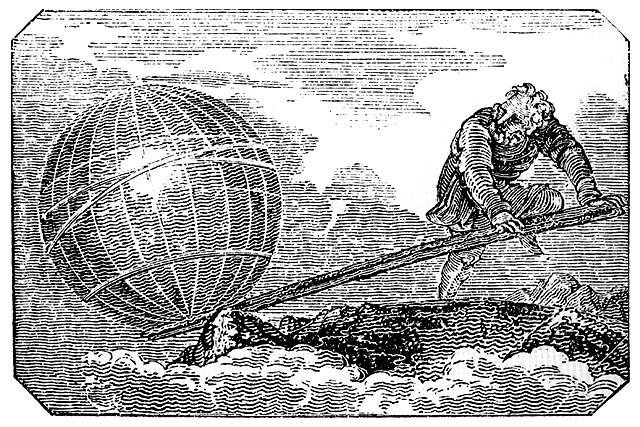
By the law, $6 \times 10^{24} \times 1 = 60 \times d$, so $d = 10^{23}$ m, about 10 million light years, more than the distance to the Andromeda galaxy. Since displacements are in the same proportion as the arms, to raise the Earth 1 cm the end would have to come down $10^{23} \times 0.01 = 10^{21}$ m. The law is true; it is the place to stand that is missing.
Sources: Archimedes, On the Equilibrium of Planes, book I · Pappus of Alexandria, Mathematical Collection, book VIII · Plutarch, Life of Marcellus, 14 · E. J. Dijksterhuis, Archimedes (1956), ch. IX · Thomas L. Heath, The Works of Archimedes (1897).
All topics on Archimedes · ← Eureka: the king’s crown and Archimedes’s principle · The measurement of the circle and the number π →