
Euler's Eyes
2026-10-29
The life of Archimedes
Timeline
- c. 287 BCBorn in Syracuse, the son of the astronomer Phidias.
- c. 270 BCHiero II becomes master of Syracuse; later he proclaims himself king.
- c. 250 BCAround this time, he writes to Conon of Samos and to Dositheus, in Alexandria, sending them his results.
- c. 240 BCWrites to Eratosthenes, in Alexandria, the letter we know as The Method.
- 215 BCHiero dies. Syracuse allies itself with Carthage against Rome.
- 214 BCThe Roman general Marcellus begins the siege of Syracuse. Archimedes’s machines defend the city.
- 212 BCSyracuse falls. Archimedes is killed by a Roman soldier.
- 75 BCCicero, a Roman magistrate in Sicily, finds his tomb again.
A Greek city in Sicily
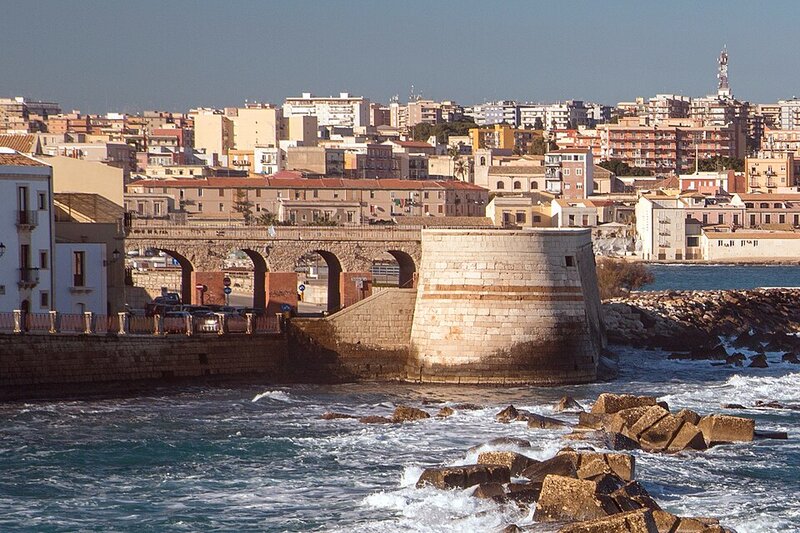
Archimedes was born around 287 BC in Syracuse, on the east coast of Sicily. The date comes from a twelfth-century Byzantine author, John Tzetzes, who says he died at 75. Syracuse was then one of the largest cities in the Greek world, with two harbours and a fortified island, Ortygia, at the heart of the ancient city.
Almost everything we know about his family comes from a sentence of his own. In The Sand Reckoner, citing estimates of the size of the Sun, Archimedes mentions “Phidias, my father”, an astronomer. Plutarch states that he was a kinsman and friend of King Hiero II, who ruled Syracuse for more than fifty years.
The letters to Alexandria
The great centre of Greek science was Alexandria, in Egypt, with its Museum and its Library. Archimedes probably studied there as a young man. What is certain is that, back in Syracuse, he kept in touch with the Alexandrian mathematicians: many of his books begin as letters, addressed to the astronomer Conon of Samos, after Conon’s death to his pupil Dositheus, and to the geographer Eratosthenes of Cyrene, the man who measured the circumference of the Earth.
The letters reveal a temperament. Archimedes sent his colleagues the statements of theorems without the proofs, so that they could try to prove them. In one of them, he admits that he deliberately included two false results, to unmask anyone who claimed to have discovered everything on their own.

The king’s engineer
For Hiero, Archimedes was also an engineer. The story of the gold crown and the cry of “eureka” takes place at court. Plutarch tells that, having claimed that with a given force any weight could be moved, Archimedes was challenged by the king to prove it. He chose a newly built cargo ship, which could only be launched by many men, had it loaded with passengers and cargo and, sitting at a distance, pulling with his hand the end of a system of pulleys, made the ship glide smoothly, as if it were in the water. It is the law of the lever in action.
The siege
Hiero died in 215 BC, in the middle of the war between Rome and Carthage. His successor went over to the Carthaginian side, and in 214 BC the Roman general Marcus Claudius Marcellus attacked Syracuse by land and sea. The ancient historians, Polybius, Livy and Plutarch, describe the Romans’ astonishment at the machines of Archimedes: catapults that reached different distances, cranes that dropped stones, and a claw that lifted the prows of ships and let them fall. According to Plutarch, the soldiers fled at the sight of a rope or a beam appearing over the wall. The city only fell in 212 BC, through a lapse during a festival.
Death before the diagram
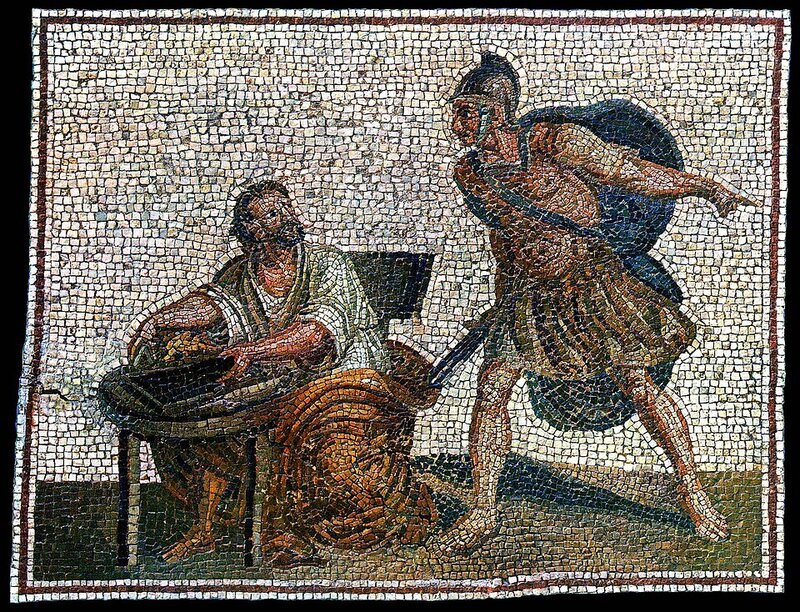
Marcellus is said to have ordered that Archimedes be spared. But in the sack of the city, a soldier found him. Plutarch gives several versions: in the most famous, Archimedes was so absorbed in a problem that he did not notice the invasion, and asked the soldier to wait until he had finished the proof; the soldier, annoyed, killed him. Later, Latin authors put into his mouth the sentence “do not disturb my circles”.
Exercise: dates before Christ
Archimedes was born around 287 BC and died in 212 BC. How long did he live? And how much time separates his death from Cicero’s visit to the tomb, in 75 BC?
In the years before Christ, the numbers decrease as time goes on, so we subtract the other way round: $287 - 212 = 75$ years, in agreement with Tzetzes. From his death to Cicero: $212 - 75 = 137$ years. (Since there is no year zero, care is only needed when the interval crosses from 1 BC to AD 1.)
Exercise: how long did the siege last?
The siege began in 214 BC and the city fell in 212 BC. If the siege began in the spring of 214 and ended in the autumn of 212, roughly how many months did it last?
From one spring to the same season of the following year is 12 months; from 214 to 212 is two years, 24 months, and from spring to autumn about 6 more. The siege lasted about 30 months, two and a half years.
Sources: Plutarch, Life of Marcellus, 14–19 · Polybius, Histories, VIII, 3–7 · Livy, History of Rome, XXIV, 34, and XXV, 31 · Cicero, Tusculan Disputations, V, 64–66 · E. J. Dijksterhuis, Archimedes (1956) · Reviel Netz and William Noel, The Archimedes Codex (2007) · biography of Archimedes, MacTutor.
All topics on Archimedes · Eureka: the king’s crown and Archimedes’s principle →