
Euler's Eyes
2026-10-24
Solving any triangles
Solving any triangle means calculating its main elements: $a$, $b$, $c$, $\hat{A}$, $\hat{B}$ and $\hat{C}$. To do this, it is necessary to provide three information about the triangle, at least one of which is the measurement of a segment linked to it (side, height, median, etc.).
The story
The first European treatise dedicated entirely to solving triangles, both plane and spherical, was De triangulis omnimodis (“On triangles of all types”), written around 1464 by the German astronomer Regiomontanus and published only in 1533. He organized the solving cases in a very similar way to what we will do here, and the book was the gateway to trigonometry in Renaissance Europe.
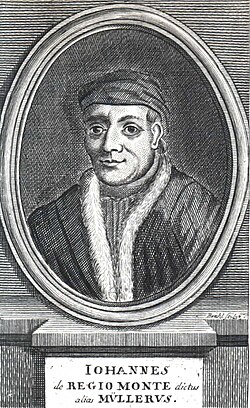
- Nasce Johannes Müller, que latinizará o nome da cidade (“monte do rei”) em Regiomontanus.
- Entra na universidade aos 11 anos.
- Aluno e colaborador de Georg Peurbach. Com a morte do mestre, assume a tarefa de resumir o Almagesto.
- Na casa do cardeal Bessarion, lê manuscritos gregos e escreve o De triangulis omnimodis (c. 1464).
- Trabalha na corte do rei Matias Corvino, da Hungria, e calcula tábuas trigonométricas.
- Monta uma gráfica para livros científicos e imprime as Efemérides, que Colombo levaria nas suas viagens.
- Chamado pelo papa para ajudar na reforma do calendário, morre na cidade, aos 40 anos.
Sources: Regiomontanus (MacTutor).
In everyday life
- The other side of the river. A surveyor measures a base of 100 m on one bank and the angles to a tree on the other bank; with one side and two angles, solve the triangle and find the width of the river.
- Wind and airplanes. The speed of an airplane in relation to the ground is the third side of a triangle formed by air speed and wind speed; the law of cosines gives the value and the law of sines gives the deviation of the route.
- Data that is not enough. The ambiguous case explains why, in accident investigations and navigation, two sides and an angle that is not understood can correspond to two different situations, and more information is needed.
Theory
There are four classic problems for solving any triangles.
Exemplo1st problem — given one side (a) and two angles (B and C)
$$\hat{A} = 180^\circ - (\hat{B} + \hat{C})$$$$b = \frac{a\operatorname{sen}\hat{B}}{\operatorname{sen}\hat{A}}$$$$c = \frac{a\operatorname{sen}\hat{C}}{\operatorname{sen}\hat{A}}$$There is a solution if, and only if, $\hat{B} + \hat{C} < 180^\circ$.
Exemplo2nd problem — given two sides (b and c) and the angle between them (A)
$$a = \sqrt{b^2 + c^2 - 2bc\cos\hat{A}}$$$$\cos\hat{B} = \frac{a^2 + c^2 - b^2}{2ac}$$$$\cos\hat{C} = \frac{a^2 + b^2 - c^2}{2ab}$$The solution always exists and is unique.
Exemplo3rd problem — given the three sides (a, b, c)
$$\cos\hat{A} = \frac{b^2 + c^2 - a^2}{2bc}$$$$\cos\hat{B} = \frac{a^2 + c^2 - b^2}{2ac}$$$$\cos\hat{C} = \frac{a^2 + b^2 - c^2}{2ab}$$The problem only has a solution if these cosines are in the interval $]-1, 1[$, that is, if the triangular inequality holds: $a < b + c$, $b < a + c$ and $c < a + b$.
Exemplo4th problem — given two sides (a and b) and the angle opposite one of them (A)
$$\operatorname{sen}\hat{B} = \frac{b\operatorname{sen}\hat{A}}{a}$$$$\hat{C} = 180^\circ - (\hat{A} + \hat{B})$$$$c = \frac{a\operatorname{sen}\hat{C}}{\operatorname{sen}\hat{A}}$$This is the ambiguous case: there may be none, one or two solutions. The discussion comes next.
Discussion of the 4th problem
1st case: $b\operatorname{sen}\hat{A} > a$. Then $\operatorname{sen}\hat{B} = \frac{b\operatorname{sen}\hat{A}}{a} > 1$: there is no solution (the circle with radius $a$ does not reach the straight line).
2nd case: $b\operatorname{sen}\hat{A} = a$. Then $\operatorname{sen}\hat{B} = 1$ and $\hat{B} = 90^\circ$. There is a solution (unique, a right triangle) only if $\hat{A} < 90^\circ$; otherwise $\hat{A} + \hat{B} \ge 180^\circ$.
3rd case: $b\operatorname{sen}\hat{A} < a$. Then $\operatorname{sen}\hat{B} < 1$ and there are two supplementary angles that satisfy the relationship: $\hat{B}_1$, with $0^\circ < \hat{B}_1 < 90^\circ$, and $\hat{B}_2 = 180^\circ - \hat{B}_1$, with $90^\circ < \hat{B}_2 < 180^\circ$. Which one works depends on $\hat{A}$:
- $\hat{A} = 90^\circ$: only $\hat{B}_1$ is a solution, because $\hat{A} + \hat{B}_2 > 180^\circ$ (and $a > b$ is needed).
- $\hat{A} < 90^\circ$: $\hat{B}_1$ is always a solution, but $\hat{B}_2$ is only a solution if $a < b$, since $\hat{B}_2 > \hat{A} \iff b > a$ (the largest angle is opposed to the largest side). Thus, if $b\operatorname{sen}\hat{A} < a < b$, there are two triangles; if $a \ge b$, just one.
- $\hat{A} > 90^\circ$: $\hat{B}_2$ is not a solution, because $\hat{A} + \hat{B}_2 > 180^\circ$; as for $\hat{B}_1$, it is only a solution if $a > b$, since $\hat{B}_1 < \hat{A} \iff b < a$.
ResumoSummary table of the ambiguous case
| $a < b\operatorname{sen}\hat{A}$ | $a = b\operatorname{sen}\hat{A}$ | $b\operatorname{sen}\hat{A} < a < b$ | $a \ge b$ | |
|---|---|---|---|---|
| $\hat{A}$ high | none | a (rectangle) | two | one |
| $\hat{A}$ straight or obtuse | none | none | none | one (if $a > b$) |
ExemploTwo solutions
Data $a = 1$, $b = \sqrt{3} + 1$ and $\hat{A} = 15^\circ$ (exercise 378): $b\operatorname{sen}\hat{A} = (\sqrt{3} + 1)\frac{\sqrt{6} - \sqrt{2}}{4} = \frac{\sqrt{2}}{2} < 1 = a < b$. There are two triangles: $\hat{B} = 45^\circ$, $\hat{C} = 120^\circ$, or $\hat{B} = 135^\circ$, $\hat{C} = 30^\circ$.
The exercises in this section are numbers 411 to 419 from chapter list.