As for methods, I have sought to give them all the rigour that is demanded in geometry, so as never to rely on arguments drawn from the generality of algebra.
— Augustin-Louis Cauchy, preface to the Cours d'analyse (1821)
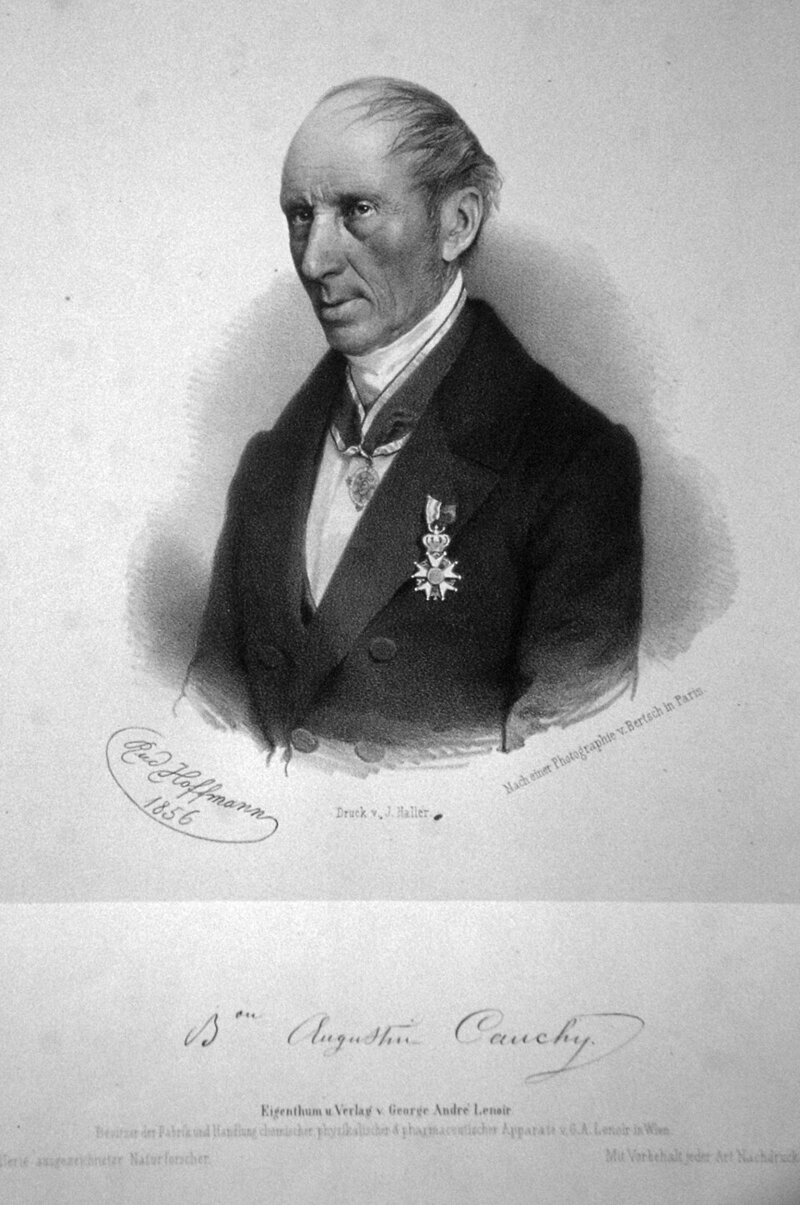
Augustin-Louis Cauchy (1789–1857) was born in Paris five weeks after the fall of the Bastille and died under the Second Empire, having lived through two revolutions, eight years of exile and every change of regime in nineteenth-century France. He was an engineer, a professor, a baron, tutor to a prince without a throne and, above all, one of the most prolific mathematicians of all time: his collected works fill 27 volumes.
Before him, calculus worked very well and nobody quite knew why. Infinitesimals appeared and vanished in the calculations, infinite series were summed without ceremony, and the result was almost always right. Cauchy rewrote the whole subject starting from a single idea, that of a limit, and the definitions of convergence, continuity, derivative and integral taught today are, in essence, his.
He also invented integration in the complex plane, which became one of the most powerful tools in mathematics, founded the mathematical theory of elasticity and gave the first great push to the theory of permutation groups. His name is attached to more theorems and concepts than that of almost any other mathematician.
In this series we tell Cauchy’s life and work through eight of his discoveries, with the calculations in plain view.
Who he was
Augustin-Louis Cauchy
- Nascimento
- 21 August 1789, Paris, France
- Morte
- 23 May 1857, Sceaux, France
- Origem
- France
- Áreas
- Analysis, complex functions, number theory, algebra, elasticity, optics
Reading guide
Biography
Discoveries and proofs
- The polygonal number theorem
- Determinants and permutations
- Limits and continuity
- The convergence of series
- Cauchy’s inequality
- The derivative and the integral
- The integral in the complex plane
- Stress in elastic solids