Euler's Eyes
2026-10-18
Four ways to write the derivative
If $y=x^3$, the derivative is $3x^2$. Everyone writes that the same way. What changes is the name given to that derivative. In a physics book you will read $\dot y$; in a calculus book, $\frac{dy}{dx}$ or $f'(x)$; in a book on differential equations, $Dy$. They are four signs with the same object, and none of them has beaten the others.
The four ways of writing
| Notation | Author | When | How it reads |
|---|---|---|---|
| $\dot y$ | Isaac Newton | 1660s, published in 1704 | the fluxion of $y$, the speed at which $y$ flows in time |
| $\dfrac{dy}{dx}$ | Gottfried Leibniz | 1675, published in 1684 | the ratio of two infinitely small differences |
| $f'(x)$ | Joseph-Louis Lagrange | 1797 | the derived function of $f$, evaluated at $x$ |
| $Df$ | Louis Arbogast | 1800 | the operator $D$ applied to the function $f$ |
Chapter 1 has already told the quarrel between Newton’s dots and Leibniz’s $d$s, in the text on Leibniz and the calculus. Here another question matters: what each way of writing shows and what it leaves out.
What each one shows
Newton’s dot shows that the variable is time. No $dt$ is written, because for Newton every quantity flows in time. It is an economical notation: $\ddot x$ is acceleration, and the second law becomes $m\ddot x=F$. But it does not say what one is differentiating with respect to when the variable is not time, and that is why it survived only in physics.
Leibniz’s $\frac{dy}{dx}$ shows both variables: what changes ($y$) and with respect to what ($x$). And it has the shape of a fraction, which makes calculations run by themselves, as in the chain rule. It is the most active of the four, and also the one that misleads most; text 3 shows when.
Lagrange’s $f'(x)$ shows that the derivative is a new function, a child of $f$. It says nothing about changes, infinitesimals or time: only about a function that generates another. That was exactly Lagrange’s intention.
Arbogast’s $D$ shows that differentiating is an operation, like multiplying. Writing $Df$ invites you to do with $D$ what one does with numbers: square it, add it, factorise it. Text 4 shows how far that goes.
Lagrange against the infinitely small
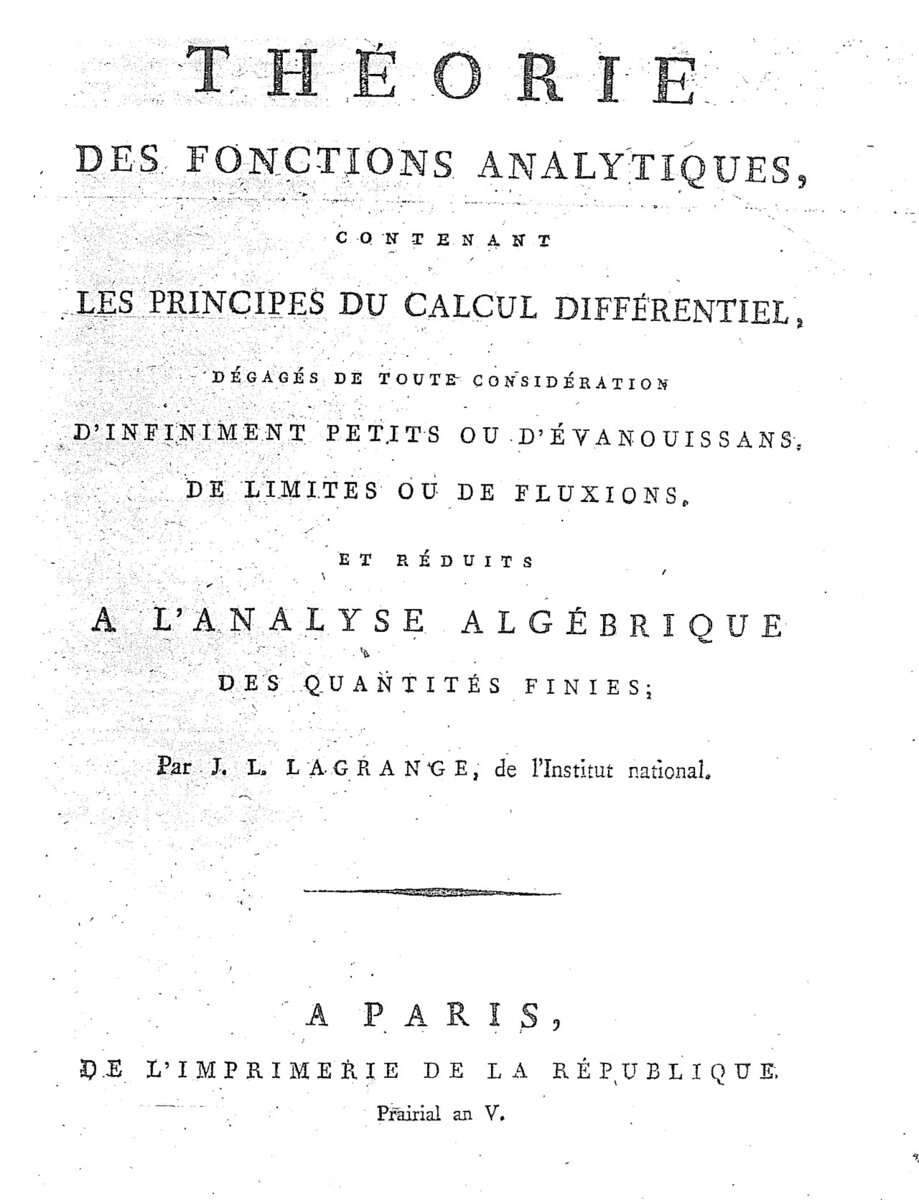
At the end of the eighteenth century, calculus worked very well and was explained very badly. Nobody could say what a $dx$ was: it could not be zero, because one divided by it; it could not be non-zero either, because in the end it was discarded. Lagrange tried a radical way out. Every function, he assumed, can be written as a power series:
$$f(x+h)=f(x)+p\,h+q\,h^2+\cdots$$The coefficient $p$ of $h$ is a new function of $x$, which he called the derived function and wrote $f'(x)$. That is where the word “derivative” we use today comes from. For $f(x)=x^3$:
$$(x+h)^3=x^3+3x^2\,h+3x\,h^2+h^3,$$and the coefficient of $h$ is $3x^2$. No infinitesimal, no limit: just algebra. The notation $f'$ carries that philosophy: the prime says “derivative of”, not “ratio of small quantities”.
Lagrange’s plan failed, because there are functions that cannot be written as power series, and in the nineteenth century Cauchy’s limit took over as the foundation. But the notation outlived the philosophy that created it.
Each field with its own notation
Today the four live side by side, and each field has chosen the one that serves it best:
- Mechanics uses dots, because almost everything is differentiated with respect to time: $\dot x$ is velocity, $\ddot x$ is acceleration.
- Analysis uses $f'(x)$, because it thinks of functions as objects.
- Applied calculus uses $\frac{dy}{dx}$, because it changes variables all the time.
- Differential equations use $D$, because they want to manipulate the derivative algebraically.
A good reader of mathematics moves from one notation to another without noticing. A beginner has to learn that all four speak of the same thing, and that is not obvious: nothing in the drawing of $\dot y$ recalls $f'(x)$.
Exercise: the same calculation in four notations
Write the second derivative of $y=x^3$ in the four notations, assuming, for Newton, that $x$ is time.
Newton: $\ddot y=6x$. Leibniz: $\frac{d^2y}{dx^2}=6x$. Lagrange: $f''(x)=6x$. Arbogast: $D^2y=6x$. The object is always the same, the function $6x$; what changes is the route each notation suggests for getting there.
Exercise: Lagrange's derivative
Use Lagrange’s method to find the derivative of $f(x)=x^2+5x$.
$f(x+h)=(x+h)^2+5(x+h)=x^2+5x+(2x+5)\,h+h^2$. The coefficient of $h$ is $2x+5$, so $f'(x)=2x+5$. Notice that there was no need to divide by $h$ or to let $h$ tend to zero.
Chapter index · ← Chapter 4: references and credits · From Δ to d: the difference that shrinks →