
Euler's Eyes
2026-10-26
Tribal conventions: Einstein, Bourbaki and the initiated reader
A notation does not belong to all mathematicians in the same way. Each field, sometimes each school, has its shortcuts, and outsiders trip over them. This is not a flaw: it is what happens with any living language, which splits into accents and jargons. But it has consequences for readers and for learners.
Einstein erases the summation sign
In 1916, in the paper that presented general relativity, Albert Einstein had to write hundreds of expressions like
$$\sum_{\mu=1}^{4} a_\mu b^\mu = a_1 b^1 + a_2 b^2 + a_3 b^3 + a_4 b^4.$$He noticed that in his formulas the sum appeared whenever an index was repeated, once below and once above. So he made a deal with the reader: when an index appears twice, the sum is understood, and the $\Sigma$ need not be written. The expression above becomes just $a_\mu b^\mu$.
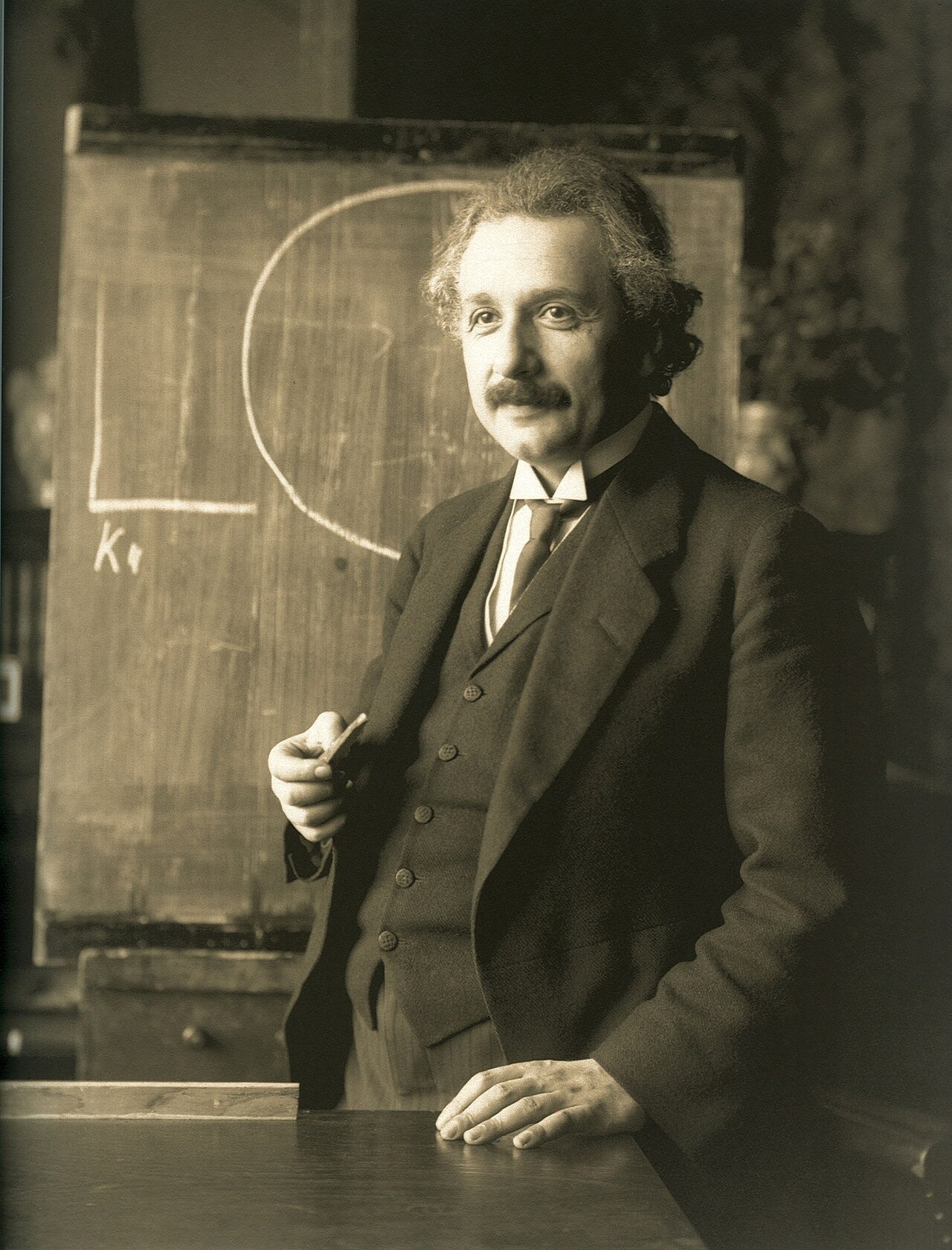
It is said that Einstein joked to a friend: “I have made a great discovery in mathematics: I have suppressed the summation sign every time the summation must be made over an index which occurs twice.” The joke has a serious point. The Einstein convention is today the lingua franca of relativity and differential geometry; a physicist reads $R_{\mu\nu} g^{\mu\nu}$ without thinking that there is a double sum of sixteen terms hidden there. A student from another field sees two letters and no sum at all.
Bourbaki’s signs
The Nicolas Bourbaki group, the French collective mathematician who rewrote the foundations of mathematics from 1935 on, left marks on notation that now seem universal. The empty-set sign $\varnothing$ was chosen by André Weil, who knew the letter Ø of the Norwegian alphabet, for the first volume of the Elements of Mathematics in 1939. And in the margins of Bourbaki’s books there is a road sign, the dangerous bend ☡, warning the reader that the passage needs extra care.
One letter, several tribes
- $i$ or $j$? For mathematicians, $\sqrt{-1}$ is $i$. For electrical engineers it is $j$, because $i$ was already taken by electric current. Both write the same thing as $3 + 4i$ and $3 + 4j$.
- $\log$. For many mathematicians, $\log x$ is the natural logarithm, base $e$. For engineers and calculators, it is base 10. For computer scientists, it is almost always base 2. The three meanings coexist in books published in the same year.
- $\langle \psi |$. Quantum physicists write states with Paul Dirac’s brackets (1939), the bra $\langle \phi |$ and the ket $| \psi \rangle$, which together form the bracket $\langle \phi | \psi \rangle$. The notation is a pun and, at the same time, makes certain calculations almost write themselves.
Exercise: undoing the convention
With indices from 1 to 3 and Einstein’s convention, write out $a_i b_i$ and $\delta_{ii}$ in full, where $\delta_{ij}$ is $1$ if $i = j$ and $0$ otherwise.
$a_i b_i = a_1 b_1 + a_2 b_2 + a_3 b_3$: it is the dot product from chapter 1. And $\delta_{ii} = \delta_{11} + \delta_{22} + \delta_{33} = 3$: the repeated index calls for a sum, and the result is the dimension of the space.
Exercise: the engineer's j
An engineer writes the impedance $Z = 3 + 4j$. What is its modulus, and how would a mathematician write the same number?
The mathematician would write $z = 3 + 4i$. In both cases the modulus is $\sqrt{3^2 + 4^2} = 5$. Changing the letter changes nothing in the calculation; it only changes who feels at home reading the formula.
Chapter index · ← The metre won, decimal time did not · Notation as a tool of thought: Iverson →