It is very probable that all the roots are real. One would of course wish for a rigorous proof of this; but I have, after some fleeting vain attempts, provisionally put aside the search for one.
— Bernhard Riemann, On the Number of Primes Less Than a Given Magnitude (1859)
Bernhard Riemann (1826–1866) lived less than forty years and published little: his collected works fit into a single volume. But almost every page opened a new field of mathematics.
The son of a Lutheran pastor in northern Germany, shy and in fragile health, he studied with Gauss in Göttingen and with Dirichlet in Berlin. In his doctoral thesis he invented the surfaces that bear his name and changed the theory of complex functions. To become a lecturer, he wrote a work on trigonometric series, from which came the definition of the integral that every student learns, and gave a lecture on the foundations of geometry that, sixty years later, would be the language of general relativity.
In 1859 he published his only paper on prime numbers, eight pages long. In it was, stated in passing, a conjecture about the zeros of the zeta function: the Riemann hypothesis, still unproved today and carrying a prize of one million dollars for whoever settles it.
In this trail we tell Riemann’s life and redo, with the calculations in plain view, seven of his ideas.
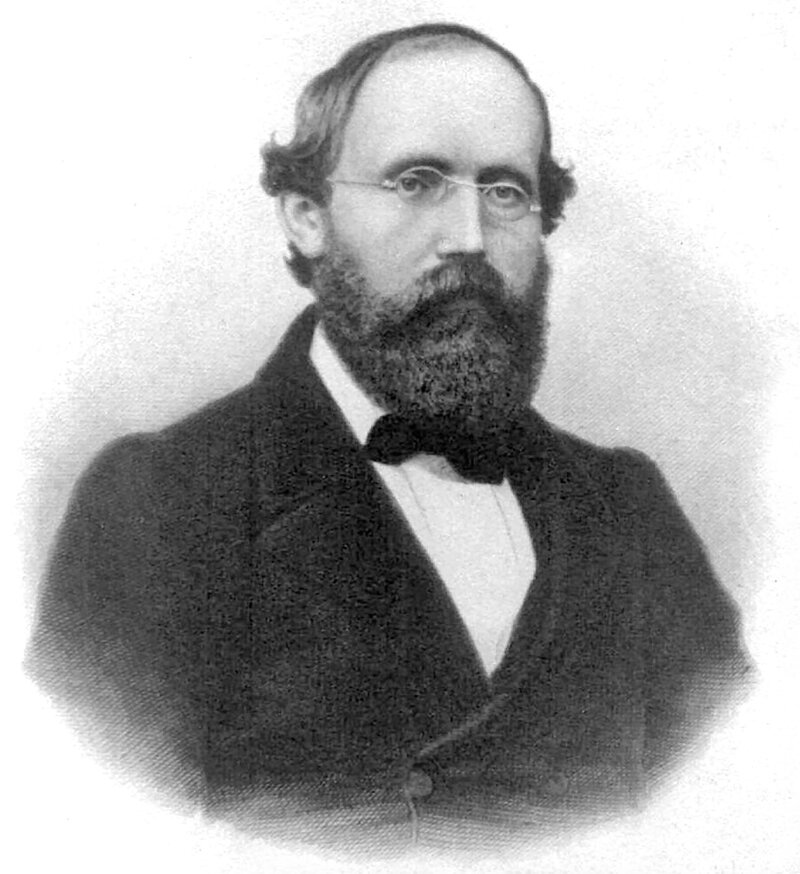
Who he was
Georg Friedrich Bernhard Riemann
- Nascimento
- 17 September 1826, Breselenz, Kingdom of Hanover
- Morte
- 20 July 1866, Selasca, Italy
- Origem
- Kingdom of Hanover (now Germany)
- Áreas
- Analysis, differential geometry, complex functions, number theory
Reading guide
Biography
Discoveries and proofs
- The Riemann integral
- The rearrangement theorem
- Riemann surfaces
- The hypotheses on which geometry is founded
- The zeta function
- Counting the prime numbers
- The Riemann hypothesis