Euler's Eyes
2026-10-28
The life of Maria Gaetana Agnesi
Timeline
- 1718Born in Milan on 16 May, the first of the 21 children of Pietro Agnesi, a wealthy silk merchant.
- 1727At nine, recites in Latin a speech defending women’s education.
- 1738Publishes the Propositiones philosophicae, 191 theses on philosophy and natural science that she defended at the gatherings in her father’s house.
- 1739Asks her father to let her enter a convent; he refuses.
- 1748Publishes the first volume of the Instituzioni analitiche, dedicated to Empress Maria Theresa. The second comes out in 1749.
- 1750Pope Benedict XIV appoints her to the chair of mathematics at the University of Bologna. She never goes to Bologna.
- 1752Her father dies. Agnesi leaves mathematics and begins caring for poor and sick women.
- 1771The Pio Albergo Trivulzio, a hospice for the elderly poor, is founded in Milan. Agnesi is asked to direct the women’s wing.
- 1799Dies on 9 January, at the hospice, and is buried in a common grave.
The girl of the salons
Maria Gaetana Agnesi was born in Milan on 16 May 1718. The city was then the capital of a duchy ruled by the Habsburgs of Vienna. Her father, Pietro Agnesi, had grown rich in the silk trade and wanted the family to rise in Milanese society. He married three times and had 21 children. Maria Gaetana was the eldest.
Pietro soon found that his daughter learned with unusual ease and hired the best teachers in the city for her. Before she was eleven, Maria Gaetana spoke, besides Italian, French, Latin, Greek, Hebrew, German and Spanish; visitors called her the “seven-tongued oracle”. Pietro began to show off his daughter at gatherings in the family house, where scholars, nobles and foreign travellers asked her questions of philosophy, physics and mathematics, and she answered each visitor in their own language. Her younger sister, Maria Teresa, played the harpsichord on those evenings; she later became a composer.
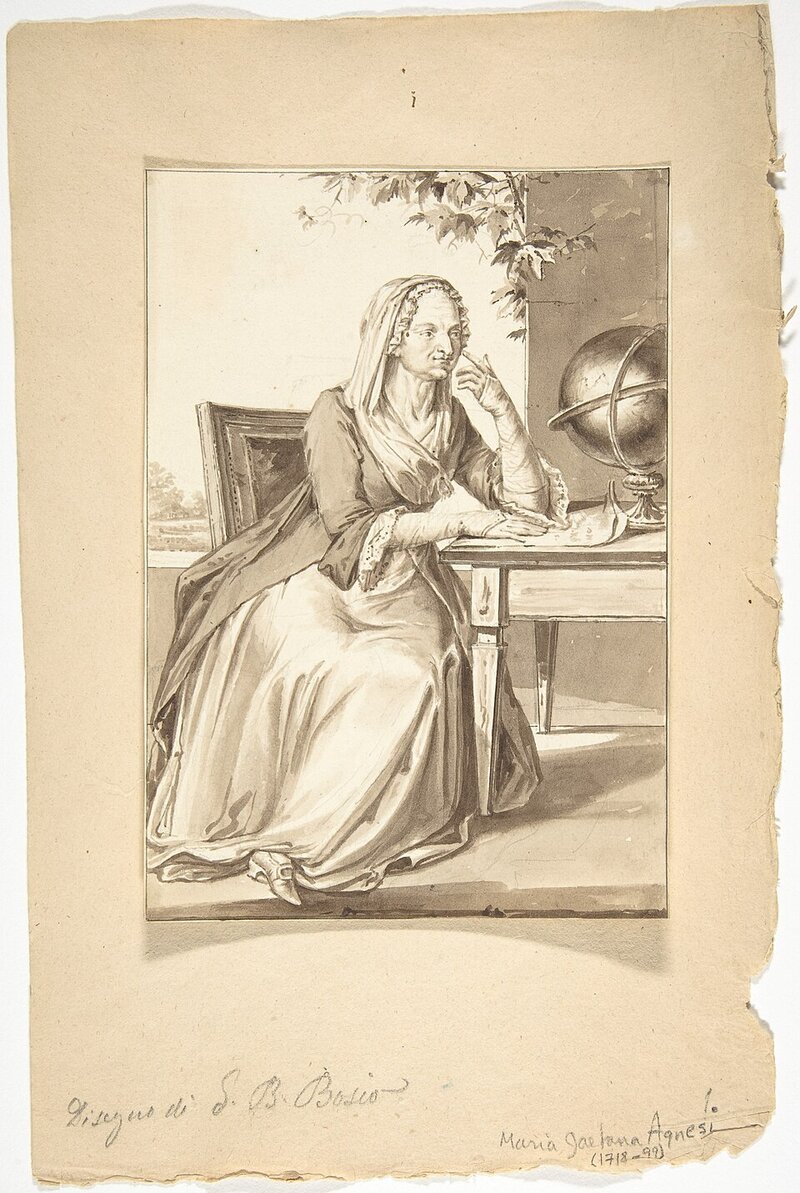
In 1727, at nine, she recited at one of these gatherings a long Latin speech, written in Italian by one of her teachers and translated by her, arguing that women had the same right to study as men. In 1738 she published the Propositiones philosophicae, a list of 191 theses on logic, mechanics, astronomy, chemistry, botany and mineralogy that she had defended before the guests.
One of those visitors, the French magistrate Charles de Brosses, came to the Agnesi house in 1739 and left an account. He met a young woman of twenty who discussed with him, in Latin, questions of physics and geometry, and who confessed that she did not like being put on display at those sessions.
The convent that never was
According to her biographers, it was around this time that Maria Gaetana asked her father to let her enter a convent. Pietro, who depended on her for the education of the younger children and for the prestige of the house, refused. They reached an agreement: she would stay at home, but she could dress simply, go to church whenever she wished and withdraw from parties and salons.
Freed from the performances, Agnesi turned to mathematics. Her guide was Ramiro Rampinelli, an Olivetan monk and mathematician who knew the new calculus well. For almost ten years she worked on a book to teach analysis to her brothers and, more generally, to young Italians.
The book
The Instituzioni analitiche ad uso della gioventù italiana (“Analytical institutions for the use of Italian youth”) came out in Milan in 1748 (first volume) and 1749 (second). So that the setting of the formulas could be followed closely, the book was printed on a press installed in the Agnesi house itself. It was dedicated to Empress Maria Theresa, who sent her in thanks a letter, a diamond ring and a crystal case set with diamonds.
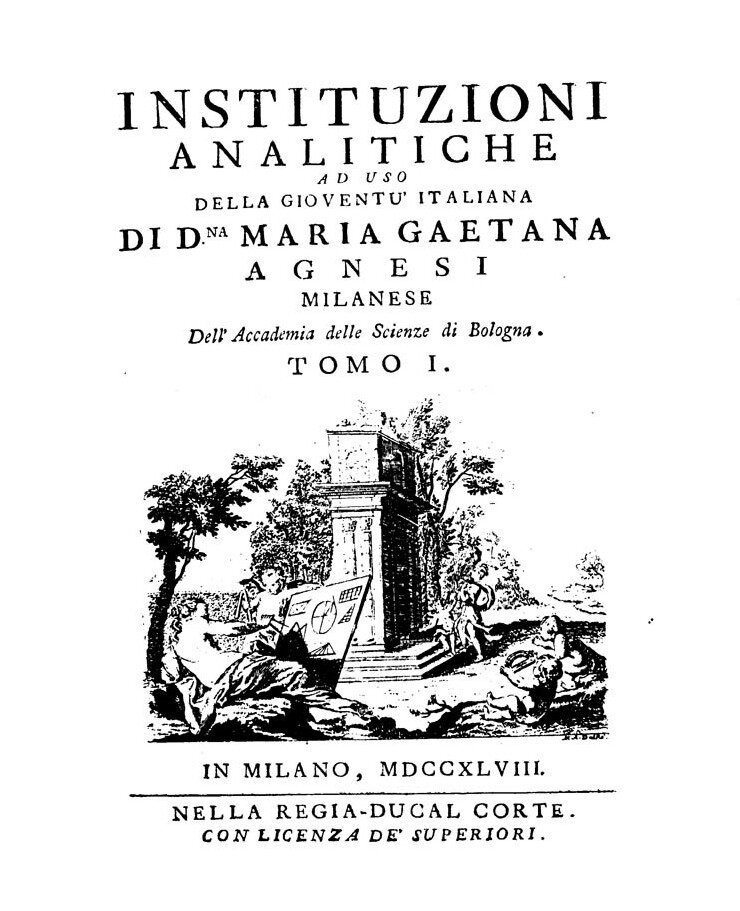
The success was immediate. A commission of the Paris Academy of Sciences examined the work in 1749 and declared it the most complete and best organized treatise of its kind. In The Instituzioni analitiche we describe what was in the book.
The chair at Bologna
Pope Benedict XIV, who had been archbishop of Bologna and took an interest in science, wrote to Agnesi to congratulate her and sent her a gold medal and a gold wreath. In 1750 he went further: he appointed her to the chair of mathematics at the University of Bologna. Bologna had already taken a similar step in 1732, when it granted a doctorate and a chair of physics to Laura Bassi; Agnesi would be the second woman to receive an appointment as a university professor.
Agnesi thanked him, but she never went to Bologna or taught there. Even so, her name stayed on the university’s list of professors for about 45 years. The story is told in A woman at the university.
The poor of Milan
Pietro Agnesi died in 1752. From then on Maria Gaetana left mathematics almost entirely. She took up the study of theology, taught the catechism and cared for the sick, first in a few rooms of her own house, then in charitable institutions, spending her inheritance on them.
In 1771 the Pio Albergo Trivulzio, a hospice for the elderly poor, opened in Milan with a donation from Prince Antonio Tolomeo Trivulzio. The archbishop of Milan invited Agnesi to visit and direct the women’s wing, especially the sick. She ended up living there.
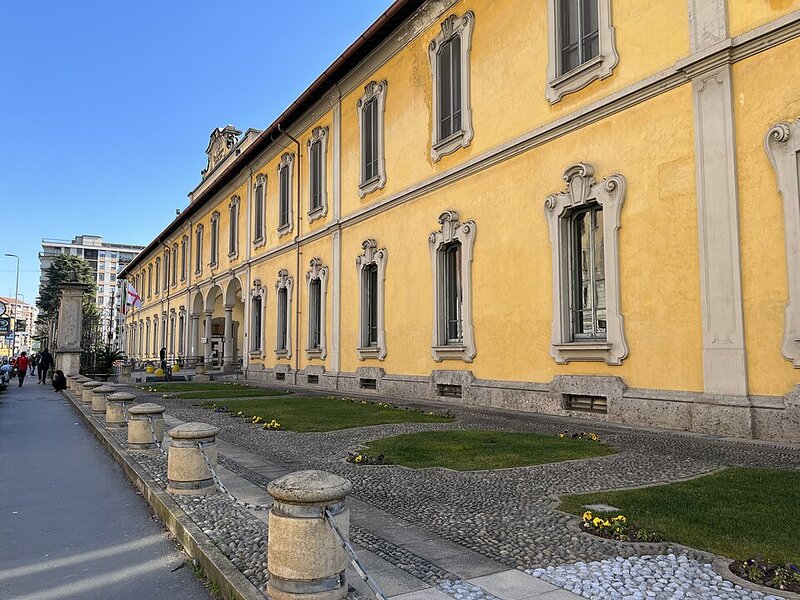
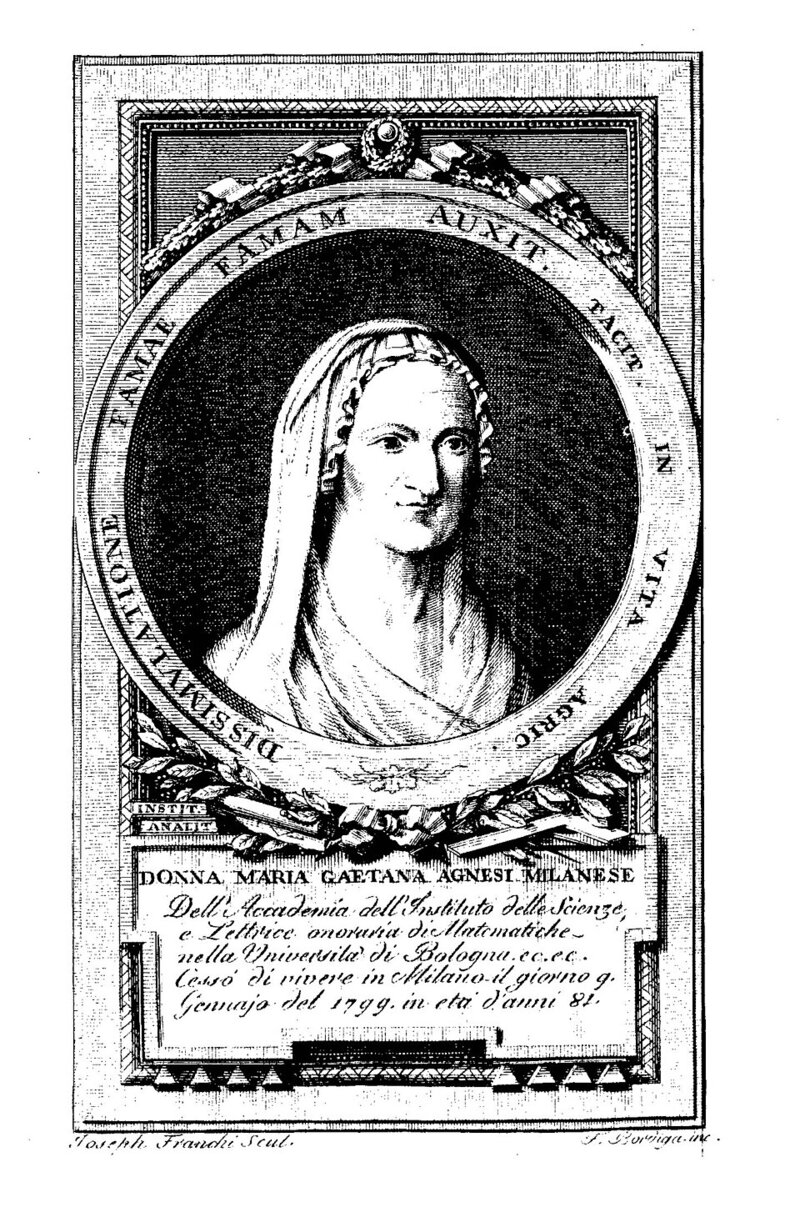
Maria Gaetana Agnesi died at the hospice on 9 January 1799, aged 80. She had spent everything she owned. She was buried in a common grave, together with fifteen other poor people. That same year, Antonio Francesco Frisi published a Historical Eulogy of her.
Exercise: how old?
Agnesi was born on 16 May 1718. How old was she when she recited the speech (1727), when she published the first volume of the Instituzioni (1748), when she was appointed at Bologna (October 1750) and when she died (9 January 1799)?
In 1727 she was 9 (or 8, if the speech came before 16 May). In 1748, 30. In October 1750, 32. In January 1799 she had not yet had her birthday that year: $1798 - 1718 = 80$ years.
Exercise: mathematics and charity
Agnesi worked for about ten years on the book, until 1748, and cared for the poor from 1752 until 1799. What fraction of her adult life, counted from the age of 18, did she devote to each of the two tasks?
Her adult life runs from 1736 to 1799: 63 years. The book took about 10 years, or $\frac{10}{63} \approx 16\%$. Charity took $1799 - 1752 = 47$ years, or $\frac{47}{63} \approx 75\%$. The mathematics that made her famous was a short chapter in a life devoted mainly to others.
Sources: Antonio Francesco Frisi, Elogio storico di Donna Maria Gaetana Agnesi (1799) · Massimo Mazzotti, The World of Maria Gaetana Agnesi, Mathematician of God (2007) · Clifford Truesdell, “Maria Gaetana Agnesi”, Archive for History of Exact Sciences 40 (1989) · biography of Agnesi, MacTutor · Charles de Brosses, Lettres familières écrites d’Italie (written 1739–1740).