
Euler's Eyes
2026-10-19
The fourth dimension: drawing what cannot be seen
All the diagrams in this chapter have one advantage: the object represented fits, one way or another, on paper. But mathematics speaks quite naturally of spaces of four, ten or a million dimensions. Algebra has no difficulty at all: a point in four dimensions is just a list of four numbers, $(x,y,z,w)$. The eye, however, lives in three. How do you draw what cannot be seen?
Flatland
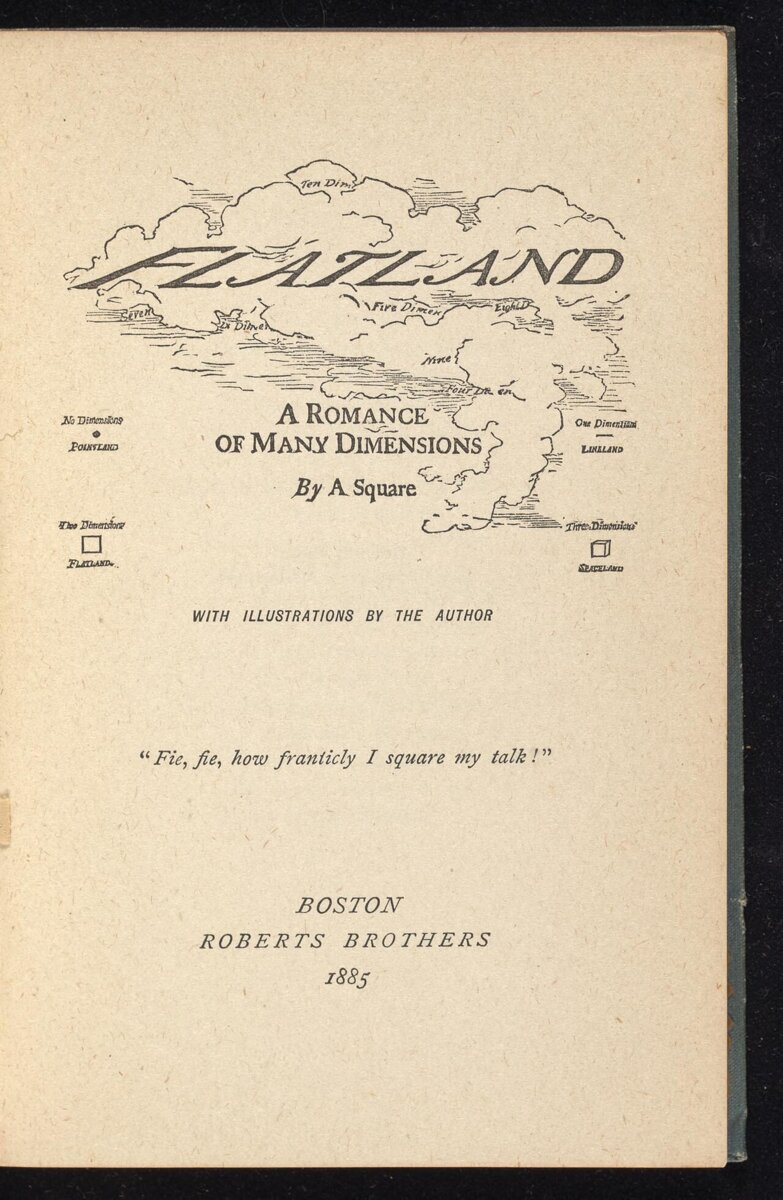
In 1884 Edwin Abbott, headmaster of a school in London, published under the pseudonym A Square a short novel called Flatland. The narrator is a square living in a two-dimensional world inhabited by triangles, squares, pentagons and circles. The inhabitants see only segments: viewed edge-on, every polygon is a line.
One day a sphere visits Flatland. The square sees a point appear, grow into a circle, shrink and vanish: these are the slices of the sphere passing through the plane. He cannot understand what the sphere is until he is lifted out of the plane and sees his own world from above. Back home, he tries to speak of the third dimension and is imprisoned for heresy.
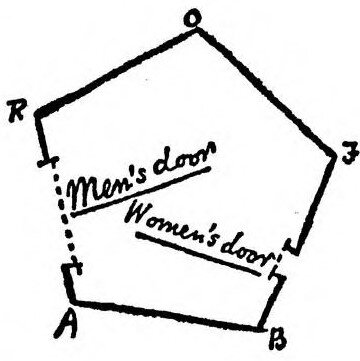
Abbott’s lesson is a method: reason by analogy. We are the square before the sphere. A four-dimensional object passing through our space would appear as a succession of three-dimensional slices growing and shrinking. We cannot see it whole, but we can ask how it would be seen by those who live one dimension below.
Counting without seeing
The analogy works even better with numbers. Look at the sequence of “cubes” in each dimension:
| Dimension | Object | Vertices | Edges |
|---|---|---|---|
| 0 | point | 1 | 0 |
| 1 | segment | 2 | 1 |
| 2 | square | 4 | 4 |
| 3 | cube | 8 | 12 |
| 4 | hypercube | 16 | 32 |
To go from one dimension to the next, copy the object and join each vertex to its copy. The vertices double: $2^n$. The edges are those of the original, those of the copy and the new joins: $2E+V$. From cube to hypercube: $2\cdot12+8=32$. Nobody has seen the 32 edges of a hypercube, but the count is certain. Notation and reasoning reach where the eye cannot. The name tesseract, for the hypercube, was coined by the English mathematician Charles Howard Hinton in 1888.
The shadow of a hypercube
What can be drawn is the shadow. The shadow of a cube on paper is two squares joined at their vertices. The shadow of a hypercube in our space is two cubes joined at their vertices, one inside the other. And the shadow of that shadow on paper is the drawing below.
Turn the hypercube in the $xw$ plane. This plane mixes a direction of our space with the fourth direction, and does not exist for us. The result looks impossible: the inner cube grows, the outer one shrinks, and the two swap places, passing through each other. For an inhabitant of Flatland, a cube turning out of the plane would also seem to turn inside out. The diagram does not show the hypercube; it shows what can be known about it with the eyes we have.
Exercise: the five-dimensional cube
How many vertices and edges does the five-dimensional cube have?
Vertices: $2^5=32$. Edges: those of the hypercube, twice, plus one join per vertex: $2\cdot32+16=80$. In general, the $n$-dimensional cube has $n\cdot2^{n-1}$ edges: for $n=5$, $5\cdot16=80$.
Exercise: the sphere in Flatland
A sphere of radius $5$ passes through Flatland. What is the radius of the circle the square sees when the centre of the sphere is $3$ units from the plane?
By Pythagoras’ theorem, the radius of the slice is $\sqrt{5^2-3^2}=\sqrt{16}=4$. When the centre is in the plane, the radius is $5$; at $5$ units, the slice becomes a point. The square sees a circle that grows from $0$ to $5$ and back to $0$.
Chapter index · ← Proofs without words · How to read a diagram: a guide and a glossary →