
Euler's Eyes
2026-10-19
Euler's circles and Venn diagrams
Between 1760 and 1762, Leonhard Euler wrote more than two hundred letters to a young German princess, a niece of the King of Prussia, to teach her physics, astronomy and philosophy. Published from 1768 onwards as Letters to a German Princess, they became one of the most widely read popular science books of the century. In some of them, to explain the reasoning of logic, Euler drew circles.
Three sentences, three drawings
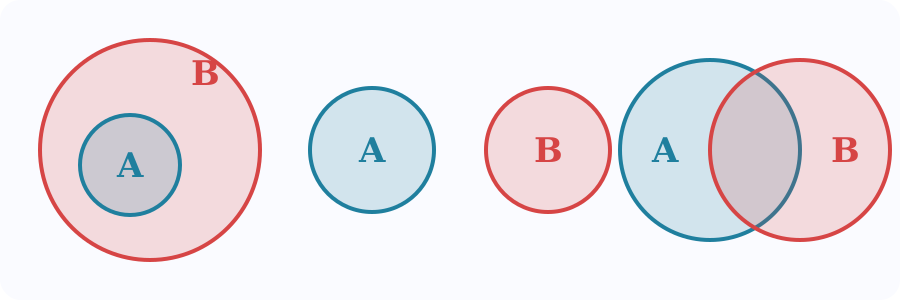
The idea is that each concept occupies a region, and the sentences of logic become positions:
- “Every A is B”: circle $A$ lies inside circle $B$.
- “No A is B”: the circles are separate.
- “Some A is B”: the circles cross, and there is something in the common part.
Now see what happens with a syllogism. “Every A is B. Every B is C.” Draw the first circle inside the second, and the second inside the third. Nothing more needs to be done: the conclusion, “every A is C”, is already in the drawing, because $A$ ended up inside $C$ without anyone putting it there. The diagram does the deduction for free.
An icon of relations
The philosopher Charles Sanders Peirce, whom chapter 2 discussed, explained why this works. A circle does not look like the set of cats or the set of mammals. But the relation between the circles, one inside the other, looks like the relation between the sets. It is an icon of relations: the drawing copies the structure, not the things. Peirce even said that all deductive reasoning is, at bottom, the observation of a diagram, drawn on paper or in the imagination.
Euler’s problem and Venn’s solution
Euler’s circles have a flaw: they force you to decide the position before you know. If the only information is “some A is B”, the circles must cross; but perhaps $A$ lies entirely inside $B$, and the drawing has no way of saying “perhaps”.
In 1880 the English logician John Venn proposed another method. Instead of drawing only the known relations, draw all the possible regions, with the circles always crossing, and mark the information:
- a shaded region is empty;
- a region with an x has at least one element.
With two sets there are four regions: only $A$, only $B$, $A$ and $B$, and neither. With three sets, eight. With $n$ sets, $2^n$. “Every A is B” becomes “the part of $A$ outside $B$ is empty”, and that part is shaded. The question is no longer “where do I put the circles?” but “which regions do I erase?”.
Exercise: shade the sentences
In a Venn diagram with two sets, $A$ and $B$, which regions are shaded for “no A is B”? And for “every A is B” and “every B is A” together?
For “no A is B”, the common part, $A\cap B$, is shaded. For the two sentences together, “$A$ outside $B$” and “$B$ outside $A$” are shaded: only the common part and the outside remain. The drawing says that $A$ and $B$ are the same set.
Exercise: a syllogism that does not hold
“Every A is B. Every C is B. Therefore every A is C.” Draw it with Euler’s circles and decide whether it holds.
Put $A$ and $C$ inside $B$. They can stay apart from each other, inside $B$, and nothing in the statement prevents it. So the conclusion does not hold: every cat is a mammal, every dog is a mammal, and no cat is a dog. The diagram shows a counterexample as soon as you try to draw it.
Chapter index · ← Chapter 5: references and credits · From Oresme to the graph: drawing a quality that varies →