
Euler's Eyes
2026-10-25
Counting, saying and writing numbers
The oldest surviving piece of written mathematics is a scratched bone. The Ishango bone, found in 1950 on the shore of Lake Edward, on the border between the Democratic Republic of the Congo and Uganda, is about 20,000 years old and carries groups of parallel notches carved in three columns. Nobody knows for sure what they counted. But the idea is clear: one mark for each thing.
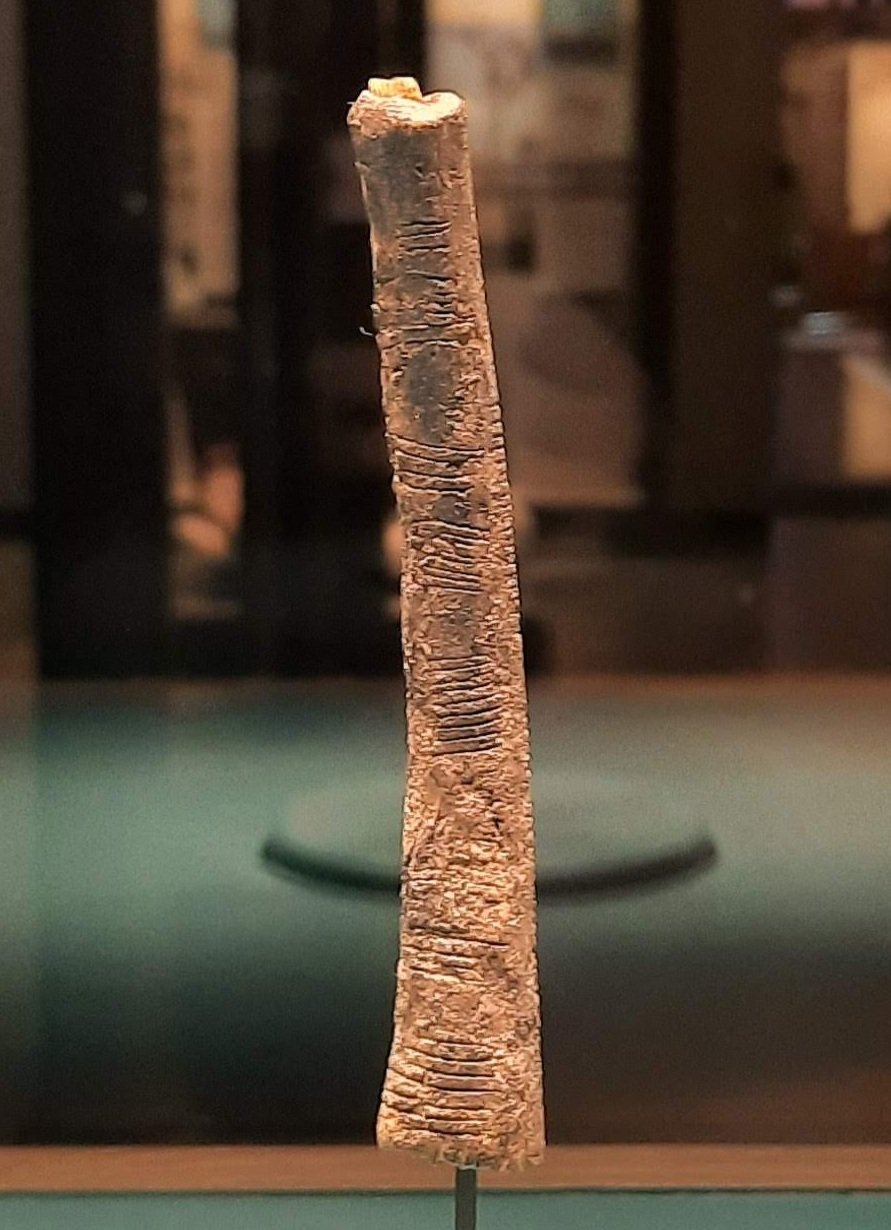
In the language of chapter 2, the notch is an icon: five marks look like five sheep, at least in number. That is why this writing does not need to be taught. You only have to look. The price is size: to write a thousand, a thousand marks.
Three representations of one number
The numbers we write today are the opposite of the notch. The digit $3$ does not look like three things, and in $304$ the $3$ is worth three hundred only because it is in the third place, as we saw in chapter 1. A child learning to count has to link three representations that do not resemble one another:
- the quantity, which can be seen and touched;
- the spoken word, “three hundred and four”;
- the written numeral, $304$.
The word and the numeral have different grammars. Speech adds pieces: three hundred and four. Writing places digits: the $0$ occupies the tens place, which speech does not even mention. When a child writes what she hears, piece by piece, she gets $3004$: the $300$ of “three hundred” followed by the $4$ of “four”.
This error has a name, a transcoding error, and it has been studied in many countries. It is systematic: it appears precisely in numbers whose spoken form hides an empty place, and it almost disappears once the child understands that each place holds one digit, and only one. It is not carelessness; it is the faithful application of a rule that works for speech and not for writing.
Languages that help and languages that hinder
In Portuguese, the names from eleven to fifteen are opaque: onze does not say “ten and one”. In English, eleven and twelve are even more opaque. In French, $97$ is quatre-vingt-dix-sept, “four twenties, ten, seven”: a whole calculation inside a word, inherited from counting in twenties.
In Chinese and Japanese, the names follow the written form. Eleven is 十一, “ten-one”; ninety-seven is 九十七, “nine-ten-seven”. The structure of place value is inside the word. Some comparative studies, such as those of Irene Miura and her colleagues at the end of the 1980s, found East Asian children representing tens and ones with blocks earlier than American children of the same age. The difference is not only one of language (school and family count for a lot), but it shows that the spoken word can help or hinder the reading of the numeral.
Exercise: reading the error
A child writes $5007$ when the teacher dictates “five hundred and seven”, and $200010$ when she dictates “two thousand and ten”. What rule is the child following?
She writes each piece of speech as a complete number and sticks the pieces together: $500$ followed by $7$ gives $5007$; $2000$ followed by $10$ gives $200010$. The rule is consistent, and that is why the error repeats. What is missing is the idea that the $7$ must occupy the ones place of the $500$, not sit next to it: $500+7=507$, and likewise $2000+10=2010$.
Exercise: the name that does the sum
In French, $80$ is quatre-vingts (“four twenties”) and $99$ is quatre-vingt-dix-neuf. What calculation does the word for $99$ hide? How would you say $77$?
$99 = 4 \times 20 + 10 + 9$. For $77$: $77 = 60 + 17$, and the French say soixante-dix-sept, “sixty, ten, seven”, that is, $60 + 10 + 7$. Anyone learning to write these numbers has to do a multiplication and two additions every time they hear one.
Chapter index · ← Chapter 6: references and credits · Read before you calculate: Bogdanov-Belsky’s painting →