A speech in which it is shown that the study of the liberal arts is by no means unsuited to the female sex.
— Title of the Latin speech Agnesi recited at the age of nine, in 1727
Maria Gaetana Agnesi (1718–1799) was the first woman to write a major treatise on mathematics and one of the first to be appointed professor at a university. The eldest daughter of a wealthy Milanese merchant, at nine she recited in Latin a speech defending women’s education, and at twenty she was debating natural philosophy with the scholars who visited her father’s house.
In 1748 she published the Instituzioni analitiche, some thousand pages that took the student from elementary algebra to differential equations, gathering in a single book, and a single notation, what was scattered in papers by Newton, Leibniz, the Bernoullis and Euler. The Paris Academy of Sciences praised it, Empress Maria Theresa sent her a diamond ring, and the pope appointed her to the chair of mathematics at Bologna.
Soon afterwards Agnesi gave up mathematics. She spent the last four decades of her life caring for poor and sick women, and died in the hospice she directed. Her name survived in a bell-shaped curve that an English translator turned, by mistake, into the “witch of Agnesi”.
In this trail we tell Agnesi’s life and redo, with the calculations in plain view, the curve, the book and what came after them.
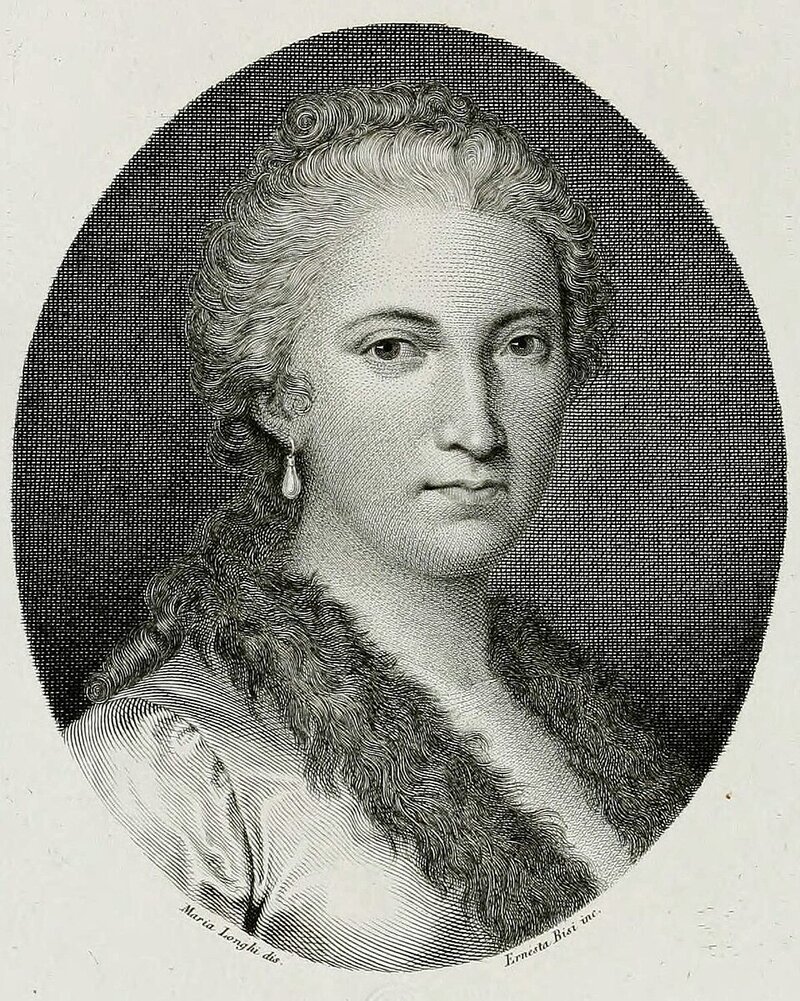
Who she was
Maria Gaetana Agnesi
- Nascimento
- 16 May 1718, Milan
- Morte
- 9 January 1799, Milan
- Origem
- Duchy of Milan (now Italy)
- Áreas
- Differential and integral calculus, analytic geometry, mathematics teaching
Reading guide
Biography
Agnesi’s mathematics
- The curve of Agnesi
- The Instituzioni analitiche
- Maxima, minima and points of inflection
- The area under the curve and the number π
- The inverse method of tangents
- The witch in statistics: the Cauchy distribution
- A woman at the university: the speech of 1727 and the chair at Bologna