
Euler's Eyes
2026-10-24
Metric elements and relationships
We know that a triangle is rectangle when one of its internal angles is right. In this chapter we will develop a geometric-trigonometric theory that allows us to calculate the measurements of segments and angles of a right-angled triangle based on a minimum number of data.
The story
The metric relationships of the right triangle are among the oldest in mathematics. Babylonian tablets from around 1800 BC, such as the famous Plimpton 322, list suits of numbers that satisfy $a^2 = b^2 + c^2$, and the YBC 7289 tablet gives an excellent approximation of $\sqrt{2}$, the diagonal of the square on its side 1. The first known proof of the theorem, however, is Greek: it appears as the proposition 47 of book I of Euclid’s The Elements (around 300 BC), and tradition attributes it to the school of Pythagoras.
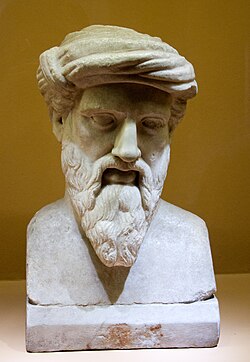
Sources: Pythagoras’s theorem in Babylonian mathematics (MacTutor) · Pythagoras (MacTutor) · Euclid, The Elements, book I, proposition 47.
In everyday life
- Bricklayer’s square. To check whether two walls form a right angle, mark 3 m on one, 4 m on the other and measure the diagonal: you have to give 5 m.
- Shortcut. Crossing diagonally over land measuring 30 m by 40 m runs 50 m, instead of 70 m along the sides.
- Antenna stays. The cable that attaches a tower of height $h$ to a point on the ground at a distance $d$ from the base measures $\sqrt{h^2 + d^2}$.
Theory
Main elements
For the elements of a triangle $ABC$ we will use the usual notation:
| element | notation |
|---|---|
| sides | $\overline{AB}$, $\overline{BC}$, $\overline{AC}$ |
| internal angles | $B\hat{A}C$, $A\hat{B}C$, $A\hat{C}B$ |
| side measurements | $a = BC$, $b = AC$, $c = AB$ |
| angle measurements | $\hat{A}$, $\hat{B}$, $\hat{C}$ |
Each side has the (lowercase) name of the opposite vertex. Whenever we deal with a right triangle $ABC$, we will be thinking that the angle $\hat{A}$ measures $90^\circ$. The side $\overline{BC}$, opposite the right angle, is the hypotenuse; the sides $\overline{AB}$ and $\overline{AC}$, adjacent to the right angle, are the legs. To simplify the language, we will say that the triangle has a hypotenuse $a$ and legs $b$ and $c$, confusing the sides with their measurements.
Geometric Properties
Let us take a right triangle $ABC$ at $A$ and conduct $\overline{AD}$ perpendicular to $\overline{BC}$, with $D$ at $\overline{BC}$. We get:
- $\overline{AD}$, the height relative to the hypotenuse (measurement $h$);
- $\overline{BD}$, the projection of the leg $\overline{AB}$ onto the hypotenuse (measurement $m$);
- $\overline{CD}$, the projection of the leg $\overline{AC}$ onto the hypotenuse (measurement $n$).
The angles $\hat{B}$ and $D\hat{A}C$ are congruent (both are complements of $\hat{C}$), and likewise $\hat{C} \equiv B\hat{A}D$. Thus, the three triangles $ABC$, $DBA$ and $DAC$ are similar, as they have two congruent angles. From this similarity come metric relationships.
TeoremaMetric relations in the right triangle
- $c^2 = a \cdot m$ and $b^2 = a \cdot n$: each side is the geometric mean between the hypotenuse and its projection onto it.
- $b \cdot c = a \cdot h$: the product of the legs is equal to the product of the hypotenuse and the height relative to it.
- $h^2 = m \cdot n$: the height relative to the hypotenuse is the geometric mean between the segments that it determines on the hypotenuse.
- Pythagorean Theorem: $a^2 = b^2 + c^2$.
View the demos
1) $\triangle ABC \sim \triangle DBA$ gives $\dfrac{a}{c} = \dfrac{c}{m}$, that is, $c^2 = am$. And $\triangle ABC \sim \triangle DAC$ gives $\dfrac{a}{b} = \dfrac{b}{n}$, that is, $b^2 = an$.
2) $\triangle ABC \sim \triangle DBA$ also gives $\dfrac{a}{c} = \dfrac{b}{h}$, that is, $bc = ah$.
3) $\triangle DBA \sim \triangle DAC$ gives $\dfrac{h}{n} = \dfrac{m}{h}$, that is, $h^2 = mn$.
4) Adding member to member the two relations of (1):
$$b^2 + c^2 = an + am = a(n + m) = a \cdot a = a^2.$$The median relative to the hypotenuse
TeoremaMedian relative to the hypotenuse
In every right-angled triangle, the median relative to the hypotenuse measures half of the hypotenuse. Consequently, every right-angled triangle can be inscribed in a circle whose diameter is the hypotenuse.
View the demo
Let $M$, $N$ and $O$ be the midpoints of $\overline{AB}$, $\overline{AC}$ and $\overline{BC}$. By the mean base theorem, $\overline{OM} \parallel \overline{AC}$ and $\overline{ON} \parallel \overline{AB}$; as $\hat{A}$ is straight, the quadrilateral $AMON$ is a rectangle. The diagonals of a rectangle are equal, so
$$OA = MN = \frac{BC}{2}.$$Then $OA = OB = OC = \frac{a}{2}$, and the circle with center $O$ and radius $\frac{a}{2}$ passes through the three vertices.
The exercises in this section are numbers 321 to 330 from chapter list.