Euler's Eyes
2026-10-28
The curve of Agnesi
Agnesi did not discover the curve that bears her name. But it was through her book that the curve became known, because she used it as an example of how to pass from a geometric construction to an equation, which was exactly what Descartes’s new method promised.
The construction
Start with a circle of diameter $OM = a$, with $O$ at the bottom and $M$ at the top, and draw the line tangent to the circle at $M$. Now:
- choose any point $N$ on the tangent line;
- draw the line $ON$, which cuts the circle at a point $A$;
- the point $P$ of the curve lies on the vertical through $N$ and on the horizontal through $A$.
As $N$ moves along the tangent, the point $P$ traces a bell-shaped curve:
The equation
Put $O$ at the origin, with the $y$-axis along the diameter. The circle has centre $\left(0, \frac{a}{2}\right)$ and radius $\frac{a}{2}$, that is,
$$x^2 + \left(y - \frac{a}{2}\right)^2 = \frac{a^2}{4} \quad\Longleftrightarrow\quad x^2 + y^2 = ay.$$The tangent at $M$ is the line $y = a$, and the point $N$ is $(n, a)$. The points of the line $ON$ have the form $(tn, ta)$. Substituting into the equation of the circle:
$$t^2 n^2 + t^2 a^2 = a \cdot ta \quad\Longrightarrow\quad t = \frac{a^2}{n^2 + a^2},$$discarding the solution $t = 0$, which is $O$ itself. The height of the point $A$ is therefore $ta = \frac{a^3}{n^2 + a^2}$. The point $P$ has the abscissa of $N$ and the height of $A$, and so, writing $x$ for $n$:
$$y = \frac{a^3}{x^2 + a^2}.$$It is one of the simplest curves one can write: with $a = 1$, $y = \frac{1}{1 + x^2}$.
The shape of the bell
The equation shows everything the figure suggests:
- the curve is symmetric, because $x$ appears only squared;
- the highest point is $(0, a)$, the point $M$ itself, because the denominator is smallest when $x = 0$;
- as $x$ grows, $y$ decreases and approaches zero without ever reaching it: the $x$-axis is an asymptote. For large $x$, $y \approx \frac{a^3}{x^2}$, which falls off like the inverse square.
A curve with many owners
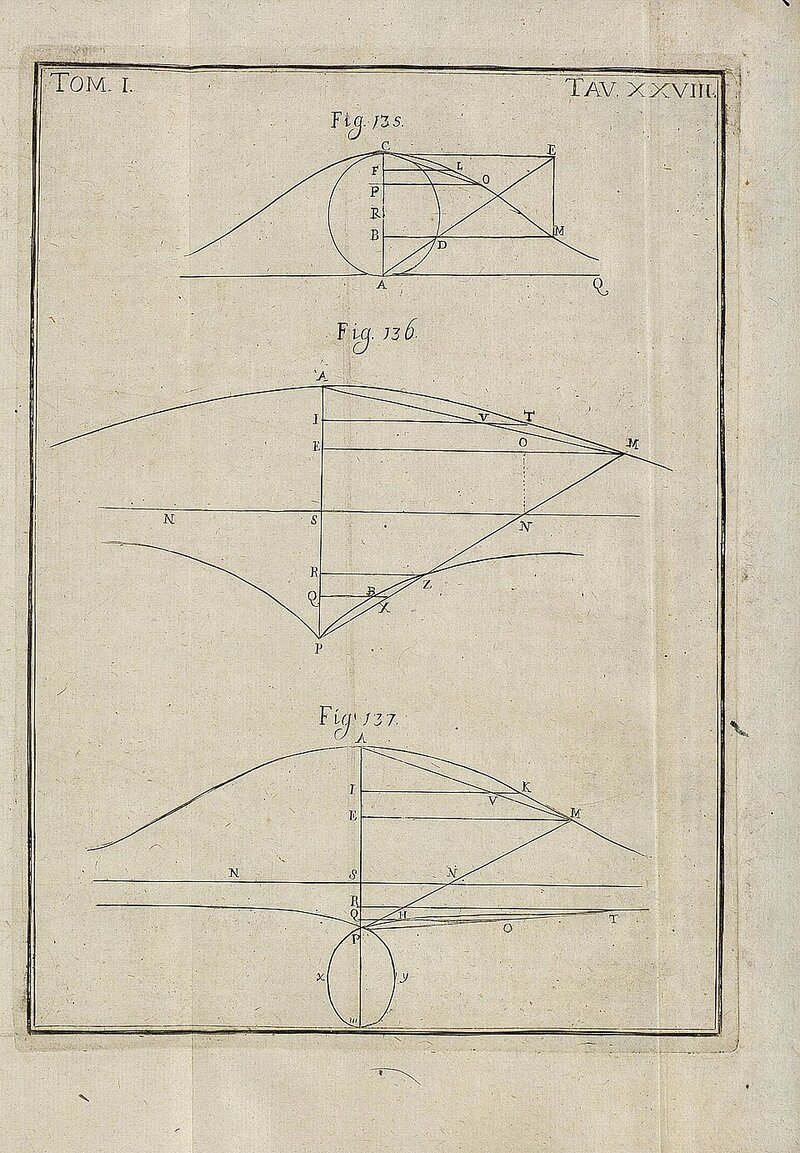
Pierre de Fermat already knew the curve in the mid-seventeenth century. Isaac Newton described the same construction in a manuscript that was only published in 1779. In 1703 the mathematician and monk Guido Grandi, of Pisa, gave the geometric construction, and in 1718 he proposed a name: in Latin versoria, in Italian versiera, words used for the rope that turns the sail of a boat. Agnesi treated the curve in the first volume of the Instituzioni analitiche, in 1748, and called it la versiera.
Exercise: some points of the curve
For $a = 2$, compute the height of the curve at $x = 2$ and find the values of $x$ at which the curve is at half its maximum height.
With $a = 2$, $y = \frac{8}{x^2 + 4}$. At $x = 2$: $y = \frac{8}{8} = 1$. The maximum height is $a = 2$, and half of it is 1. Solving $\frac{8}{x^2 + 4} = 1$: $x^2 = 4$, $x = \pm 2$. In general, the curve is at half height at $x = \pm a$: the “width at half height” of the bell is $2a$, twice the diameter of the circle.
Exercise: the equation with an angle
Let $\theta$ be the angle between the line $ON$ and the diameter $OM$. Show that the point $P$ is $(a \tan\theta,\ a\cos^2\theta)$.
The point $N = (x, a)$ is at height $a$ and at horizontal distance $x$ from the axis, so $\tan\theta = \frac{x}{a}$ and $x = a\tan\theta$. Then
$$y = \frac{a^3}{a^2\tan^2\theta + a^2} = \frac{a}{1 + \tan^2\theta} = a\cos^2\theta,$$using $1 + \tan^2\theta = \frac{1}{\cos^2\theta}$. As $\theta$ goes from $-90°$ to $90°$, the point $P$ runs over the whole curve.
Sources: Maria Gaetana Agnesi, Instituzioni analitiche ad uso della gioventù italiana, vol. I (1748), book I · Guido Grandi, Quadratura circuli et hyperbolae (1703) and Note al trattato del Galileo del moto naturale accelerato (1718) · John Colson (trans.), Analytical Institutions, ed. John Hellins (1801) · Clifford Truesdell, “Maria Gaetana Agnesi”, Archive for History of Exact Sciences 40 (1989).
All topics on Maria Gaetana Agnesi · ← The life of Maria Gaetana Agnesi · The Instituzioni analitiche →