
Euler's Eyes
2026-10-28
ITA 2024 – 2nd phase: Mathematics solved
Source: ITA – 2nd phase Mathematics exam. Files on the ITA past exams page.
The 2nd phase Mathematics exam of ITA 2024 has 10 written questions. ITA does not publish official solutions for the 2nd phase; the solutions below are ours, and each answer was checked by a second route (substitution, another formula or a computer check).
Answers
| Question | Topic | Answer |
|---|---|---|
| 1 | Arithmetic and geometric progressions | $n = 4$ |
| 2 | Paths over the bridges (Euler path) | 32 (16 in each direction) |
| 3 | Inequality with absolute values of logarithms | $-4 < x < -\frac14$ or $\frac14 < x < 4$ |
| 4 | Positive definite matrix | $-1 < b < 1$ |
| 5 | Polynomial symmetric about $x = 1$ | $1 \pm \sqrt{3}$ and $1 \pm i\sqrt{6}$ |
| 6 | Longest segment inside a solid | $\frac{4\sqrt{161}}{5}$ |
| 7 | Circle tangent to the $y$-axis | $(x - 4 - \sqrt{6})^2 + (y - 3 + \sqrt{6})^2 = (4 + \sqrt{6})^2$ |
| 8 | Trapezoid with vertices on the parabola | $\frac{483}{64}$ |
| 9 | Complex roots and area | $4\sqrt{5}$ |
| 10 | Tangent of the half angle | $\frac{1 + \sqrt{5}}{2}$, $\frac{\sqrt{5}}{5}$ and $\frac{5 - \sqrt{5}}{10}$ |
Question 1: How many terms of the geometric progression add up to −80?
Statement
Let $(a_n)$ be an arithmetic progression and $(b_n)$ a geometric progression. If the common difference of $(a_n)$ is $r$, $r \ne 0$, the ratio of $(b_n)$ is $q = 1/r$, $a_1 = b_1 = 4$ and
$$a_1 + a_2 + a_3 + a_4 + a_5 = \frac{50}{3},$$find $n$ such that the sum of the first $n$ terms of the geometric progression equals $-80$.
Solution
1. The common difference. $a_1 + \dots + a_5 = 5a_1 + 10r = 20 + 10r = \frac{50}{3}$, so $r = -\frac{1}{3}$ and $q = \frac{1}{r} = -3$.
2. Sum of the geometric progression. With $b_1 = 4$ and $q = -3$:
$$S_n = \frac{4\left((-3)^n - 1\right)}{-3 - 1} = 1 - (-3)^n$$3. Solving. $1 - (-3)^n = -80 \Rightarrow (-3)^n = 81 = (-3)^4 \Rightarrow n = 4$.
Checking: $4 - 12 + 36 - 108 = -80$ ✔
Answer: $n = 4$.
To review, see Arithmetic progression.
Question 2: Crossing each bridge exactly once
Statement
Four cities $A$, $B$, $C$ and $D$ are connected by six distinct bridges as follows:
- one bridge connects $A$ and $B$;
- one bridge connects $A$ and $C$;
- one bridge connects $B$ and $C$;
- two bridges connect $B$ and $D$;
- one bridge connects $C$ and $D$.
How many paths are possible that link all the cities and cross every bridge exactly once, given that it is allowed to pass through the same city more than once?
Solution
It is the Königsberg bridges problem in miniature: we want Euler paths.
1. Degrees. Counting the bridges at each city: $A$ has 2, $B$ has 4, $C$ has 3 and $D$ has 3. In a path that uses each bridge once, every intermediate city is entered and left the same number of times; so the cities of odd degree are exactly the start and the end. The path starts at $C$ and ends at $D$, or the other way round.
2. Simplifying $A$. $A$ only has the bridges $AB$ and $AC$, which are used in a row ($B \to A \to C$ or $C \to A \to B$). We can treat this stretch as a “bridge” $e$ between $B$ and $C$. That leaves: two links $B$–$C$ ($e$ and the bridge $f = BC$), the bridge $g = CD$ and two bridges $h_1, h_2$ between $B$ and $D$.
3. Counting the paths from $C$ to $D$.
-
Starting with $g$ ($C \to D$). From $D$ we go to $B$ by $h_1$ or $h_2$ (2 choices). At $B$ we cannot go back to $D$ (the $B$–$C$ links would be left unused), so we go to $C$ by $e$ or $f$ (2 choices), come back to $B$ by the other one and finish at $D$ by the remaining bridge $h$. Total: $2 \cdot 2 = 4$.
-
Starting with $e$ or $f$ ($C \to B$, 2 choices). At $B$:
- go back to $C$ by the other link; from $C$ only $g$ to $D$ is left, and from $D$ we do $D \to B \to D$ with $h_1, h_2$ in some order: 2 paths;
- go to $D$ by one $h$ (2 choices); from $D$, either we go to $C$ by $g$ and then $C \to B \to D$, or we go to $B$ by the other $h$ and then $B \to C \to D$: 2 paths. Subtotal $2 \cdot 2 = 4$.
Per initial choice, $2 + 4 = 6$; with the 2 choices, 12.
From $C$ to $D$: $4 + 12 = 16$ paths.
4. The two directions. Each path from $C$ to $D$, walked backwards, is a path from $D$ to $C$. Total: $16 + 16 = 32$.
We checked by computer, listing every route that uses the six bridges once: 16 start at $C$, 16 start at $D$ and none starts at $A$ or $B$.
Answer: 32 paths (16 from $C$ to $D$ and 16 from $D$ to $C$; if a path and its reverse are considered the same, there are 16).
Question 3: A sum of absolute values of logarithms
Statement
Find all real values of $x$ for which
$$\left|\log_{1/2}|x|\right| + \left|\log_2|x|\right| < 4.$$Solution
1. A single base. $\log_{1/2} u = -\log_2 u$, so $\left|\log_{1/2}|x|\right| = \left|\log_2|x|\right|$ and the inequality is
$$2\left|\log_2|x|\right| < 4 \quad\Longleftrightarrow\quad -2 < \log_2|x| < 2 \quad\Longleftrightarrow\quad \frac{1}{4} < |x| < 4$$(with $x \ne 0$ for the logarithm to exist, which is already guaranteed).
Checking with $x = 1$: $0 + 0 < 4$ ✔. With $x = 4$: $2 + 2 = 4$, which is not smaller, and indeed it is left out.
Answer: $x \in \left]-4, -\frac{1}{4}\right[ \;\cup\; \left]\frac{1}{4}, 4\right[$.
To review, see Properties of logarithms.
Question 4: When the matrix is positive definite
Statement
Given a symmetric matrix $A \in M_n(\mathbb{R})$, we say that $A$ is positive definite if
$$X^T A X = [y], \quad y > 0,$$for every $X \in M_{n,1}(\mathbb{R})$ with at least one non-zero entry. Find all possible values of $b \in \mathbb{R}$ such that the matrix
$$A = \begin{pmatrix} 1 & b \\ b & 1 \end{pmatrix}$$is positive definite.
Solution
1. The quadratic form. With $X = \begin{pmatrix} u \\ v \end{pmatrix}$:
$$X^T A X = u^2 + 2buv + v^2 = (u + bv)^2 + (1 - b^2)v^2$$2. If $|b| < 1$: both terms are $\ge 0$. The sum is zero only if $v = 0$ and $u + bv = 0$, that is, $u = v = 0$. So it is positive for every $X \ne 0$ ✔
3. If $|b| \ge 1$: take $u = -b$, $v = 1$. Then $X^T A X = 1 - b^2 \le 0$, and $A$ is not positive definite.
Answer: $-1 < b < 1$.
Question 5: Roots of a polynomial symmetric about 1
Statement
Find the roots of the polynomial $p(x) = x^4 - 4x^3 + 9x^2 - 10x - 14$, given that $p(1 + x) = p(1 - x)$ for all $x \in \mathbb{C}$.
Solution
1. Changing variables. The relation says that $p(1 + t)$ is an even function of $t$: it has only even powers. Computing:
$$p(1 + t) = (1 + t)^4 - 4(1 + t)^3 + 9(1 + t)^2 - 10(1 + t) - 14 = t^4 + 3t^2 - 18$$(the terms in $t^3$ and $t$ cancel: $4 - 4 = 0$ and $4 - 12 + 18 - 10 = 0$.)
2. Biquadratic equation. $t^4 + 3t^2 - 18 = (t^2 + 6)(t^2 - 3) = 0$, so $t = \pm\sqrt{3}$ or $t = \pm i\sqrt{6}$.
3. Back to $x = 1 + t$.
$$x = 1 \pm \sqrt{3}, \qquad x = 1 \pm i\sqrt{6}$$Checking with Vieta: the sum of the roots is $4$ (coefficient $-(-4)$) ✔ and the product is $(1 - 3)(1 + 6) = -14$ ✔
Answer: $1 + \sqrt{3}$, $1 - \sqrt{3}$, $1 + i\sqrt{6}$ and $1 - i\sqrt{6}$.
Question 6: The longest segment inside the L-shaped solid
Statement
The solid $S$ is formed by the union of two congruent rectangular boxes, positioned and sized as in the figure (vista frontal = front view, vista superior = top view).
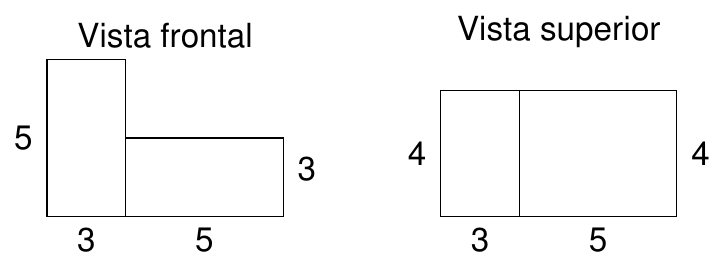
Let $\overline{AB}$ be a line segment entirely contained in $S$ that contains one of the vertices of $S$. Find the largest possible value of $m(\overline{AB})$.
Solution
1. Coordinates. Both boxes are $3 \times 4 \times 5$. Set
- tall box: $0 \le x \le 3$, $0 \le y \le 4$, $0 \le z \le 5$;
- low box: $3 \le x \le 8$, $0 \le y \le 4$, $0 \le z \le 3$.
The longest segment must go from one end of the “L” to the other: from a lower right corner, such as $V = (8, 0, 0)$, to the face $x = 0$, climbing as much as possible without “piercing” the edge $x = 3$, $z = 3$.
2. The restriction. Let the other endpoint be $E = (0, y, z)$. Along $VE$, the height grows linearly with the distance travelled in $x$. At the point where $x = 3$ (after covering 5 of the 8 units in $x$), the height is $\frac{5}{8}z$, and there the segment is still in the low box, so
$$\frac{5}{8}z \le 3 \quad\Rightarrow\quad z \le \frac{24}{5}$$Before that ($x > 3$) the height is even smaller, and after it ($x < 3$) we are in the tall box, which goes up to $z = 5$. Also $y \le 4$.
3. Maximising. $m(\overline{VE})^2 = 8^2 + y^2 + z^2$ is largest with $y = 4$ and $z = \frac{24}{5}$:
$$m(\overline{VE})^2 = 64 + 16 + \frac{576}{25} = \frac{2576}{25} \quad\Rightarrow\quad m(\overline{VE}) = \frac{\sqrt{2576}}{5} = \frac{4\sqrt{161}}{5} \approx 10.15$$The segment touches the inner edge $x = 3$, $z = 3$ (at the point $y = 2.5$), which is allowed, since the solid includes its boundary.
4. Other attempts are shorter. From the top corners of the tall box one cannot reach the right side while climbing little; “straight” links such as $(0,0,0)$ to $(8,4,3)$ give $\sqrt{89} \approx 9.43$; and a segment through the inner corner $(3, 0, 3)$ has to stay in the plane $y = 0$ and measures at most $\sqrt{64 + \frac{576}{25}} \approx 9.33$. A computer search, sweeping thousands of directions from each of the 12 vertices, found nothing longer than $\frac{4\sqrt{161}}{5}$.
Answer: $m(\overline{AB})_{\max} = \dfrac{4\sqrt{161}}{5} \approx 10.15$.
Question 7: The larger circle tangent to the y-axis
Statement
Find the equation of the circle with the largest radius that is tangent to the $y$-axis and passes through the points $(1, 4)$ and $(3, 6)$.
Solution
1. Form of the centre. Tangent to the $y$-axis and passing through points with $x > 0$: the centre is $(r, k)$ with $r > 0$ and radius $r$.
2. Passing through the points.
$$(1 - r)^2 + (4 - k)^2 = r^2 \quad\Rightarrow\quad 1 - 2r + (4 - k)^2 = 0$$$$(3 - r)^2 + (6 - k)^2 = r^2 \quad\Rightarrow\quad 9 - 6r + (6 - k)^2 = 0$$From the 1st, $2r = 1 + (4 - k)^2$. Substituting $6r = 3 + 3(4 - k)^2$ into the 2nd:
$$6 - 3(16 - 8k + k^2) + 36 - 12k + k^2 = 0 \quad\Rightarrow\quad -2k^2 + 12k - 6 = 0 \quad\Rightarrow\quad k = 3 \pm \sqrt{6}$$3. The two radii.
- $k = 3 - \sqrt{6}$: $4 - k = 1 + \sqrt{6}$, $r = \frac{1 + 7 + 2\sqrt{6}}{2} = 4 + \sqrt{6}$.
- $k = 3 + \sqrt{6}$: $4 - k = 1 - \sqrt{6}$, $r = 4 - \sqrt{6}$.
The larger one is $r = 4 + \sqrt{6}$, with centre $(4 + \sqrt{6},\ 3 - \sqrt{6})$.
Checking with $(3, 6)$: $(3 - r)^2 + (6 - k)^2 = (1 + \sqrt{6})^2 + (3 + \sqrt{6})^2 = 7 + 2\sqrt{6} + 15 + 6\sqrt{6} = 22 + 8\sqrt{6} = (4 + \sqrt{6})^2$ ✔
Answer: $(x - 4 - \sqrt{6})^2 + (y - 3 + \sqrt{6})^2 = (4 + \sqrt{6})^2 = 22 + 8\sqrt{6}$.
Question 8: The trapezoid PABV under the parabola
Statement
Consider the parabola with equation $y = 4x - x^2$ and vertex $V$. Let $T$ be the trapezoid $PABV$, where $P = (0, 0)$, $A$ is a point with abscissa in the interval $[2, 4]$ and zero ordinate, and $B$ is a point on the parabola with positive ordinate. Given that $m(\overline{AB}) = \frac{7}{8}\sqrt{5}$, find the area of $T$.
Solution
1. The vertex. $y = 4 - (x - 2)^2$, so $V = (2, 4)$.
2. Which sides are parallel? If $PA \parallel BV$, segment $BV$ would be horizontal and $B$ would have ordinate 4, that is, $B = V$. So the parallel sides are $AB$ and $VP$. Line $PV$ has slope $\frac{4}{2} = 2$.
3. Finding $A$ and $B$. With slope 2 and length $\frac{7\sqrt{5}}{8}$, segment $AB$ moves $\frac{7}{8}$ in $x$ and $\frac{7}{4}$ in $y$ (since $\sqrt{1 + 4} = \sqrt{5}$). As $A$ is on the $x$-axis and $B$ has positive ordinate, $B = \left(a + \frac{7}{8}, \frac{7}{4}\right)$. On the parabola:
$$4b - b^2 = \frac{7}{4} \quad\Rightarrow\quad 4b^2 - 16b + 7 = 0 \quad\Rightarrow\quad b = \frac{7}{2} \text{ or } b = \frac{1}{2}$$Then $a = b - \frac{7}{8} = \frac{21}{8}$ or $-\frac{3}{8}$; only $a = \frac{21}{8}$ lies in $[2, 4]$. $A = \left(\frac{21}{8}, 0\right)$ and $B = \left(\frac{7}{2}, \frac{7}{4}\right)$.
4. Area. The bases are $m(\overline{PV}) = 2\sqrt{5}$ and $m(\overline{AB}) = \frac{7\sqrt{5}}{8}$. The height is the distance from $A$ to line $PV$: $2x - y = 0$:
$$h = \frac{|2\cdot\frac{21}{8} - 0|}{\sqrt{5}} = \frac{21}{4\sqrt{5}}$$$$S = \frac{1}{2}\left(2\sqrt{5} + \frac{7\sqrt{5}}{8}\right)\cdot\frac{21}{4\sqrt{5}} = \frac{1}{2}\cdot\frac{23}{8}\cdot\frac{21}{4} = \frac{483}{64}$$Checking with the shoelace formula with $P(0,0)$, $A\left(\frac{21}{8},0\right)$, $B\left(\frac72,\frac74\right)$, $V(2,4)$: $\frac{1}{2}\left(\frac{21}{8}\cdot\frac{7}{4} + \frac{7}{2}\cdot 4 - 2\cdot\frac{7}{4}\right) = \frac{1}{2}\left(\frac{147}{32} + \frac{21}{2}\right) = \frac{483}{64}$ ✔
Answer: $S = \dfrac{483}{64} \approx 7.55$.
Question 9: The quadrilateral of the four roots
Statement
Let $z = 1 + ai$ be a root of the polynomial $p(x) = x^4 + 10x^2 + mx + 29$, where $a$ and $m$ are real numbers. Find the area of the quadrilateral whose vertices are the four complex roots of $p(x)$ in the Argand–Gauss plane.
Solution
1. Factorisation. The coefficients are real, so $1 - ai$ is also a root, and $(x - 1)^2 + a^2 = x^2 - 2x + 1 + a^2$ divides $p$. Since there is no $x^3$ term, the sum of the roots is 0, and the other two add up to $-2$:
$$p(x) = (x^2 - 2x + 1 + a^2)(x^2 + 2x + c)$$2. Comparing coefficients. Expanding,
- $x^2$: $c - 4 + 1 + a^2 = 10 \Rightarrow c = 13 - a^2$;
- constant term: $c(1 + a^2) = 29$.
With $s = a^2$: $(13 - s)(1 + s) = 29 \Rightarrow s^2 - 12s + 16 = 0 \Rightarrow s = 6 \pm 2\sqrt{5}$.
3. The other roots. $x^2 + 2x + c = 0$ gives $x = -1 \pm i\sqrt{c - 1}$, with $c - 1 = 12 - s = 6 \mp 2\sqrt{5} > 0$. Note that $6 \pm 2\sqrt{5} = (\sqrt{5} \pm 1)^2$. So, in both cases, the heights are $\sqrt{5} + 1$ and $\sqrt{5} - 1$ (in some order):
| roots | $s = 6 + 2\sqrt{5}$ | $s = 6 - 2\sqrt{5}$ |
|---|---|---|
| $1 \pm ai$ | $1 \pm (\sqrt{5} + 1)i$ | $1 \pm (\sqrt{5} - 1)i$ |
| $-1 \pm i\sqrt{c - 1}$ | $-1 \pm (\sqrt{5} - 1)i$ | $-1 \pm (\sqrt{5} + 1)i$ |
4. Area. The vertices form an isosceles trapezoid with vertical bases at $x = 1$ and $x = -1$ (distance 2), of lengths $2(\sqrt{5} + 1)$ and $2(\sqrt{5} - 1)$:
$$S = \frac{2(\sqrt{5} + 1) + 2(\sqrt{5} - 1)}{2}\cdot 2 = 4\sqrt{5}$$Both cases give the same area (one is the mirror image of the other in the imaginary axis, with $m = \pm 8\sqrt{5}$).
Remark: we assumed $a \ne 0$. If $a = 0$, then $z = 1$ would be a real root, $m = -40$, and the four roots ($1$, $\approx 1.81$ and $\approx -1.40 \pm 3.75i$) do not form a convex quadrilateral: the point $1$ lies inside the triangle formed by the other three.
Answer: $4\sqrt{5}$.
Question 10: Tangents of the half angles
Statement
Given that $\tan(\alpha + \beta) = -2$ and $\sin(\alpha) = (4 - \sqrt{5})\sin(\beta)$ for $\alpha, \beta \in (0, \pi/2)$, compute
$$\tan\left(\frac{\alpha + \beta}{2}\right), \quad \tan\left(\frac{\alpha - \beta}{2}\right) \quad\text{and}\quad \frac{\tan\left(\frac{\alpha - \beta}{2}\right)}{\tan\left(\frac{\alpha + \beta}{2}\right)}.$$Solution
1. Tangent of $\frac{\alpha + \beta}{2}$. With $T = \tan\frac{\alpha + \beta}{2}$, the double-angle formula gives
$$\frac{2T}{1 - T^2} = -2 \quad\Rightarrow\quad T^2 - T - 1 = 0 \quad\Rightarrow\quad T = \frac{1 \pm \sqrt{5}}{2}$$Since $0 < \frac{\alpha + \beta}{2} < \frac{\pi}{2}$, $T > 0$: $T = \frac{1 + \sqrt{5}}{2}$.
2. The ratio. Turning sums into products,
$$\frac{\sin\alpha - \sin\beta}{\sin\alpha + \sin\beta} = \frac{2\cos\frac{\alpha + \beta}{2}\sin\frac{\alpha - \beta}{2}}{2\sin\frac{\alpha + \beta}{2}\cos\frac{\alpha - \beta}{2}} = \frac{\tan\frac{\alpha - \beta}{2}}{\tan\frac{\alpha + \beta}{2}}$$Dividing numerator and denominator by $\sin\beta$:
$$\frac{(4 - \sqrt{5}) - 1}{(4 - \sqrt{5}) + 1} = \frac{3 - \sqrt{5}}{5 - \sqrt{5}} = \frac{(3 - \sqrt{5})(5 + \sqrt{5})}{20} = \frac{10 - 2\sqrt{5}}{20} = \frac{5 - \sqrt{5}}{10}$$3. Tangent of $\frac{\alpha - \beta}{2}$.
$$\tan\frac{\alpha - \beta}{2} = \frac{5 - \sqrt{5}}{10}\cdot\frac{1 + \sqrt{5}}{2} = \frac{5 + 5\sqrt{5} - \sqrt{5} - 5}{20} = \frac{\sqrt{5}}{5}$$Checking numerically: $\alpha + \beta = 2\arctan\frac{1 + \sqrt{5}}{2} \approx 2.035$ and $\alpha - \beta = 2\arctan\frac{\sqrt{5}}{5} \approx 0.841$ give $\alpha \approx 1.438$ and $\beta \approx 0.597$, both in $(0, \pi/2)$, with $\tan(\alpha + \beta) = -2$ and $\frac{\sin\alpha}{\sin\beta} \approx 1.764 = 4 - \sqrt{5}$ ✔
Answer: $\tan\dfrac{\alpha + \beta}{2} = \dfrac{1 + \sqrt{5}}{2}$, $\tan\dfrac{\alpha - \beta}{2} = \dfrac{\sqrt{5}}{5}$ and the ratio is $\dfrac{5 - \sqrt{5}}{10}$.
To review, see Half-angle formulas.