
Euler's Eyes
2026-10-30
Limits and continuity
In the eighteenth century calculus was a formidable and somewhat mysterious machine. Euler summed divergent series and drew correct results from them; Lagrange tried to base everything on power series; books spoke of “infinitely small” quantities that were zero when convenient and non-zero when not. It worked, but nobody could explain exactly why.
The Cours d’analyse
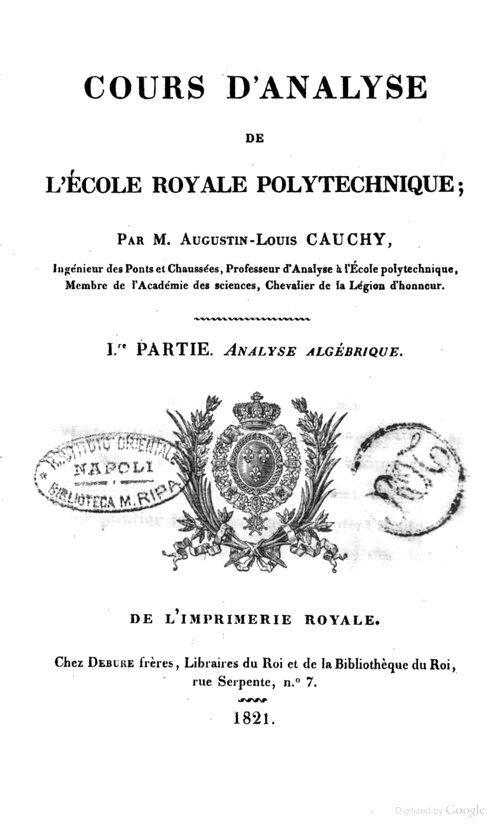
In 1821 Cauchy published the Cours d’analyse de l’École royale polytechnique, with the lessons he gave to future engineers. In the preface he announced his intention of giving analysis “all the rigour that is demanded in geometry”. Everything begins with a definition:
When the values successively attributed to the same variable approach a fixed value indefinitely, so as to end up differing from it by as little as one wishes, this last value is called the limit of all the others.
— Augustin-Louis Cauchy, Cours d'analyse (1821)
From then on, an infinitesimal is no longer a mysterious quantity: it is simply a variable whose limit is zero. For example, $\frac{1}{n}$ is an infinitesimal as $n$ grows, because, given any small number, $\frac{1}{n}$ eventually becomes smaller than it and never comes back.
Continuous function
The second definition is that of continuity. For Euler, a continuous function was one given by a single formula. Cauchy replaced this idea with another, which looks at how the function behaves:
The function f(x) will be continuous between the given limits if, for each value of x between these limits, the numerical value of the difference f(x + α) − f(x) decreases indefinitely with that of α.
— Augustin-Louis Cauchy, Cours d'analyse (1821)
In today’s language: a small increase in the variable produces a small change in the function. Forty years later, Weierstrass would write this with the letters every student knows: for every $\varepsilon > 0$ there is a $\delta > 0$ such that $|f(x+\alpha) - f(x)| < \varepsilon$ whenever $|\alpha| < \delta$. The letters themselves already appear in Cauchy’s proofs of 1823.
The intermediate value theorem
With the definition in hand, Cauchy proved a fact that everyone found obvious: if $f$ is continuous on $[a, b]$ and $f(a)$ and $f(b)$ have opposite signs, there is a point between $a$ and $b$ where $f$ is zero. The Bohemian Bernard Bolzano had published a proof in 1817 that almost nobody read.
Cauchy’s idea is to keep narrowing the interval. In its simplest version, bisection, you cut $[a, b]$ in half and keep the half on which the function still changes sign. Repeating this gives nested intervals, each half as long as the one before. The left ends form a sequence that only increases, the right ends one that only decreases, and the distance between them tends to zero: both have the same limit $c$. By continuity, $f(c)$ is the limit of the negative values at the ends on one side and of the positive values at the ends on the other. It can only be $f(c) = 0$.
Take $f(x) = x^3 - 2x - 5$, the equation Newton used to show off his method. Since $f(2) = -1$ and $f(3) = 16$, there is a root between 2 and 3:
| step | interval | midpoint $m$ | $f(m)$ |
|---|---|---|---|
| 1 | $[2,\ 3]$ | $2.5$ | $5.625 > 0$ |
| 2 | $[2,\ 2.5]$ | $2.25$ | $1.891 > 0$ |
| 3 | $[2,\ 2.25]$ | $2.125$ | $0.346 > 0$ |
| 4 | $[2,\ 2.125]$ | $2.0625$ | $-0.351 < 0$ |
| 5 | $[2.0625,\ 2.125]$ | $2.09375$ | $-0.009 < 0$ |
After five steps the root lies in $[2.09375,\ 2.125]$; the exact value is $2.0945515\ldots$ In the figure, advance the steps and watch the interval close in:
Exercise: how many steps?
Starting from an interval of length 1, how many bisection steps are needed to guarantee the root with an error smaller than $10^{-6}$?
After $n$ steps the interval has length $2^{-n}$. We want $2^{-n} < 10^{-6}$, that is, $2^n > 1\,000\,000$. Since $2^{19} = 524\,288$ and $2^{20} = 1\,048\,576$, $n = 20$ steps are enough. Each step gives a little more than 0.3 of a decimal place, because $\log_{10} 2 \approx 0.301$.
Exercise: a fifth-degree equation
Show that $x^5 - x - 1 = 0$ has a root between 1 and 2 and carry out three bisection steps.
$f(1) = -1 < 0$ and $f(2) = 32 - 2 - 1 = 29 > 0$. Since $f$ is continuous, there is a root in $[1, 2]$. Step 1: $f(1.5) \approx 5.09 > 0$, the root is in $[1,\ 1.5]$. Step 2: $f(1.25) \approx 0.80 > 0$, leaving $[1,\ 1.25]$. Step 3: $f(1.125) \approx -0.32 < 0$, leaving $[1.125,\ 1.25]$. The root is $1.1673\ldots$ This equation cannot be solved by radicals, as Abel and Galois showed, but bisection finds it to as many decimal places as you like.
Sources: Augustin-Louis Cauchy, Cours d’analyse de l’École royale polytechnique. 1re partie: Analyse algébrique (1821), ch. 2 and note III · Judith V. Grabiner, The Origins of Cauchy’s Rigorous Calculus (1981) · Robert E. Bradley and C. Edward Sandifer, Cauchy’s Cours d’analyse: An Annotated Translation (2009) · George Berkeley, The Analyst (1734).
All topics on Augustin-Louis Cauchy · ← Determinants and permutations · The convergence of series →