
Euler's Eyes
2026-10-23
Addition formulas
Let’s deduce formulas to calculate the trigonometric functions of the sum $(a + b)$ and the difference $(a - b)$ of any two real numbers $a$ and $b$, known as the circular functions of $a$ and $b$.
The story
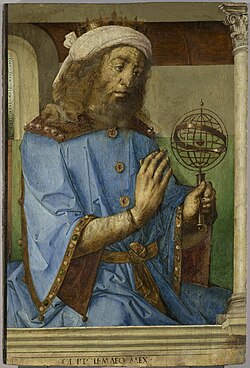
In Almagest, Ptolemy proved that, in an inscribed quadrilateral, the product of the diagonals is equal to the sum of the products of the opposite sides — Ptolemy’s theorem. Applied to a quadrilateral with a side equal to the diameter, it gives exactly the chord formulas for the sum and difference of two arcs, which Ptolemy used to assemble his half-by-half degree table. In the form of sines, the formulas appear with the Persian astronomer Abu al-Wafa (10th century), whom we already met in chapter II. The demonstration we will do — based on the distance between two points — uses Descartes’ analytical geometry and is much more recent.
strings of 36°, 60°, 72°, 90°, 120°"] --> B["difference string
72° − 60° = 12°"] B --> C["half string
6°, 3°, 1½°, ¾°"] C --> D["inequality
string of 1°"] D --> E["half
½° chord"] E --> F["sum of ½° in ½°
complete board up to 180°"]
Sources: Ptolemy (MacTutor) · Abu al-Wafa (MacTutor).
In everyday life
- Rotate images. To rotate a point $(x, y)$ by an angle $\theta$, imaging programs calculate $(x\cos\theta - y\operatorname{sen}\theta,\; x\operatorname{sen}\theta + y\cos\theta)$ — addition formulas written in coordinates.
- Map that rotates with your cell phone. When you turn your body, the maps application adds the compass rotation to the direction that was already on the screen: sum of arcs.
- Exact values. A bearing of $30^\circ$ followed by a turn of $45^\circ$ gives the direction $75^\circ$, and $\operatorname{sen} 75^\circ = \operatorname{sen}(30^\circ + 45^\circ) = \frac{\sqrt{6} + \sqrt{2}}{4} \approx 0{,}966$.
Theory
Cosine of the sum
Let $P$, $Q$ and $R$ be the cycle points associated with the numbers $a$, $a + b$ and $-b$, respectively. In relation to the system $uOv$, the coordinates of these points are
$$P(\cos a, \operatorname{sen} a) \qquad Q(\cos(a + b), \operatorname{sen}(a + b)) \qquad R(\cos b, -\operatorname{sen} b).$$TeoremaCosine of the sum
$$\cos(a + b) = \cos a \cdot \cos b - \operatorname{sen} a \cdot \operatorname{sen} b$$View the demo
The arcs $\overset{\frown}{AQ}$ and $\overset{\frown}{RP}$ have the same measurement ($a + b$); therefore the strings $\overline{AQ}$ and $\overline{PR}$ are the same. Applying the formula for the distance between two points of analytical geometry, with $A(1, 0)$:
$$d_{AQ}^2 = [\cos(a + b) - 1]^2 + [\operatorname{sen}(a + b) - 0]^2 = \cos^2(a + b) - 2\cos(a + b) + 1 + \operatorname{sen}^2(a + b) = 2 - 2\cos(a + b)$$$$d_{RP}^2 = [\cos a - \cos b]^2 + [\operatorname{sen} a + \operatorname{sen} b]^2 = \cos^2 a - 2\cos a\cos b + \cos^2 b + \operatorname{sen}^2 a + 2\operatorname{sen} a\operatorname{sen} b + \operatorname{sen}^2 b$$$$= 2 - 2\cos a\cos b + 2\operatorname{sen} a\operatorname{sen} b.$$From $d_{AQ} = d_{RP}$ comes $2 - 2\cos(a + b) = 2 - 2\cos a\cos b + 2\operatorname{sen} a\operatorname{sen} b$, which is the formula.
Cosine of the difference
TeoremaCosine of the difference
$$\cos(a - b) = \cos a \cdot \cos b + \operatorname{sen} a \cdot \operatorname{sen} b$$View the demo
Using the previous formula and parity ($\cos(-b) = \cos b$, $\operatorname{sen}(-b) = -\operatorname{sen} b$):
$$\cos(a - b) = \cos[a + (-b)] = \cos a\cos(-b) - \operatorname{sen} a\operatorname{sen}(-b) = \cos a\cos b - \operatorname{sen} a(-\operatorname{sen} b).$$Sine of sum and difference
TeoremaSine of the sum and sine of the difference
$$\operatorname{sen}(a + b) = \operatorname{sen} a \cdot \cos b + \operatorname{sen} b \cdot \cos a$$$$\operatorname{sen}(a - b) = \operatorname{sen} a \cdot \cos b - \operatorname{sen} b \cdot \cos a$$View the demos
We use the complementary arcs, $\operatorname{sen} x = \cos\left(\frac{\pi}{2} - x\right)$:
$$\operatorname{sen}(a + b) = \cos\left[\frac{\pi}{2} - (a + b)\right] = \cos\left[\left(\frac{\pi}{2} - a\right) - b\right] = \cos\left(\frac{\pi}{2} - a\right)\cos b + \operatorname{sen}\left(\frac{\pi}{2} - a\right)\operatorname{sen} b,$$that is, $\operatorname{sen}(a + b) = \operatorname{sen} a\cos b + \cos a\operatorname{sen} b$. For the difference:
$$\operatorname{sen}(a - b) = \operatorname{sen}[a + (-b)] = \operatorname{sen} a\cos(-b) + \operatorname{sen}(-b)\cos a = \operatorname{sen} a\cos b + (-\operatorname{sen} b)\cos a.$$Tangent of sum and difference
TeoremaTangent of sum and difference
$$\operatorname{tg}(a + b) = \frac{\operatorname{tg} a + \operatorname{tg} b}{1 - \operatorname{tg} a \cdot \operatorname{tg} b} \qquad \left(a, b, a + b \ne \frac{\pi}{2} + k\pi\right)$$$$\operatorname{tg}(a - b) = \frac{\operatorname{tg} a - \operatorname{tg} b}{1 + \operatorname{tg} a \cdot \operatorname{tg} b} \qquad \left(a, b, a - b \ne \frac{\pi}{2} + k\pi\right)$$View the demos
Dividing numerator and denominator by $\cos a\cos b$ (not null, according to the conditions):
$$\operatorname{tg}(a + b) = \frac{\frac{\operatorname{sen} a\cos b}{\cos a\cos b} + \frac{\operatorname{sen} b\cos a}{\cos a\cos b}}{\frac{\cos a\cos b}{\cos a\cos b} - \frac{\operatorname{sen} a\operatorname{sen} b}{\cos a\cos b}} = \frac{\operatorname{tg} a + \operatorname{tg} b}{1 - \operatorname{tg} a\operatorname{tg} b}.$$For the difference, as the tangent is odd:
$$\operatorname{tg}(a - b) = \operatorname{tg}[a + (-b)] = \frac{\operatorname{tg} a + \operatorname{tg}(-b)}{1 - \operatorname{tg} a\operatorname{tg}(-b)} = \frac{\operatorname{tg} a - \operatorname{tg} b}{1 + \operatorname{tg} a\operatorname{tg} b}.$$Cotangent of sum and difference
TeoremaCotangent of sum and difference
$$\operatorname{cotg}(a + b) = \frac{\operatorname{cotg} a \cdot \operatorname{cotg} b - 1}{\operatorname{cotg} a + \operatorname{cotg} b} \qquad (a, b, a + b \ne k\pi)$$$$\operatorname{cotg}(a - b) = \frac{\operatorname{cotg} a \cdot \operatorname{cotg} b + 1}{\operatorname{cotg} b - \operatorname{cotg} a} \qquad (a, b, a - b \ne k\pi)$$View the demos
Dividing numerator and denominator by $\operatorname{sen} a\operatorname{sen} b$:
$$\operatorname{cotg}(a + b) = \frac{\frac{\cos a\cos b}{\operatorname{sen} a\operatorname{sen} b} - 1}{\frac{\cos b}{\operatorname{sen} b} + \frac{\cos a}{\operatorname{sen} a}} = \frac{\operatorname{cotg} a\operatorname{cotg} b - 1}{\operatorname{cotg} a + \operatorname{cotg} b}.$$And, with $\operatorname{cotg}(-b) = -\operatorname{cotg} b$:
$$\operatorname{cotg}(a - b) = \frac{\operatorname{cotg} a(-\operatorname{cotg} b) - 1}{\operatorname{cotg} a + (-\operatorname{cotg} b)} = \frac{\operatorname{cotg} a\operatorname{cotg} b + 1}{\operatorname{cotg} b - \operatorname{cotg} a}.$$ExemploAn unremarkable bow with exact value
$$\cos 15^\circ = \cos(45^\circ - 30^\circ) = \frac{\sqrt{2}}{2} \cdot \frac{\sqrt{3}}{2} + \frac{\sqrt{2}}{2} \cdot \frac{1}{2} = \frac{\sqrt{6} + \sqrt{2}}{4}.$$Compare with the exercise 126: there we obtained $\cos 15^\circ = \frac{\sqrt{2 + \sqrt{3}}}{2}$. The two values are the same, because $\left(\frac{\sqrt{6} + \sqrt{2}}{4}\right)^2 = \frac{8 + 2\sqrt{12}}{16} = \frac{2 + \sqrt{3}}{4}$.
To memorize
Brazilian students invented phrases to store addition formulas. Two of the best known:
ResumoTwo sentences
- “My land has palm trees, where the thrush sings: sine $a$ cosine $b$, sine $b$ cosine $a$.”
- “Itches $a$, scratches $b$, changes the sign without knowing: sine $a$, sine $b$.”
In the difference, the middle sign in both formulas is changed.
Better than memorizing is checking with known values. With $a = 60^\circ$ and $b = 30^\circ$, the sum is $90^\circ$, whose sine is $1$ and whose cosine is $0$:
$$\operatorname{sen} 90^\circ = \frac{\sqrt{3}}{2}\cdot\frac{\sqrt{3}}{2} + \frac{1}{2}\cdot\frac{1}{2} = \frac{3}{4} + \frac{1}{4} = 1, \qquad \cos 90^\circ = \frac{1}{2}\cdot\frac{\sqrt{3}}{2} - \frac{\sqrt{3}}{2}\cdot\frac{1}{2} = 0.$$If the phrase is changed, the account does not close.
The exercises in this section are numbers 131 to 146 from chapter list.