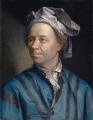
Euler's Eyes
2026-10-22
Trigonometric cycle
The trigonometric cycle is the “race track” of trigonometry: a circle of radius 1 in which each real number is a route from a starting point. All the functions of the next chapters will be read in it.
The story
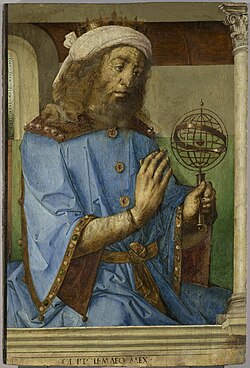
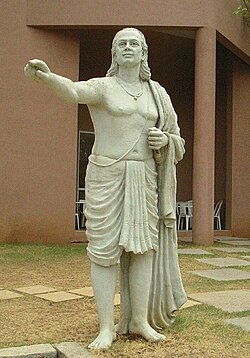
Greek and Indian astronomers worked with circles of large radius — Ptolemy used radius 60 and Aryabhata, 3438 — to avoid fractions in tables. It was Euler, in the 18th century, who fixed the radius 1: thus the length of the arc is the measurement of the angle itself in radians, and sine and cosine become numbers, not lengths of segments. The idea of wrapping the real line around the circumference, allowing negative arcs greater than a turn, is what transforms the trigonometry of triangles into a theory of periodic functions.
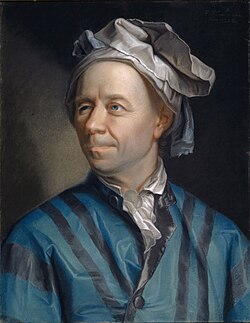
- Born and raised in Switzerland. At 13 he enters the university and starts Saturday lessons with Johann Bernoulli.
- He travels down the Rhine by boat, crosses Germany by coach and sets sail from Lübeck for Russia.
- He works at the Academy of Sciences. He solves the Basel problem, studies the Königsberg bridges and loses the sight of his right eye.
- At the invitation of Frederick II he moves to the Berlin Academy. He publishes the Introductio in analysin infinitorum and the formula $e^{ix}=\cos x+i\sin x$.
- He returns at the invitation of Catherine the Great. He goes almost blind but keeps dictating papers until his death in 1783.
Sources: Euler (MacTutor) · Aryabhata (MacTutor).
In everyday life
- Ferris wheel. The height of a cabin is the height of the center plus $r \operatorname{sen}\theta$, where $\theta$ is the arc traversed from the rightmost point — it is the expanded trigonometric cycle.
- Longitude. Walking $190^\circ$ east from Greenwich leads to the same meridian as walking $170^\circ$ west: congruous arcs, with different names.
- Games and animations. A character that rotates $370^\circ$ is in the same position as one that rotates $10^\circ$; programs keep the angle “reduced” to one turn so as not to accumulate huge numbers.
Theory
Definition
Let us take in the plane an orthogonal Cartesian system $uOv$ and the circle $\lambda$ with center $O$ and radius $r = 1$. The length of $\lambda$ is $2\pi$ because $r = 1$. Let them be $A = (1, 0)$, $B = (0, 1)$, $A' = (-1, 0)$ and $B' = (0, -1)$.
DefiniçãoTrigonometric cycle
We associate each real number $x$ with a single point $P$ of $\lambda$ as follows:
- if $x = 0$, then $P$ coincides with $A$;
- if $x > 0$, we carry out from $A$ a path of length $x$ in counterclockwise and mark $P$ at the end of the path;
- if $x < 0$, we carry out from $A$ a path of length $|x|$ in clockwise; the end of the route is $P$.
The circle $\lambda$, originating at $A$, is the cycle (or circle) trigonometric. If $P$ is associated with $x$, we say that $P$ is the image of $x$ in the cycle.
Congruent numbers
If $P$ is the image of the number $x_0$, then $P$ is also the image of
$$x_0 + 2\pi,\quad x_0 + 4\pi,\quad x_0 + 6\pi,\ \ldots$$and also of
$$x_0 - 2\pi,\quad x_0 - 4\pi,\quad x_0 - 6\pi,\ \ldots$$because adding or subtracting $2\pi$ adds or removes an entire lap from the route.
PropriedadeNumbers that have the same image
$P$ is the image of the elements of the set
$$\{\,x \in \mathbb{R} \mid x = x_0 + 2k\pi,\ k \in \mathbb{Z}\,\}.$$DefiniçãoCongruent numbers
Two real numbers $x_1 = x_0 + 2k_1\pi$ and $x_2 = x_0 + 2k_2\pi$ ($k_1, k_2 \in \mathbb{Z}$), which have the same image $P$ in the cycle, satisfy $x_1 - x_2 = 2k\pi$, with $k = k_1 - k_2$. That’s why we say that $x_1$ and $x_2$ are congruous module $2\pi$, or simply congruous.
ExemploFinding the image of a large number
To mark $\dfrac{25\pi}{3}$, we write $\dfrac{25\pi}{3} = \dfrac{\pi}{3} + \dfrac{24\pi}{3} = \dfrac{\pi}{3} + 8\pi$. As $8\pi$ are 4 full turns, $\dfrac{25\pi}{3}$ and $\dfrac{\pi}{3}$ are congruous and have the same image: the point at $\dfrac{1}{6}$ of the cycle, counterclockwise from $A$.
The exercises in this section are numbers 17 to 22 from chapter list.