Young man, in mathematics you don’t understand things. You just get used to them.
— John von Neumann, as quoted by Felix Smith
John von Neumann (1903–1957) seemed to be everywhere at once. At 19 he gave a new definition of numbers; at 24 he created the mathematical theory of games; at 28 he wrote the foundations of quantum mechanics. During the war he calculated the explosive lenses of the plutonium bomb at Los Alamos. Afterwards he designed the structure that almost every computer still follows, invented the Monte Carlo method with Stanisław Ulam, and imagined machines able to build copies of themselves, before anyone knew how DNA does it.
His colleagues described him as the fastest man they had ever met. He threw famous parties in Princeton, drove badly and fast, told jokes in several languages and could, his friends said, repeat from memory pages of a book read years before. He died of cancer at 53, in Washington, still working on a book about the computer and the brain.
In this trail we tell von Neumann’s life and redo, with the calculations in full view, eight of his ideas.
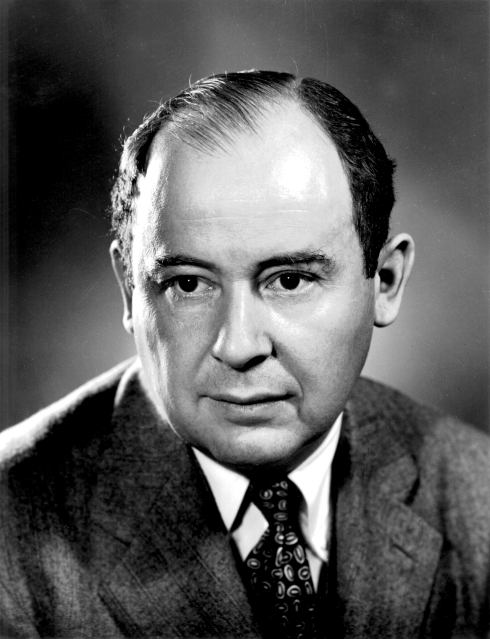
Who he was
John von Neumann (Neumann János Lajos)
- Nascimento
- 28 December 1903, Budapest
- Morte
- 8 February 1957, Washington
- Origem
- Hungary and the United States
- Áreas
- Logic, analysis, quantum mechanics, game theory, economics, computing and nuclear physics
Reading guide
Biography
Discovery and proof
- Ordinals: numbers made of empty sets
- The minimax theorem: how to play without being second-guessed
- Quantum mechanics in a Hilbert space
- The von Neumann architecture: the EDVAC report
- Merge sort: sorting by joining
- The Monte Carlo method: calculating by rolling dice
- The biased coin that becomes fair
- Self-reproducing automata