
Euler's Eyes
2026-10-23
Fundamental equations
Let $f$ and $g$ be two trigonometric functions of the variable $x$. Solving the equation $f(x) = g(x)$ is determining the set $S$ of numbers $r$ for which $f(r) = g(r)$ is a true sentence. This set is the solution set (or truth set) of the equation.
The story
Trigonometric equations appeared long before they had that name: Greek, Indian and Arab astronomers needed to find the arc that has a given sine to convert observations into positions in the sky. The most famous of these is the Kepler equation, published in Astronomia nova (1609):
$$M = E - e\operatorname{sen} E,$$which gives the position $E$ of a planet in its elliptical orbit based on the elapsed time ($M$) and the eccentricity $e$ of the orbit. It cannot be solved with the operations of algebra, and Kepler, after much trying, challenged geometers to find a method; he himself solved it tentatively. The idea of writing all of the solutions of an equation in a single formula, with an integer $k$, only became natural after Euler, in the 18th century, began to treat sine and cosine as functions of a real number, defined for any arc — positive, negative or greater than one revolution.
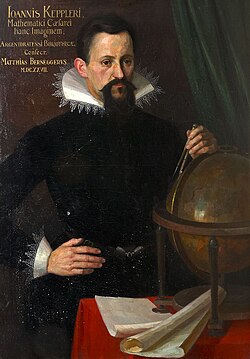
- Nasce numa família pobre. A varíola, na infância, lhe deixa a vista fraca.
- Estuda teologia na universidade, onde o professor Michael Mästlin lhe apresenta, em aulas particulares, a teoria de Copérnico.
- Professor de matemática. Publica o Mysterium cosmographicum (1596).
- Assistente e depois sucessor de Tycho Brahe. Na Astronomia nova (1609) publica as duas primeiras leis e a equação $M = E - e\operatorname{sen}E$.
- Matemático da província. Publica a terceira lei (1619) e defende a mãe, acusada de bruxaria em Leonberg.
- Morre durante uma viagem para cobrar salários atrasados.
Sources: Kepler (MacTutor) · Euler (MacTutor) · L. Euler, Introductio in analysin infiniterum (1748).
In everyday life
- Ferris wheel. On a wheel with a center at a height of 20 m, radius 18 m and one revolution every 10 minutes, the cabin that starts from the height of the center rising reaches 29 m when $20 + 18\operatorname{sen}\theta = 29$, that is, $\operatorname{sen}\theta = \frac{1}{2}$: in $\frac{1}{12}$ and $\frac{5}{12}$ of the revolution, at 50 s and at 4 min 10 s.
- Outlet. The grid voltage, with 60 cycles per second, passes through zero 120 times per second — the solutions to $\operatorname{sen}(2\pi \cdot 60\,t) = 0$.
- Tides. Knowing what time the tide reaches a certain height is solving a trigonometric equation; The Navy’s tide tables provide these calculated solutions.
Theory
Fundamental equations
Almost all trigonometric equations, after being transformed with the relations and formulas from the previous chapters, reduce to one of the three fundamental equations:
$$\operatorname{sen}\alpha = \operatorname{sen}\beta \qquad \cos\alpha = \cos\beta \qquad \operatorname{tg}\alpha = \operatorname{tg}\beta.$$Here $\alpha$ and $\beta$ are expressions in $x$ (e.g. $\alpha = 2x$ and $\beta = \frac{\pi}{3}$). Equations with cotangent, secant and cosecant reduce to these by inversion: $\operatorname{cossec} x = \operatorname{cossec} a \iff \operatorname{sen} x = \operatorname{sen} a$, and so on.
Solving sin α = sin β
If $\operatorname{sen}\alpha = \operatorname{sen}\beta = \overline{OP_1}$, the images of $\alpha$ and $\beta$ in the cycle are on the line perpendicular to the sine axis that passes through $P_1$: either both in $P$, or both in $P'$, or one in each of these points.
TeoremaEquation sin α = sin β
$$\operatorname{sen}\alpha = \operatorname{sen}\beta \iff \alpha = \beta + 2k\pi \;\;\text{ou}\;\; \alpha = \pi - \beta + 2k\pi \qquad (k \in \mathbb{Z})$$That is: $\alpha$ and $\beta$ are congruous or supplementary (less than full turns).
View the demo
(⇐) If $\alpha = \beta + 2k\pi$, then $\operatorname{sen}\alpha = \operatorname{sen}\beta$ by periodicity. If $\alpha = \pi - \beta + 2k\pi$, then $\operatorname{sen}\alpha = \operatorname{sen}(\pi - \beta) = \operatorname{sen}\beta$ (2nd quadrant reduction).
(⇒) Using the product transformation formula,
$$\operatorname{sen}\alpha - \operatorname{sen}\beta = 2\operatorname{sen}\frac{\alpha - \beta}{2}\cos\frac{\alpha + \beta}{2} = 0.$$Therefore $\operatorname{sen}\frac{\alpha - \beta}{2} = 0$, that is, $\frac{\alpha - \beta}{2} = k\pi$ and $\alpha = \beta + 2k\pi$; or $\cos\frac{\alpha + \beta}{2} = 0$, that is, $\frac{\alpha + \beta}{2} = \frac{\pi}{2} + k\pi$ and $\alpha = \pi - \beta + 2k\pi$.
Exemplosin x = √2/2
As $\frac{\sqrt{2}}{2} = \operatorname{sen}\frac{\pi}{4}$:
$$x = \frac{\pi}{4} + 2k\pi \;\;\text{ou}\;\; x = \pi - \frac{\pi}{4} + 2k\pi = \frac{3\pi}{4} + 2k\pi.$$$S = \left\{x \in \mathbb{R} \;\middle|\; x = \frac{\pi}{4} + 2k\pi \text{ ou } x = \frac{3\pi}{4} + 2k\pi\right\}$.
Resolution of cos α = cos β
If $\cos\alpha = \cos\beta = \overline{OP_2}$, the images of $\alpha$ and $\beta$ are on the line perpendicular to the cosine axis through $P_2$: in $P$ or $P'$, symmetrical with respect to the $u$ axis.
TeoremaEquation cos α = cos β
$$\cos\alpha = \cos\beta \iff \alpha = \pm\beta + 2k\pi \qquad (k \in \mathbb{Z})$$That is: $\alpha$ and $\beta$ are congruous or complementary ($\alpha + \beta = 2k\pi$).
View the demo
(⇐) $\cos(\pm\beta + 2k\pi) = \cos(\pm\beta) = \cos\beta$, because the cosine is even and periodic.
(⇒) $\cos\alpha - \cos\beta = -2\operatorname{sen}\frac{\alpha + \beta}{2}\operatorname{sen}\frac{\alpha - \beta}{2} = 0$. Then $\frac{\alpha + \beta}{2} = k\pi$, that is, $\alpha = -\beta + 2k\pi$; or $\frac{\alpha - \beta}{2} = k\pi$, that is, $\alpha = \beta + 2k\pi$.
Exemplocos 2x = cos x
$2x = \pm x + 2k\pi$. With the sign $+$: $x = 2k\pi$. With the sign $-$: $3x = 2k\pi$, $x = \frac{2k\pi}{3}$. As the first family is contained in the second ($k$ multiple of 3), $S = \left\{x \in \mathbb{R} \;\middle|\; x = \frac{2k\pi}{3}\right\}$.
Resolution of tan α = tan β
If $\operatorname{tg}\alpha = \operatorname{tg}\beta = \overline{AT}$, the images of $\alpha$ and $\beta$ are on the straight line $OT$: at $P$ or at the diametrically opposite point $P'$.
TeoremaEquation tg α = tg β
$$\operatorname{tg}\alpha = \operatorname{tg}\beta \iff \alpha = \beta + k\pi \qquad (k \in \mathbb{Z};\ \alpha, \beta \ne \tfrac{\pi}{2} + k\pi)$$That is: $\alpha$ and $\beta$ are congruous or supplementary (they differ by half a turn).
View the demo
(⇐) The tangent has period $\pi$.
(⇒) $\operatorname{tg}\alpha - \operatorname{tg}\beta = \dfrac{\operatorname{sen}(\alpha - \beta)}{\cos\alpha\cos\beta} = 0 \Rightarrow \operatorname{sen}(\alpha - \beta) = 0 \Rightarrow \alpha - \beta = k\pi$.
AtençãoBeware of existence
When solving equations with tangent, cotangent, secant or cosecant, check that the solutions found do not cancel out any denominator of the original equation. For example, by multiplying both members by $\cos x$ we can introduce solutions $x = \frac{\pi}{2} + k\pi$ that do not fit.
The exercises in this section are numbers 193 to 214 from chapter list.