
Euler's Eyes
2026-10-30
The nebular hypothesis
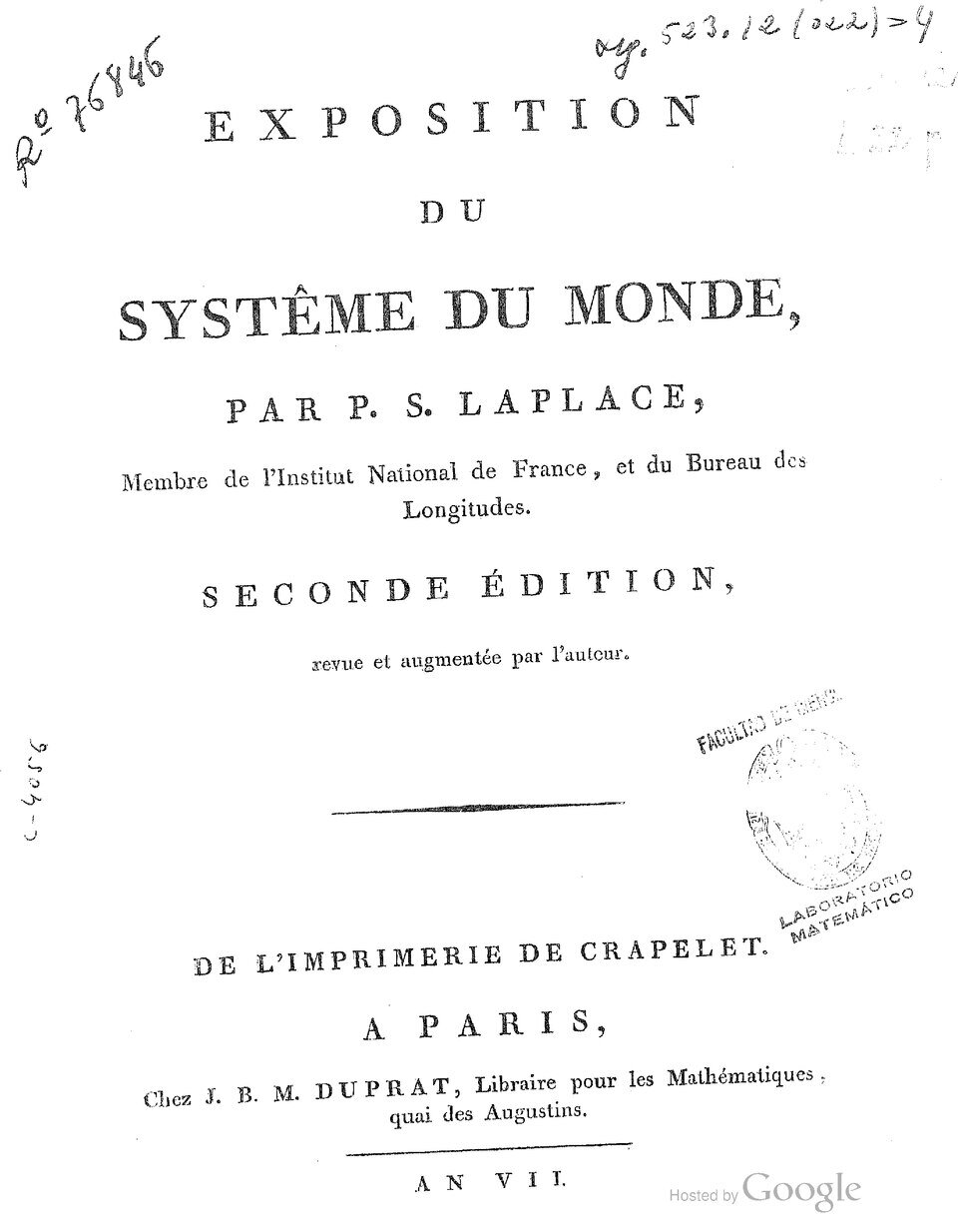
The Exposition of the System of the World, of 1796, was a book for readers without mathematical training. In it Laplace told, in prose, everything celestial mechanics had discovered. At the end, in a note that he himself presented “with the distrust that everything not a result of observation or calculation should inspire”, he ventured an explanation for the origin of the Solar System.
Too great a coincidence
Laplace started from facts everyone knew. The planets then known go around the Sun in the same direction, in orbits almost in the same plane and almost circular. They also spin on themselves in the same direction, and the same holds for the satellites around the planets. Adding up planets, satellites and rotations, Laplace counted 43 motions, all in the same direction.
If each motion could, by chance, go one way or the other with probability $\frac{1}{2}$, what would be the probability that they all agree? The first motion chooses the direction; the other 42 must follow it:
$$\left(\frac{1}{2}\right)^{42} = \frac{1}{4\,398\,046\,511\,104} \approx \frac{1}{4.4 \times 10^{12}}.$$Laplace wrote that one could bet “more than four thousand billion to one” that this arrangement had a common cause. It is probabilistic reasoning applied to the sky, typical of him: instead of saying the coincidence is strange, he measured it.
The spinning cloud
The proposed cause was this. In the beginning, the Sun would have been wrapped in an enormous hot atmosphere, a nebula, which turned slowly and extended beyond the present orbits. As it cooled, the cloud contracted. And as it contracted it spun ever faster, until, at the edge, centrifugal force equalled gravity and rings of matter broke away. Each ring would have gathered into a planet, turning in the same direction as the original cloud. The satellites would be born in the same way, from the atmospheres of the planets.
Why does a shrinking cloud spin faster? It is the conservation of angular momentum, the same that makes a skater speed up when she pulls in her arms. For a mass $m$ turning at a distance $r$ from the axis with angular velocity $\omega$, the angular momentum is
$$L = m\,r^2\,\omega.$$Without external torques, $L$ does not change. If the cloud shrinks to half its radius, $r^2$ becomes four times smaller and, to compensate, $\omega$ becomes four times larger:
$$m\,r^2\,\omega = m\left(\frac{r}{2}\right)^2\omega' \quad\Rightarrow\quad \omega' = 4\omega.$$Exercise: the shrinking star
The Sun has a radius of about $700\,000$ km and turns once every 25 days. If it shrank, without losing mass or angular momentum, to a radius of 10 km, like a neutron star, what would its new rotation period be? (Assume the shape of the mass distribution does not change, so that $L \propto r^2\omega$.)
The radius decreases by a factor $\frac{700\,000}{10} = 70\,000$, so $\omega$ increases by $70\,000^2 = 4.9 \times 10^9$. The period decreases in the same proportion: $25 \text{ days} = 2\,160\,000$ s, and $\frac{2\,160\,000}{4.9 \times 10^9} \approx 4.4 \times 10^{-4}$ s. Less than half a thousandth of a second: the order of magnitude of the fastest pulsars known.
Exercise: fewer motions
In 1796 fewer satellites were known than today. If Laplace had counted only the 6 planets known before 1781 (Mercury to Saturn), with their orbital motions, what would be the chance of all of them turning the same way by accident?
The first chooses the direction and the other 5 must follow: $\left(\frac{1}{2}\right)^5 = \frac{1}{32}$, about 3%. Small, but not absurd. It is by putting together dozens of independent motions that the coincidence becomes unbelievable: each extra motion halves the chance.
Sources: Pierre-Simon Laplace, Exposition du système du monde (1796; note VII of the 1835 edition) · Stephen G. Brush, Nebulous Earth: The Origin of the Solar System and the Core of the Earth from Laplace to Jeffreys (1996) · Immanuel Kant, Allgemeine Naturgeschichte und Theorie des Himmels (1755) · ALMA Partnership, “The 2014 ALMA Long Baseline Campaign: First Results from High Angular Resolution Observations toward the HL Tau Region”, The Astrophysical Journal Letters 808 (2015).
All topics on Pierre-Simon Laplace · ← Jupiter, Saturn and the stability of the Solar System · The dark stars →