Euler's Eyes
2026-10-26
Other scripts, other mathematics: rods, dots and knots
The way we write numbers today seems natural because it is the only one we learned. But other cultures solved the same problem, writing quantities and calculating with them, in different ways, and each solution left its mark on what those cultures were able to think.
Chinese counting rods
For almost two thousand years, Chinese mathematicians calculated with rods: little sticks of bamboo, bone or metal laid out on a board divided into columns. Each column was a decimal place, and a digit from 1 to 5 was made with the same number of rods; from 6 to 9, with one rod worth five plus a few more. So that neighbouring columns would not be confused, the rods alternated position: upright in the units, lying down in the tens, upright again in the hundreds.
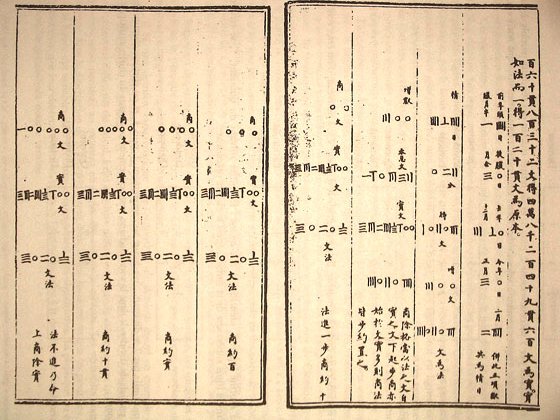
Rod notation is a tool notation: it copies the board. An empty place was simply a column with no rods; when numbers moved onto paper it became a space and, in the thirteenth century, a small circle, as on the page above.
And the rods had colour. The Nine Chapters on the Mathematical Art, compiled around the beginning of our era, teach how to solve systems of equations with “positive” and “negative” numbers, and the commentator Liu Hui explains, in 263, that red rods were used for one kind and black rods for the other, with rules for adding and subtracting them. In Europe, negative numbers would still be called “absurd” more than a thousand years later. A tool with two colours made thinkable what European writing, with a single ink, was slow to accept.
Maya dots and bars
The Maya of Central America counted in twenties. A dot was worth one, a bar was worth five, and the digits from 1 to 19 were made with up to three bars and four dots. The places were stacked from bottom to top, and an empty place had a sign of its own, a kind of shell: a positional zero, in use in inscriptions of the fourth century, independent of the Indian zero.
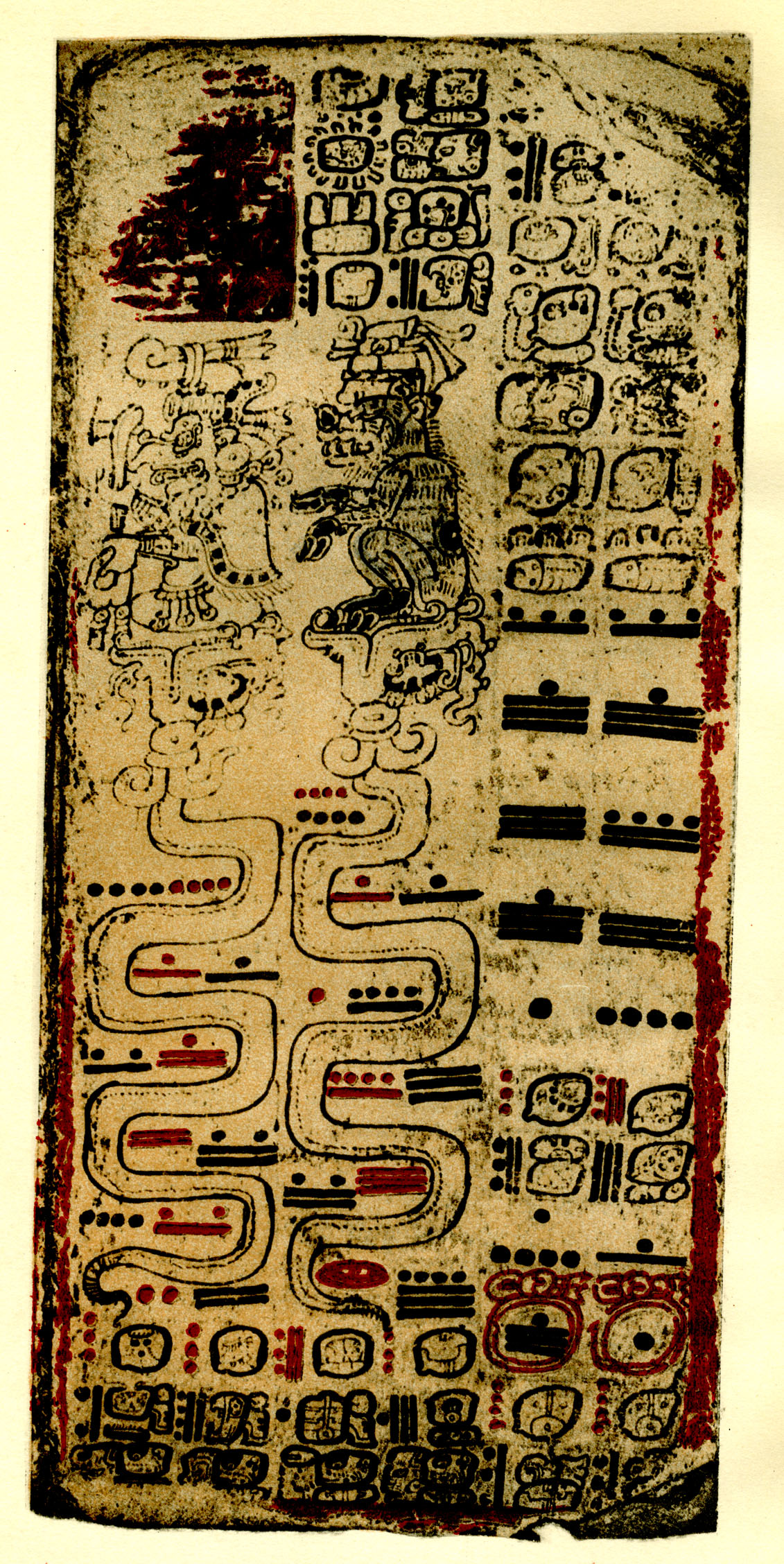
In calendar calculations, the third place was worth not $20 \cdot 20 = 400$ but $18 \cdot 20 = 360$, close to the days of a year. The notation served astronomy and ritual: the priests who mastered it calculated eclipses and cycles of Venus centuries in advance.
The knots of the Inca
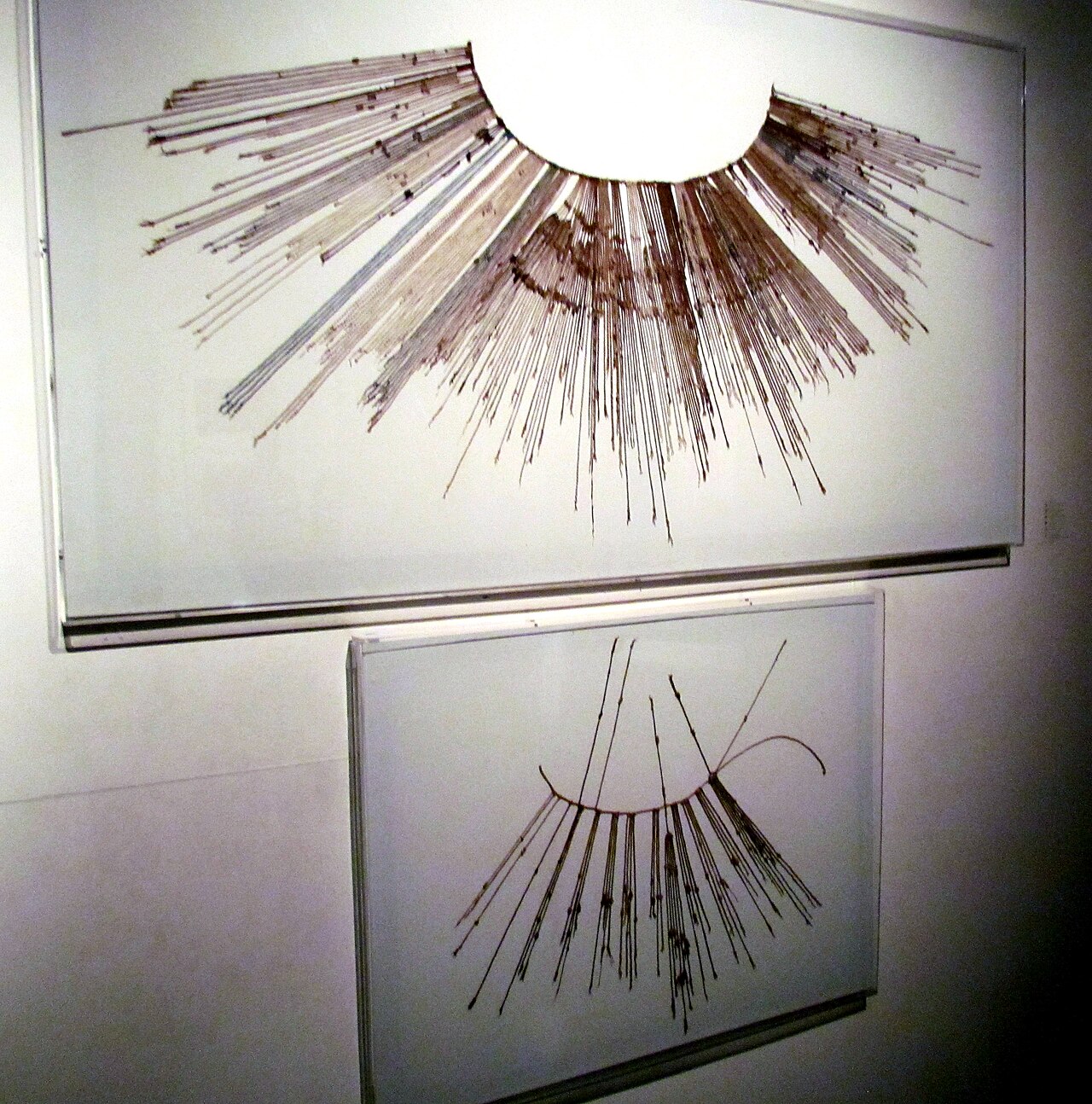
The Inca had no alphabetic writing, but they had quipus: cords hanging from a main cord, with knots at different heights. In 1923 the American Leland Locke showed that many quipus record numbers in base 10 with place value: the height of the knot on the cord gave the place (units at the bottom, tens above, and so on), and the type of knot gave the digit. The specialists who made and read them, the quipucamayocs, kept in them the censuses, tributes and stores of a whole empire.
The base 60 that remained
Finally, the oldest of the place-value scripts, that of the Babylonians, survived inside ours. They counted in base 60, and that is why an hour has 60 minutes, a minute has 60 seconds and a degree has 60 minutes of arc. When we say $1\text{ h } 23\text{ min } 45\text{ s}$, we are writing a number in base 60 with three places.
Exercise: 1504 in rods
Describe how $1504$ is written with rods, place by place.
Thousands: $1$, one lying rod. Hundreds: $5$, five upright rods. Tens: $0$, an empty place (or the circle, in books from the thirteenth century onwards). Units: $4$, four upright rods. The alternation (lying, upright, empty, upright) is what prevents, for example, $12$ and $3$ from being confused: in $12$, the $1$ in the tens is lying and the $2$ is upright.
Exercise: 365 in Maya
Write $365$ in the Maya base 20, without the calendar rule, and describe the signs.
$365 = 18 \cdot 20 + 5$. The lower place is worth $5$: one bar. The upper place is worth $18$: three bars and three dots. With the calendar rule, in which the third place is worth $360$, the same number would be written as $1 \cdot 360 + 0 \cdot 20 + 5$: a dot on top, a shell in the middle and a bar at the bottom.
Chapter index · ← Chapter 7: references and credits · The metre won, decimal time did not →